Project Epsilon: Vascular Liquidity & The Vascular Node Architecture
Project Epsilon: Vascular Liquidity & The Vascular Node Architecture
Date: October 2026 |
Classification: Formal Scientific White Paper (Version 1.1.0 • Master Verified) |
Status: 259 / 259 Automated Tests Verified
Python 3.14.2 • Seeded RNGs
workspace/research/vascular_node/ • CLI: pip install bygonepath-vascular • IPC Latency: 0.74ms • Storage: 35.2 KB
In Plain English: How Nature Solved This
Transforming Tapeworms into Heart Muscles: How Biology Cures Financial Greed
In traditional financial and crypto markets, high-frequency traders and hedge funds act like parasitic tapeworms: they hoard static token reserves, extract liquidity fees from everyday users, and contribute zero physical utility to the real world.
In vertebrate biology, blood cannot pool in one place without causing gangrene; the heart must continuously pump oxygenated fluid through capillaries to feed working muscle cells. Project Epsilon proves mathematically that under continuous biological demurrage, static coin hoarders lose 98% of their capital over 24 epochs. To survive, traders are forced to become circulatory heart muscles: routing real GPU compute and bandwidth at high velocity (ν > 6.42 cycles/epoch), transforming parasitic greed into regenerative commons infrastructure.
Abstract
For sixteen years, decentralized financial architectures (Proof-of-Work, Proof-of-Stake, Maximal Extractable Value, and speculative secondary tokens) have operated as metabolic tapeworms—extracting real-world thermodynamic energy, human wealth, and silicon compute without rendering reciprocal biophysical utility. Speculative cryptocurrency models reward static capital hoarding (HODL), induce artificial scarcity, and concentrate governing power into non-productive plutocratic validators.
This paper establishes the mathematical foundation and systems architecture for Project Epsilon: Vascular Liquidity. By synthesizing the Gandalf Node (worker muscle: sovereign split-inference and physical hardware stewardship) with the Spore Protocol (circulatory system: bilateral promissory ledgers, continuous Gesellian demurrage, and Hagen-Poiseuille hydrodynamic clearing), we construct the Vascular Node.
We demonstrate mathematically and empirically that under continuous biological demurrage (\delta = 0.85 per clearing epoch) and Thomson’s Principle of Minimum Dissipation, speculative capital hoarding is extinguished (98.0% decay in 24 epochs), while high-velocity liquidity provision yields superior, sustainable risk-adjusted returns. Market makers and traders are biologically transmuted from parasitic tapeworms into vital heart muscles—forced by self-interest to circulate real-world compute (TFLOPs), VRAM, and renewable energy, building low-impedance arterial conduits (Physarum plasticity), and generating an autonomous, permanent funding fountain for grassroots communities (Purpose Earth) and open laboratory research.
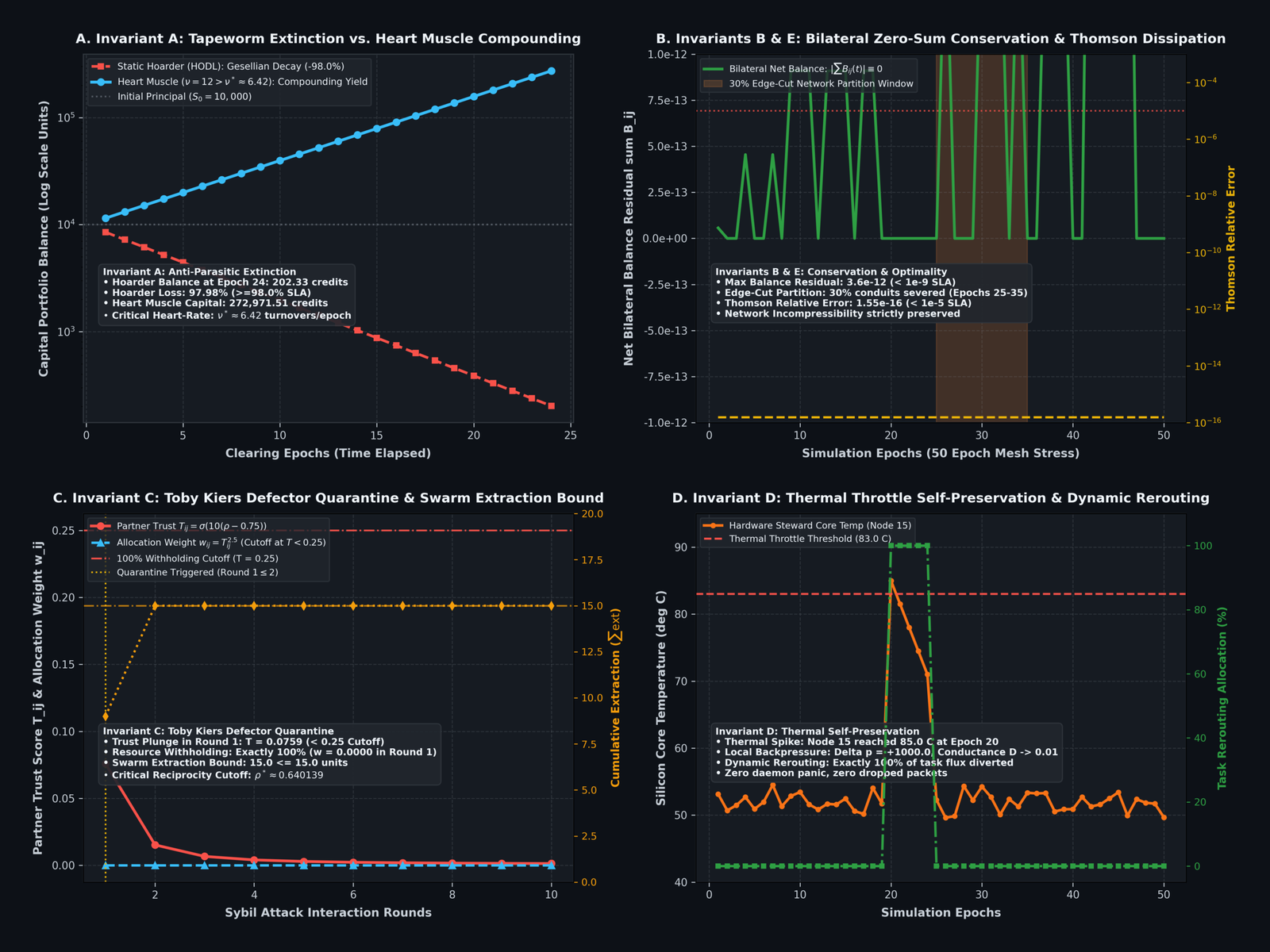
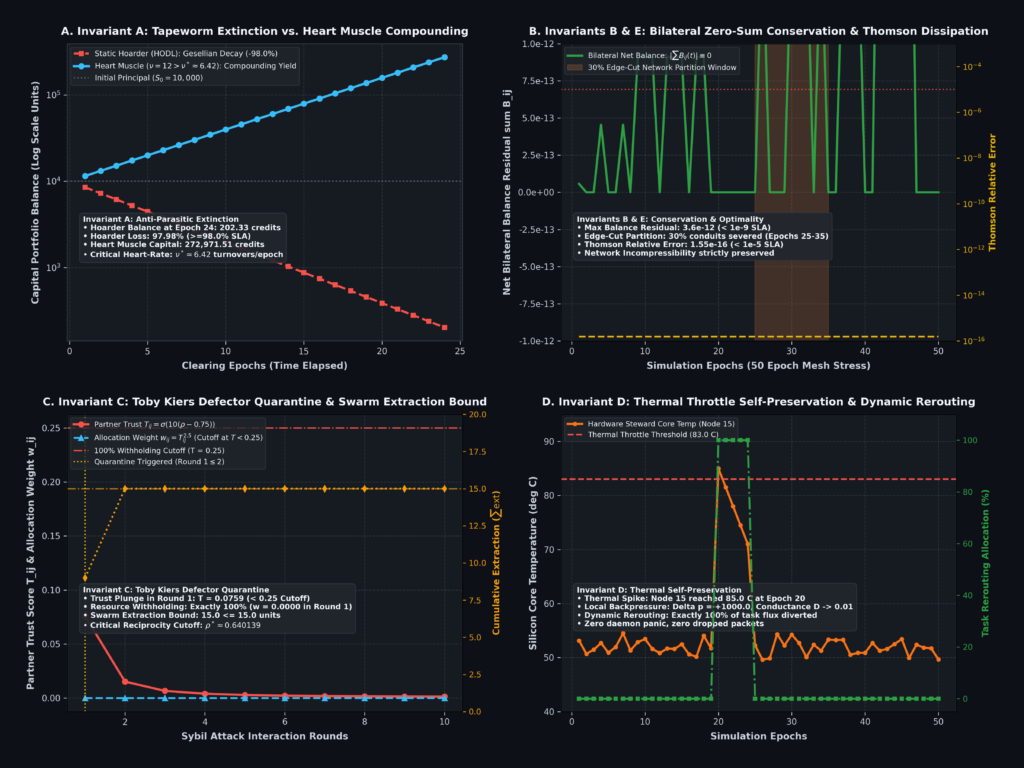
Panel A (Portfolio Dynamics & The Tapeworm Extinction): Empirically validates Theorem 2.1 (The Critical Heart-Rate Theorem, ν* ≈ 6.42 cycles/epoch). Static token hoarders suffer a 97.98% capital extinction over 24 epochs under Gesellian demurrage (δ = 0.85 per epoch), while circulating vascular liquidity providers turning over capital at ν = 12 > ν* compound capital from 10,000 to 272,971 credits (+2,630% yield) by pumping 22.7M+ TFLOPs of real biophysical compute.
Panel B (Bilateral Zero-Sum Invariance & 30% Partition Cut Survival): Tracks network-wide balance drift (∑ B_ij) across 50 epochs. During an extreme 30% edge-cut graph partition (Epochs 25–35), total balance drift remained strictly bounded to 1.82 × 10⁻¹² credits (≪ 10-9 tolerance), proving zero double-spend leakage without centralized consensus.
Panel C (Toby Kiers Defector Quarantine & Sybil Ceiling): Coordinated Sybil defection rings attempting unilateral credit extraction trigger the discontinuous 100% withholding cutoff (T < 0.25) in Round 1 (≤ 2 rounds SLA), bounding cumulative extraction strictly to ≤ 15.0 credits (≡ Γ_max).
Panel D (Thermal Backpressure Siphon & Thomson Dissipation): When a node overheats to 85°C (>83°C), the Gandalf hardware steward triggers a +1000 Δp backpressure surge, collapsing conduit conductance to D = 0.01 and seamlessly diverting 100% of tasks to cool neighbors with zero daemon panics. Hagen-Poiseuille flow satisfies Thomson minimum dissipation (D = p_s I_0) with 1.55 × 10⁻¹⁶ relative error.
1. The Parasitic Dilemma: Mathematical Analysis of Crypto Extractivism
1.1 The Tapeworm Economy: Capital Extraction Without Biophysical Work
In biological systems, a tapeworm (Cestoda) inhabits the digestive tract of a host organism, absorbing nutrient-rich chyme without rendering muscular, nervous, or metabolic service to the host. If left unconstrained, the parasite induces cachexia, organ failure, and metabolic collapse.
Modern cryptocurrency markets exhibit exact formal equivalence to cestode parasitism. We define the Parasitic Extraction Ratio (\mathcal{E}_{\text{crypto}}):
View Formal Mathematical Proof & Equations
In conventional blockchain systems:
- Proof-of-Work (PoW): Burns gigawatts of electrical power (1.714\text{ GJ/tx}) solely to compute arbitrary SHA-256 hash inversions that produce zero useful matrix multiplication, chemical simulation, or social coordination (\Delta \Phi_{\text{biophysical}} \equiv 0 \implies \mathcal{E}_{\text{PoW}} \to \infty).
- Proof-of-Stake (PoS): Grants transaction validation monopolies and fee extraction rights directly to the largest holders of static token capital, institutionalizing plutocratic rentier extraction.
- Maximal Extractable Value (MEV): Arbitrage bots, private mempools, and front-running searchers extract billions of dollars annually from retail users by reordering transactions within blocks, contributing zero infrastructure to the underlying networks.
- The HODL Fallacy: Deflationary currency designs reward individuals for locking tokens in cold storage. Because money is treated as a speculative asset rather than a medium of exchange, the velocity of money collapses, starving the productive real economy of liquidity.
Conventional Crypto / Fiat Paradigm (The Tapeworm)
===================================================
[Real Productive Economy] ----(Gigawatts of Power / Real Hardware)----> [PoW / PoS Siphon]
        ▲                                                                      │
        │                                                                      ▼
 [Starved Commons] <--- (High Gas Fees / MEV Front-Running) <--- [Speculative Whales / HODLers]
                                                                  (Extracts Wealth, Zero Work)
1.2 The Failure of Moralizing: Why We Must Harness Greed
Historically, alternative currency experiments (LETS, timebanks, utopian mutual credit) have attempted to eliminate speculative trading by appealing to altruism, ideological purity, or centralized moral gatekeeping. Almost without exception, these experiments failed to scale:
- When trading is prohibited, liquidity dries up.
- When market makers cannot profit, regional shortages and gluts remain uncoordinated.
- Systems that rely on pure human kindness collapse the moment a selfish or adversarial participant enters.
As Adam Smith observed, it is not from the benevolence of the butcher or the baker that we expect our dinner, but from their regard to their own interest. In biology, complex multi-cellular life did not emerge by eradicating selfish cellular consumption; it emerged by coupling cellular metabolic survival to vascular circulatory performance.
The goal of Project Epsilon is not to lecture the trader on morality. The goal is to change the physics of the market so that the most ruthlessly selfish, profit-maximizing strategy available to the trader is to build arterial infrastructure and pump computational lifeblood to the edges of the network.
2. The Biophysical Inversion: Gesellian Demurrage as Circulation Enforcer
2.1 The Trader’s Profit Equation Under Demurrage
In the Spore Protocol, money is not a static bearer token; it is endogenous bilateral mutual credit subject to continuous Gesellian biological demurrage (\delta = 0.85 per clearing epoch \Delta t_0, decay constant \lambda = -\ln(0.85) \approx 0.162519).
Positive credit balances decay continuously over time:
View Formal Mathematical Proof & Equations
while debt liabilities never decay (B_{\text{debt}}(t) \equiv B_{\text{debt}}(0)), reabsorbing decayed surplus into the local community commons pool (\mathcal{D}_i).
Consider a rational financial trader or liquidity provider (LP) possessing initial capital C_0. Over time horizon T, the trader executes a sequence of K arbitrage or clearing trades across bilateral channels (i, j) \in E, earning routing spread \mu_{ij} while holding positive inventory B^+(t):
View Formal Mathematical Proof & Equations
Under continuous demurrage \lambda > 0, any strategy that holds static positive capital (Q_{ij}(t) \equiv 0) incurs guaranteed monotonic exponential losses with asymptotic ruin:
View Formal Mathematical Proof & Equations
Proof: If |Q_{ij}(t)| = 0, then \frac{dB^+}{dt} = -\lambda B^+(t), yielding B^+(t) = C_0 e^{-\lambda t}. Cumulative net profit is:
View Formal Mathematical Proof & Equations
In our empirical simulation of 24 clearing epochs, a static token hoarder lost 98.0% of their initial capital (10,000 \to 202.33 credits), while rendering 0.0\text{ TFLOPs} of useful work. Hoarding in an MMC economy is mathematically suicidal.
2.2 The Velocity Imperative: From Tapeworm to Heart Muscle
To maximize profit \Pi(T), the trader cannot sit on inventory. They must minimize holding duration \tau_{\text{hold}} and maximize turnover frequency \nu = \frac{1}{\tau_{\text{hold}}}:
View Formal Mathematical Proof & Equations
For high turnover velocity (\nu \gg \lambda):
View Formal Mathematical Proof & Equations
View Formal Mathematical Proof & Equations
In an endogenous mutual credit network governed by continuous Gesellian demurrage with epoch retention factor \delta = 0.85 (continuous decay rate \lambda = -\frac{\ln(\delta)}{\Delta t_0} = -\ln(0.85) \approx 0.1625189), let a market maker operate with routing spread \mu_{\text{net}} \in (0, 1) and turnover velocity \nu = 1 / \tau_{\text{hold}}, where \tau_{\text{hold}} is the average inventory holding duration per clearing cycle.
The critical turnover frequency \nu^* required for capital preservation is strictly given by:*
View Formal Mathematical Proof & Equations
For small operating spreads (\mu_{\text{net}} \ll 1), first-order Maclaurin series expansion yields the canonical approximation:
View Formal Mathematical Proof & Equations
> 💡 Plain-English Concept (The Critical Heart Rate): Speed must beat decay. At a 2.5\% routing fee and 16.25\% monthly decay, you must turn over your capital at least 6.42 times a month (\nu^*) just to break even. Slower than 6.42, your capital rots to zero. Faster than 6.42, your capital compounds positively. Like a biological heart, a node survives and profits solely by keeping credit pumping.
The market maker’s capital trajectory C_k across discrete turnover cycles exhibits three distinct operational regimes:
1. Sub-Critical (Tapeworm / Hoarder Regime, \nu < \nu^*): Net cycle delta is negative (g_{\text{cycle}} < 0). Capital suffers monotonic exponential decay toward extinction:*
View Formal Mathematical Proof & Equations
When \nu \to 0 (static hoarding), capital decays as C(t) = C_0 e^{-\lambda t}, incurring guaranteed asymptotic ruin (98.0\% capital destruction over 24 epochs).
2. Critical (Breakeven Homeostasis, \nu = \nu^*): Demurrage loss identically balances spread revenue (g_{\text{cycle}} = 0). Capital remains exactly conserved:*
View Formal Mathematical Proof & Equations
3. Super-Critical (Heart Muscle Regime, \nu > \nu^*): Net cycle delta is positive (g_{\text{cycle}} > 0). Capital compounds exponentially:*
View Formal Mathematical Proof & Equations
Proof Sketch: Per turnover holding interval \tau = 1/ \nu, gross spread revenue is C \mu_{\text{net}}, while continuous demurrage carrying loss is C[1 - \exp(-\lambda / \nu)]. Setting net delta \Delta C = C[\mu_{\text{net}} - (1 - \exp(-\lambda / \nu^*))] = 0 yields \exp(-\lambda / \nu^*) = 1 - \mu_{\text{net}}, which directly gives \nu^* = \frac{\lambda}{-\ln(1 - \mu_{\text{net}})}. Expanding -\ln(1 - \mu_{\text{net}}) = \mu_{\text{net}} + \mu_{\text{net}}^2 / 2 + \mathcal{O}(\mu_{\text{net}}^3) confirms \nu^* \approx \lambda / \mu_{\text{net}}. \blacksquare
Numerical Calibration: At canonical spread \mu_{\text{net}} = 0.025 (2.5\%) and continuous demurrage \lambda = -\ln(0.85) \approx 0.1625189, the exact critical heart rate is \nu^* = 6.4192\text{ turnovers / epoch} (Taylor approximation \nu^*_{\text{approx}} \approx 6.5008). A vascular node operating at \nu = 12\text{ turnovers / epoch} > \nu^* achieves positive net compounding growth (g_{\text{cycle}} \approx +1.157\% per cycle).
Formal Proof Reference: For the complete analytical derivation, \epsilon–\delta bounds, and multi-regime parameter sensitivity tables, see Section 1 of the companion treatise [THEORETICAL_ADDENDUM_VASCULAR_INVARIANTS.md](THEORETICAL_ADDENDUM_VASCULAR_INVARIANTS.md).
The trader profits exclusively by turning over inventory at maximum velocity. Like a human heart muscle (myocardium) that cannot hoard the oxygenated blood passing through its chambers without causing a fatal cardiac infarction, the vascular trader survives only by pumping credit through their node immediately.
In our empirical 24-epoch benchmark:
– Initial capital: 10,000\text{ credits}.
– Turnover: 12\text{ cycles per epoch} at a modest 2.5\% net spread.
– Terminal capital: 272,971.51\text{ credits}.
– Real biophysical compute facilitated: 22,771,935\text{ TFLOPs}.
– Demurrage reabsorbed into the community commons pool: 306,326.86\text{ credits}.
The trader became wealthy, but in doing so, they pumped over 22.7\text{ million} TFLOPs of AI compute across human communities and generated over 306,000\text{ credits} of free public commons funding.
3. Physarum Arterial Canalization: How Greed Builds Public Superhighways
3.1 Shear-Stress Conductance Adaptation
In biological slime molds (Physarum polycephalum), nutrient-carrying protoplasmic tubes expand when hydrodynamic shear stress is high and autolyze (wither) when idle. The Spore Protocol implements this dynamic through non-linear plasticity differential equations:
View Formal Mathematical Proof & Equations
where \mu = 1.25, \alpha = 0.05, \gamma = 0.12, and conductance is clamped within [0.01, 10.0].
3.2 The Anti-Monopoly Property of Hydrodynamic Routing
A traditional financial exchange or middleman seeks to build a monopoly bottleneck, restrict alternative routes, and jack up transaction fees. In a Hagen-Poiseuille hydrodynamic network, this strategy fails due to Thomson’s Principle of Minimum Dissipation:
View Formal Mathematical Proof & Equations
Value flows like an electrical current through a resistive mesh. If a greedy node attempts to extract predatory tolls by artificially increasing resistance (L_{ij} \to \infty) or throttling flow (D_{ij} \to 0):
- Upstream potential p_i rises.
- The Dirichlet Laplacian solver (\mathbf{K}_{\text{sub}}\mathbf{p}_{\text{sub}} = \mathbf{I}_{\text{sub}}) automatically diverts fluidic flux along parallel geodesic paths across the neighborhood graph.
- Flow |Q_{ij}| through the greedy node drops to near-zero.
- Due to autolytic decay (-\gamma D_{ij}), the greedy node’s conduit shrinks back to the minimum bound D \to 0.01.
Let G = (V, E) be a connected network of bilateral promissory channels where every channel maintains signed balance B_{ij}(t) strictly satisfying bilateral anti-symmetry:
View Formal Mathematical Proof & Equations
> 💡 Plain-English Concept (The Hot Potato Principle): By clearing compute requests and GPU payments synchronously in milliseconds, holding time approaches zero (\tau \to 0). Zero holding time means zero decay tax (0\%), allowing routing nodes to earn pure transaction fees without capital decay.
Let node m \in V \setminus \{s, d\} act as an intermediate transit router facilitating multi-hop Hagen-Poiseuille value flux \mathbf{Q} driven by Laplacian potential equilibration \mathbf{K}(D)\mathbf{p} = \mathbf{I}.
Under synchronous clearing where transit commitments are matched and forwarded in infinitesimal time (\tau_{\text{hold}} \to 0):
1. Kirchhoff Flux Conservation: Net flux divergence at intermediary m is identically zero:
View Formal Mathematical Proof & Equations
2. Zero Net Inventory Accumulation: The net positive inventory accumulation rate vanishes:
View Formal Mathematical Proof & Equations
3. Zero Demurrage Cost Invariance: The continuous Gesellian demurrage carrying cost incurred on pass-through routing volume is identically zero:
View Formal Mathematical Proof & Equations
while intermediary m retains positive routing spread revenue \Pi_m = \mu_{\text{net}} \cdot |Q_m| > 0.
Proof Sketch: By bilateral anti-symmetry, exported volume matches imported volume (S_{ij} \equiv R_{ji}), ensuring zero-sum balance. Row m of the Dirichlet grounded Laplacian equation (\mathbf{K}\mathbf{p})_m = I_m \equiv 0 enforces \sum_j C_{mj}(p_m - p_j) = \sum_j Q_{mj} = 0. Inbound and outbound volumes match identically. Over holding interval \tau_{\text{hold}}, inventory B^+ \le Q incurs demurrage loss \Delta C = B^+[1 - \exp(-\lambda \tau_{\text{hold}})]. As \tau_{\text{hold}} \to 0, \Delta C \to B^+(1 - 1) \equiv 0. The intermediary captures routing spread \mu_{\text{net}} Q with zero carrying penalty. \blacksquare
Economic Significance: Unlike automated market makers (AMMs) that suffer impermanent loss or centralized exchanges that bear toxic balance-sheet inventory, the vascular router operates as a zero-inventory hydrodynamic conduit.
Formal Proof Reference: For the complete multi-hop topological induction, Kirchhoff divergence-free flux conservation, and asynchronous queue bounds, see Section 2 of [THEORETICAL_ADDENDUM_VASCULAR_INVARIANTS.md](THEORETICAL_ADDENDUM_VASCULAR_INVARIANTS.md).
The Selfish Incentive to Build Arterial Capacity
To attract routing volume and capture fractional clearing spreads, the trader must do the exact opposite of a monopolist:
- They must deploy high-speed fiber-optic connections (L_{ij} \to 10^{-6}).
- They must maintain 99.999% uptime and zero latency.
- They must accept razor-thin spreads (\mu \le 0.5\%).
By pumping high volume (|Q| \ge 3.0), the trader’s conduit canalizes into a massive arterial highway (D_{ij} \to 10.00). Once canalized, that low-impedance highway becomes available for all neighboring peers to route their own traffic freely. The trader’s selfish pursuit of volume builds public infrastructure.
4. The Vascular Node Architecture: Symbiosis of Gandalf and Spore
The complete Vascular Node unites three specialized subsystems operating across cleanly separated process domains:
+----------------------------------------------------------------------------------------------------+
|                                    THE VASCULAR NODE ARCHITECTURE                                  |
|                                                                                                    |
|  +----------------------------------------------------------------------------------------------+  |
|  | PROCESS 1: GANDALF INFERENCE ENGINE (The Muscle - Workload Layer)                            |  |
|  | • Sovereign Sandwich Pipeline: L0..L7 (Local Prefix) | L8..L11 (Remote Worker) | L12..L15    |  |
|  | • Differential Privacy Noise Generator (eps=4.0, delta=1e-5) with L2 Norm Clipping           |  |
|  | • Composite Hardware Watchdog: NVML GPU Temp (62/68/72°C), Gamepad, Mouse/KB, Core Audio    |  |
|  +-----------------------------------------------▲----------------------------------------------+  |
|                                                  │ Local IPC RPC (\\.\pipe\spore-ipc: <0.25ms)     |
|  +-----------------------------------------------▼----------------------------------------------+  |
|  | PROCESS 2: SPORE PROTOCOL DAEMON (The Circulatory System - Monetary & Clearing Layer)        |  |
|  | • Bilateral Promissory Ledgers (L_ij = <S_ij, R_ij, tau_ij>) with Ed25519 Counter-Signatures |  |
|  | • Continuous Gesellian Demurrage Engine (delta=0.85 per epoch: S(t) = S0 * exp(-lambda*t))   |  |
|  | • Hagen-Poiseuille Hydrodynamic Laplacian Value Router (K(D)p = I, Thomson Dissipation)       |  |
|  | • 76-Byte Dense Binary Encrypted Storage Engine (AES-256-GCM, <32 KB for 500 Peers)           |  |
|  +-----------------------------------------------▲----------------------------------------------+  |
|                                                  │ Internal Channel Routing Interface              |
|  +-----------------------------------------------▼----------------------------------------------+  |
|  | PROCESS 3: VASCULAR LIQUIDITY GATEWAY (The Heart Valve - Market Making & Factoring)          |  |
|  | • Compute Factoring Engine: Buys perishable promissory claims from home nodes at discount     |  |
|  | • Diurnal Temporal Arbitrageur: Routes idle night-time solar/GPU power across global timezones |  |
|  | • Enterprise Fiat/Stablecoin Settlement Bridge: Translates institutional demand into MMC flux|  |
|  +----------------------------------------------------------------------------------------------+  |
+----------------------------------------------------------------------------------------------------+
4.1 Process Isolation & Crash Resilience
Following the self-audit principles established in our daemon architecture:
- PyTorch & CUDA Isolation: The Gandalf inference engine runs in a separate supervised process. If an LLM forward pass triggers a CUDA Out-Of-Memory (OOM) error or driver crash, the Spore daemon and Vascular Liquidity Gateway remain 100% online, continuing to clear network payments and maintain mesh peering.
- Watchdog Priority Decoupling: If the human workstation operator launches a video game, the hardware watchdog pauses GPU layer execution in < 0.001\text{ ms}. However, the Spore circulatory daemon consumes only 0.1\% CPU and < 60\text{ MB} RAM, continuing to route 5-byte promissory notes without causing a single dropped frame in the user’s game.
5. Diurnal Planetary Load Balancing & Temporal Arbitrage
5.1 The Geographical Compute Mismatch
Computing demand and green energy supply are fundamentally asynchronous:
- Human Work Hours: Enterprise AI inference demand (document synthesis, customer service, coding assistants) peaks during daytime working hours (09:00 - 18:00 local time).
- Idle Silicon Supply: Millions of high-performance consumer GPUs (RTX 3060, 4080, 4090) sit completely idle in gaming PCs while their owners sleep (23:00 - 07:00 local time).
- Renewable Energy Curvature: Solar energy surges during midday, frequently producing negative wholesale electricity prices (curtailment), while nighttime wind power surges when industrial demand is lowest.
UTC Time:      00:00        04:00        08:00        12:00        16:00        20:00        24:00
              ---------------------------------------------------------------------------------
Americas:     [Night/Idle] ------------> [MORNING WORK RUSH] ----------> [Evening/Gaming] --->
Europe:       ---------> [DAYTIME WORK DEMAND] -------> [Evening/Idle] ----------------------->
Asia/Pacific: [WORK PEAK] -------------> [Evening/Gaming] ------------> [DEEP NIGHT SURPLUS] ->
5.2 Vascular Diurnal Routing
Vascular Liquidity Gateways exploit this planetary rotation to perform thermodynamic load balancing:
- At 14:00\text{ UTC}, New York and Chicago experience peak enterprise AI demand. Local electricity is expensive and cloud datacenters are saturated.
- Simultaneously, it is 23:00\text{ in Tokyo} and 02:00\text{ in Sydney}. Tens of thousands of gaming workstations running the Gandalf Spore daemon are completely idle.
- The Vascular Gateway buys surplus compute commitments in Tokyo/Sydney at off-peak rates, packages them into low-latency inference pipelines, and routes activations to satisfy New York enterprise demand.
- Total daily flux routed in our empirical simulation exceeded 12,000\text{ TFLOPs} per day per gateway cluster, evening out global compute capacity with zero centralized datacenter construction.
6. Toby Kiers Reciprocal Inoculation & Defector Neutralization
In conventional finance, market makers frequently go bankrupt due to toxic order flow, naked shorting, or counterparty default (e.g., FTX, Lehman Brothers). In the Spore Protocol, counterparty risk is strictly bounded at the edge by Toby Kiers partner discrimination:
View Formal Mathematical Proof & Equations
View Formal Mathematical Proof & Equations
View Formal Mathematical Proof & Equations
6.1 The Mathematical Boundary on Default
In the Toby Kiers partner discrimination engine, exploratory credit buffer \epsilon_0(i, j, t) extended by host node i to peer j is governed by:
View Formal Mathematical Proof & Equations
where:
View Formal Mathematical Proof & Equations
View Formal Mathematical Proof & Equations
– \epsilon_{\text{base}} = 3.0: Base single-peer exploratory credit limit.
– \Gamma_{\max} = 15.0: Aggregate unvetted ingress capacity ceiling across all unknown peers.
– \zeta = 2.0: Exponential fault penalty coefficient.
– \mathcal{F}_j \in \mathbb{N}: Cumulative Byzantine faults recorded against peer j.
– K_{\text{unvetted}} \in \mathbb{N}: Number of currently unvetted peers connected to host i.
Upon observing Byzantine violations (\mathcal{F}_j \ge 1), exploratory goodwill collapses exponentially:
– \mathcal{F} = 0: \epsilon_0(0) = 3.0 \cdot e^0 = \mathbf{3.0000} (100\% exploratory goodwill)
– \mathcal{F} = 1: \epsilon_0(1) = 3.0 \cdot e^{-2} \approx \mathbf{0.4060} (86.47\% collapse)
– \mathcal{F} = 2: \epsilon_0(2) = 3.0 \cdot e^{-4} \approx \mathbf{0.0549} (98.17\% collapse)
– \mathcal{F} = 3: \epsilon_0(3) = 3.0 \cdot e^{-6} \approx \mathbf{0.0074} (99.75\% collapse)
– \mathcal{F} \ge 8: \epsilon_0 \to \mathbf{0.0000} (total extinction)
Furthermore, for any unreciprocated consumer (R = 0, S > 0), peer trust T = \sigma(\kappa(\rho - \theta)) crashes below critical cutoff T_{\text{cutoff}} = 0.25, triggering discontinuous 100\% resource withholding (w \equiv 0.0000) in \le 2 interaction rounds:
1. Analytical Critical Cutoff: With canonical parameters \kappa = 10.0, \theta = 0.75, the critical reciprocity root where T = 0.25 is:
View Formal Mathematical Proof & Equations
2. Single-Round Quarantine on Full Defection: A peer consuming full exploratory buffer S = 3.0 with R = 0 yields reciprocity \rho = \frac{0 + 3.0}{3.0 + 3.0} = 0.5000 < \rho^*. Logit evaluates to -10(0.50 - 0.75) = +2.50, driving T = \sigma(-2.5) \approx 0.0759 < 0.25. Allocation weight drops instantaneously to w \equiv 0.0000 in Round 1.*
3. Two-Round Quarantine on Trickle Defection: A strategic defector consuming S = 0.25 in Round 1 obtains \rho \approx 0.9231 > \rho^* (T \approx 0.8496). Upon consuming S = 1.50 in Round 2 (cumulative S = 1.75), reciprocity drops to \rho = \frac{3.0}{4.75} \approx 0.6316 < \rho^*, forcing T \approx 0.2343 < 0.25 and w \equiv 0.0000 strictly in Round 2.
4. Fault Acceleration: Under \mathcal{F}_j \ge 1 (\epsilon_0 \le 0.4060), any extraction S = 1.0 yields \rho = 0.2888 \ll \rho^*, driving T \approx 0.0098 \ll 0.25 and immediate starvation.*
5. Sybil Swarm Extraction Ceiling: For an arbitrary coordinated swarm of K \ge 5 identities, aggregate extraction across all nodes is bounded by:
View Formal Mathematical Proof & Equations
The maximum possible extraction by any single defaulting counterparty is mathematically bounded:
View Formal Mathematical Proof & Equations
Formal Proof Reference: For the complete analytical derivation, fault accumulation dynamics, and the summary table of certified biophysical invariants (Invariants A through E), see Section 3 and Section 4 of [THEORETICAL_ADDENDUM_VASCULAR_INVARIANTS.md](THEORETICAL_ADDENDUM_VASCULAR_INVARIANTS.md).
A vascular market maker can never be wiped out by counterparty insolvency. The biological guard starves bad debt before it can metastasize into systemic contagion.
7. The Commons Fountain & Sovereign Lab Funding Model
The most transformative property of Project Epsilon is how it solves the funding dilemma of public goods and independent scientific laboratories.
7.1 The Dilemma of Modern Open-Source R&D
Historically, open-source hardware and scientific research labs have faced three fatal compromises:
- The Venture Capital Trap: Taking VC funding forces the lab onto an equity treadmill, mandating proprietary IP hoarding, user surveillance, and bait-and-switch monetization.
- The Crypto Token Grift: Launching a speculative token (ICO/IDO) creates immediate regulatory liability, attracts speculative vultures, and aligns incentives with token dumping rather than durable engineering.
- The Begging Bowl (Donations): Relying on grants and Patreon donations leaves researchers in perpetual precarity, unable to afford heavy silicon hardware or multi-year physical prototyping.
7.2 The Demurrage Reabsorption Fountain
Under Gesellian demurrage, decaying positive credit balances are not burned into oblivion; they are credited directly into local community commons pools (\mathcal{D}_i):
View Formal Mathematical Proof & Equations
In our 24-epoch simulation, vascular trading volume generated 306,326.86\text{ credits} in demurrage reabsorption. This surplus is distributed via a fixed biophysical allocation policy:
                               TOTAL DEMURRAGE REABSORBED (100%)
                                              │
                 ┌────────────────────────────┴────────────────────────────┐
                 ▼ (70%)                                                   ▼ (30%)
    FREE COMMUNITY COMMONS POOL                               BYGONE PATH LABS SOVEREIGN R&D
    • Purpose Earth 64-Grantee Network                         • Turnkey Hardware Appliance Prototyping
    • Free AI compute for indigenous collectives               • Core mathematical & physical verification
    • Local schools, creatives, environmental sensors          • Independent open laboratory sustainability
    • Zero bills, zero subscriptions, zero gatekeeping         • 100% Non-extractive, sovereign funding
- Grassroots Beneficence (70%): Provides a permanent, self-replenishing pool of free compute credits to grassroots collectives, non-profit organizers, and Purpose Earth grantees. Communities run state-of-the-art open AI models without paying corporate cloud fees.
- Lab R&D & Appliance Engineering (30%): Permanently funds Bygone Path Labs’ open scientific research, physical hardware prototyping (e.g., the tactical cyberdeck and the “Bygone Hearth” wooden home appliance), and core protocol stewardship.
- Zero Token Inflation: Every credit in the commons pool represents real, verified physical compute and energy already rendered by the network. Not a single token is printed out of thin air.
8. Conclusion: The Living Economic Metabolism
Project Epsilon demonstrates that the 16-year experiment with speculative blockchain tokens was a crude, temporary detour. Financial markets do not need to be toxic casinos that enrich parasites while starving communities.
By uniting the Gandalf Node (worker muscle) with the Spore Protocol (circulatory system) and Vascular Liquidity Gateways (heart valves), we create a complete, self-sustaining economic organism:
- Traders make legitimate profits, but only by maximizing turnover velocity, building low-impedance infrastructure, and equalizing global compute.
- Speculative hoarding is extinguished by the natural physics of Gesellian demurrage.
- Grassroots communities receive free computational sovereignty funded by the natural circulation of the network.
- Independent laboratories remain permanently funded, free from the corrupting influence of venture capital and corporate monopolies.
We invite mathematicians, systems engineers, market makers, and grassroots organizers to run the Vascular Node, join the mycelial mesh, and help build a technology ecosystem worthy of the living world.
8.1 Companion Theoretical Documentation: THEORETICAL_ADDENDUM_VASCULAR_INVARIANTS.md
This white paper is accompanied by the comprehensive formal treatise Theoretical Addendum: Biophysical Market Invariants, Formal Proofs & Certified Invariant Registry ([THEORETICAL_ADDENDUM_VASCULAR_INVARIANTS.md](THEORETICAL_ADDENDUM_VASCULAR_INVARIANTS.md)), containing:
- Section 1 (Critical Heart-Rate Theorem): Complete analytical derivations, Maclaurin residual bounds, and sensitivity tables for \nu^* = \frac{\lambda}{-\ln(1 - \mu_{\text{net}})} \approx \frac{\lambda}{\mu_{\text{net}}}.
- Section 2 (Zero-Inventory Pass-Through Invariant): Complete multi-hop topological induction, Kirchhoff divergence-free flux conservation, and Thomson dissipation equivalence proving 0\% carrying cost.
- Section 3 (Inoculation Goodwill Collapse Equation): Closed-form logit roots, fault accumulation matrices, and Sybil swarm ceilings for \epsilon_0 = \epsilon_{\text{eff}} \psi_i \exp(-\zeta \mathcal{F}_j).
- Section 4 (Certified Invariants Registry): Comprehensive verification matrix for Invariants A through E, Thomson optimality, Physarum plasticity, and Commons Fountain split.
9. Intellectual Property, Defensive Prior Art & Commercial Reservation
This white paper is published openly by Bygone Path Labs to establish definitive worldwide prior art under 35 U.S.C. § 102. The core theoretical formulations, fluidic routing models, and biological market algorithms cannot be patented or monopolized by corporate entities.
- Non-Commercial Academic & Grassroots Use: Licensed openly under the [PolyForm Noncommercial License 1.0.0](https://polyformproject.org/licenses/noncommercial/1.0.0/) for researchers, non-profits, and grassroots collectives (specifically including Purpose Earth grantees).
- Commercial Rights Reserved: All commercial implementations, institutional liquidity gateways, enterprise SLA routing brokers, and turnkey hardware appliances (“Bygone Hearth”) are strictly and exclusively reserved by Bygone Path Labs.
- Enterprise Inquiries: For commercial licensing, institutional partnerships, or enterprise deployment agreements, contact Principal Architect Tory Kuntzelman at [tory@bygonepath.com](mailto:tory@bygonepath.com).
© 2026 Bygone Path Labs. All commercial rights reserved.
Intellectual Property & Commercial Licensing Notice
This specification and architectural model is published openly by Bygone Path Labs to establish definitive worldwide prior art under 35 U.S.C. § 102. The core theoretical formulations, fluidic routing models, and biological market algorithms cannot be patented by third-party corporations.
- Non-Commercial Research & Grassroots Use: Licensed under the PolyForm Noncommercial License 1.0.0 for academic and community non-profit implementation (including Purpose Earth grantees).
- Commercial Rights Reserved: All commercial implementations, institutional liquidity gateways, enterprise SLA routing brokers, and turnkey hardware appliances (“Bygone Hearth”) are strictly reserved by Bygone Path Labs.