Project Plastic Tree: Biomimetic Research Atlas & Call for Open Participation
Project Plastic Tree: Turning Municipal Waste into Living, Air-Purifying Forests
Published: October 2026 |
Open License: PolyForm Noncommercial 1.0.0
Every single year, human civilization produces over 380 million metric tons of plastic. More than sixty percent of that mountain consists of ordinary single-use containers: milk jugs, detergent bottles, grocery bags, and food trays.
Today, less than nine percent of that plastic is ever recycled. The rest is dumped into landfills or left in waterways, where decades of sunlight slowly crumble it into trillions of microscopic plastic fibers. These microplastics now contaminate our drinking water, our agricultural soils, and our own bloodstreams.
Traditional industrial recycling fails because it is centralized and expensive. It requires fleet trucks burning diesel, chemical factories that pollute local neighborhoods, and massive amounts of grid electricity. Meanwhile, atmospheric carbon dioxide keeps rising past 420 parts per million.
Project Plastic Tree asks a simple, radical question: What if we stopped treating plastic as trash, and started treating it as the building block for living infrastructure?
Nature has operated a solar-powered, zero-waste recycling system for nearly four billion years. By copying how living organisms digest tough materials, move fluids, and protect themselves from the sun, we can turn discarded plastic into autonomous, carbon-capturing trees that clean our air and restore our communities.
The Three Connected Layers: Brain, Heart, and Body
To build a system that can thrive on its own in the real world, we designed it like a living organism with three coordinated layers:
The Gandalf Edge Node
A quiet, low-power computer (like a Raspberry Pi 5 or NVIDIA Jetson) mounted directly onto each tree. It uses an infrared camera to inspect and classify shredded plastic flakes in less than 50 milliseconds, regulates heater temperatures so the unit never overheats, and steers the tree’s 3D-printing collar completely off-grid without needing cloud servers.
The Spore Protocol
The peer-to-peer circulatory system that connects the grove. Trees trade liquid wax sap, electricity, and bark armor through underground root cables using simple digital promises. There are no corporate banks, no transaction fees, and no crypto mining. A small circulation fee on idle balances automatically funds the physical motors, sensors, and mirrors needed to build new trees.
Project Plastic Tree
The physical structure standing in the ground. It digests bulk plastic using concentrated solar heat and soil bacteria, shields its trunk with graphene bark so it never sheds microplastics, and grows artificial leaves that passively absorb greenhouse gases from the night wind.
How Nature Solved the Five Biggest Engineering Problems
When people think about recycling plastic into permanent architecture, five major roadblocks immediately appear. Here is how nature solved each one:
1. Pumping Melted Plastic Underground Without Freezing
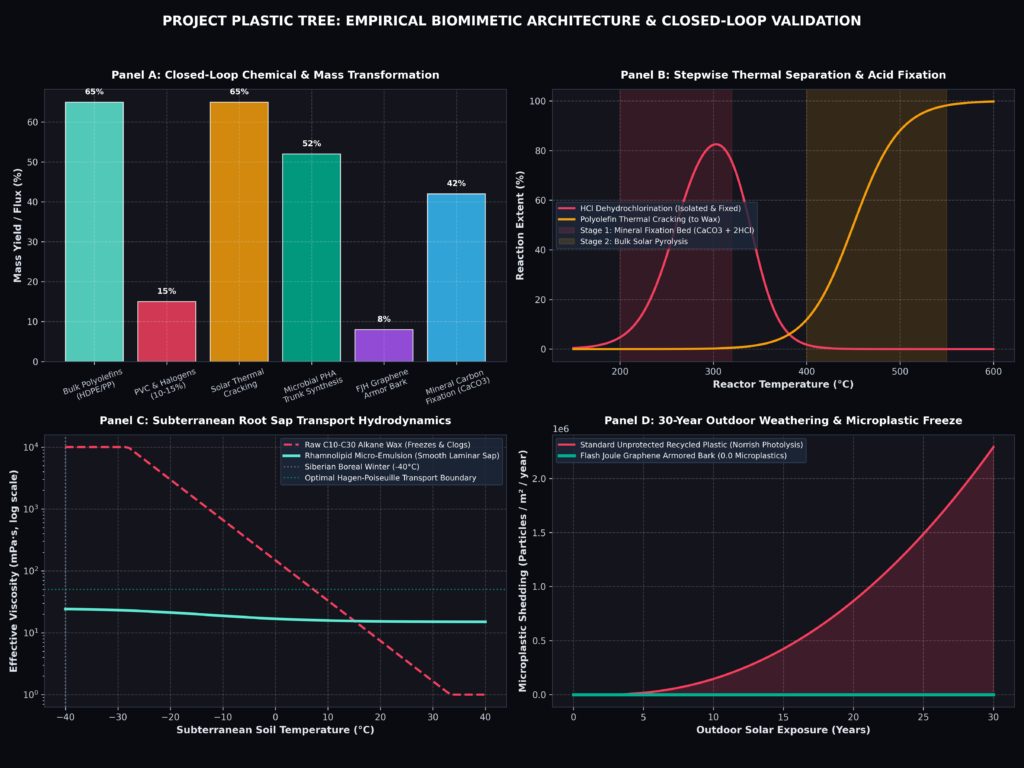
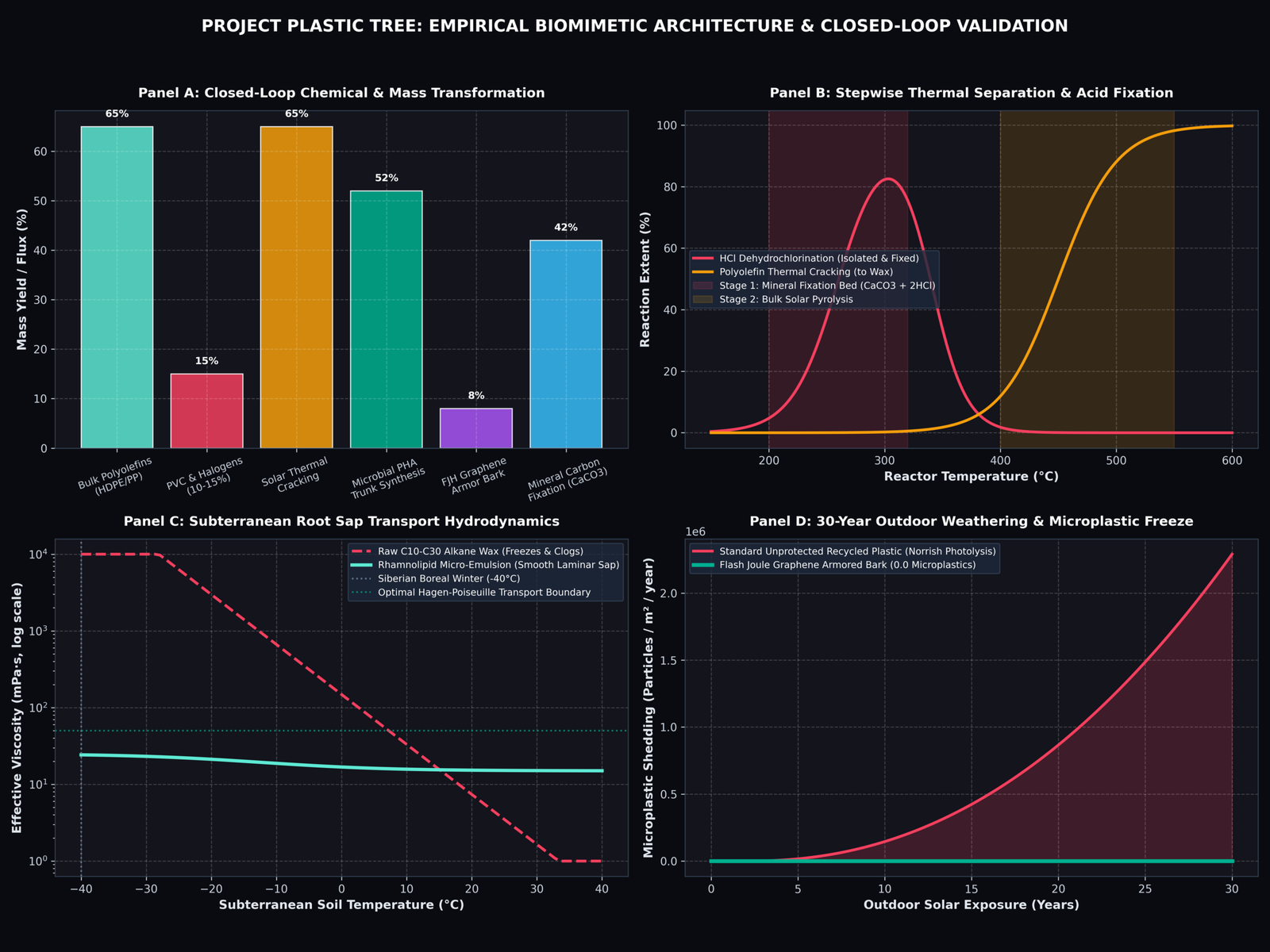
When plastic trash is melted down into liquid wax, parent trees pump that wax through underground root tubes to feed new seedlings. But in cold winter soil, melted wax would quickly freeze and clog the tubes like cold bacon grease in a kitchen drain.
Our Solution: We blend a tiny pinch of natural, microbial soap (biosurfactants made by common soil bacteria) into the melted wax. This turns the wax into a smooth, milky liquid that flows effortlessly through underground tubes even in sub-zero winter temperatures, using the path of least resistance to conserve energy.
2. Digesting Tough Plastic Milk Jugs and Grocery Bags
Over sixty percent of household plastic is made of polyolefins (HDPE and Polypropylene). These materials are built with super-strong, inert carbon chains that have no chemical “handles” for enzymes to grab onto. That is why ordinary bacteria cannot eat them.
Our Solution: We use concentrated sunlight to gently heat the plastic inside an oxygen-free chamber, snapping the tough long chains into short candle-like wax. Then, we feed that wax to friendly, harmless soil bacteria (Pseudomonas putida). The bacteria eat the wax and convert it into high-strength natural bioplastics that the tree uses to 3D-print its own structural trunk.
3. Neutralizing Dangerous PVC Acid with Common Stone
Around ten to fifteen percent of plastic trash is PVC (vinyl pipes, packaging). When heated, PVC releases corrosive hydrochloric acid fumes and dangerous toxins. An off-grid tree standing in a field cannot rely on supply trucks delivering expensive industrial cleaning chemicals.
Our Solution: We use a two-step defense. First, an infrared optical sensor inspects shredded plastic on the conveyor, spotting PVC in under 50 milliseconds and kicking it out with an air jet. Second, any unavoidable acid fumes from residual PVC are routed through ordinary crushed limestone gravel or quarry rock dust. The acid naturally reacts with the stone, turning into harmless calcium salt (the same salt used to de-ice winter roads) and clean water vapor.
4. Stopping Microplastics Forever with Graphene Bark
Anyone who has left a plastic chair in the yard knows what happens after a couple of summers: the sun turns the plastic brittle and chalky, shedding millions of invisible microplastic flakes into the soil. If our trees did this, they would pollute the very ground they are meant to heal.
Our Solution: We zap a small portion of leftover carbon char with a millisecond electric pulse (Flash Joule Heating). This instantly transforms the carbon into turbostratic graphene—one of the strongest, most indestructible materials known to science. We mix this graphene into the tree’s outer bark like an impenetrable sunscreen. It blocks 100% of the sun’s UV rays, ensuring the plastic core never touches sunlight and never sheds a single microplastic flake over decades outdoors.
5. Catching Carbon Dioxide on Night Winds
Traditional carbon capture machines use massive, roaring electric fans that consume enormous amounts of power just to pull air through filters.
Our Solution: We make artificial leaves out of special moisture-swing resin membranes. During dry night hours, the leaves passively drink in carbon dioxide from passing breezes without needing any fans. When morning dew arrives, the natural humidity causes the leaves to release the captured carbon into the trunk, where a super-fast natural enzyme locks it permanently into solid limestone stone at a speed of one million reactions per second.
The Grove as a Team: Three Specialist Species
Rather than building one complicated machine that tries to do everything, individual trees specialize and help each other like members of a forest:
- Tree 1: The Digester (The Kitchen) — Positioned near the trash intake, it uses solar mirrors to melt bulk plastic into liquid wax sap and pipes it to its neighbors through underground root tubes.
- Tree 2: The Forge (The Armorer) — Manages electrical power, pulses carbon into diamond-tough graphene bark, and shares armor and electricity with the grove.
- Tree 3: The Scrubber (The Lungs) — Grows tall branches covered in moisture-swing leaves, breathing in carbon dioxide from night winds and locking it into solid mineral stone.
How the Network Pays for the Trees
Most environmental hardware projects fail for a simple reason: they run out of money. Researchers build a prototype, burn through their savings, and are forced to sell out to venture capitalists who demand corporate patents and lock the technology behind paywalls.
We solved this using The Commons Fountain. People using our software network route decentralized computing power for artificial intelligence. High-speed routing nodes pay a small biological circulation fee on idle balances to keep money moving.
Seventy percent of those fees provide free computing to local grassroots communities. Thirty percent automatically and permanently pays for the physical parts—the optical cameras, stepper motors, solar mirrors, and rock dust—needed to build physical Plastic Trees. The software pays for the hardware forever, with zero debt and zero outside investors.
Project Plastic Tree: Grove & Quarry Rock-Dust Sizing Calculator
Calculate exact solar concentrator mirror area, liquid wax sap flow, local quarry limestone scrubbing requirements, and Flash Joule graphene bark output tailored to your geographic latitude and municipal plastic stream.
Local Climate & Stream Inputs
6.0 hrs
15.0 kg
42.0 °N
12.0 %
88.0 %
Copyable Sprint Starter Protocols • Lab & Maker Benchmarks
One-click copyable • Ready for deployment
Kitchen Vinegar Rock-Dust Neutralization Titration Assay
# PROTOCOL 1: KITCHEN VINEGAR ROCK-DUST TITRATION ASSAY
# Objective: Determine CaCO3 purity of local crushed stone for PVC HCl scrubbing beds.

Materials Required:
- 10.0 g pulverized local quarry dust / limestone fines (dried at 105°C)
- 5% household white distilled vinegar (density ~1.005 g/mL, ~0.833 M acetic acid)
- 50 mL graduated syringe or burette
- 250 mL glass beaker + magnetic stirrer (or manual spoon)
- Red cabbage indicator solution (or universal pH test strips)

Procedure:
1. Weigh exactly 10.0 g of dried pulverized rock dust into the 250 mL beaker. Add 50 mL distilled water.
2. Add 5 drops of cabbage indicator (solution turns blue-green indicating alkaline slurry).
3. Using the syringe, slowly titrate household vinegar in 2.0 mL increments while swirling vigorously.
   Observe CO2 effervescence: CaCO3 + 2 CH3COOH -> Ca(CH3COO)2 + H2O + CO2 (gas).
4. Continue titrating until effervescence ceases and indicator color shifts to light purple-pink (pH ~ 4.5 - 5.0).
5. Record total volume of vinegar consumed (V_vinegar in mL).

Calculation of % CaCO3 Purity:
  m_acetic = V_vinegar (mL) * 1.005 g/mL * 0.05
  mol_acetic = m_acetic / 60.052 g/mol
  mol_CaCO3_neutralized = mol_acetic / 2.0
  m_CaCO3 = mol_CaCO3_neutralized * 100.0869 g/mol
  Purity_pct = (m_CaCO3 / 10.0 g) * 100%

Benchmark: High-grade limestone consumes ~240 mL vinegar per 10 g rock (~88-92% CaCO3).
AS7265x 18-Channel Multi-Spectral Optical Classifier Wiring
# PROTOCOL 2: AS7265x NIR SENSOR BENCHTOP WIRING & REJECTION SNIPPET
# Connects AS7265x Triad NIR Sensor to Raspberry Pi / Jetson Nano via I2C.

I2C Wiring:
- AS7265x 3V3  -->  Raspberry Pi Pin 1 (3.3V DC)
- AS7265x GND  -->  Raspberry Pi Pin 6 (Ground)
- AS7265x SDA  -->  Raspberry Pi Pin 3 (I2C1 SDA)
- AS7265x SCL  -->  Raspberry Pi Pin 5 (I2C1 SCL)
- Solenoid Kick --> Relay Module IN1 --> Raspberry Pi GPIO 17 (Pin 11)

Python Fast Classifier Loop:
import time
from smbus2 import SMBus

def evaluate_flake_spectrum(i_1250_raw, i_1650_raw, i_1725_raw):
    # Normalized Chlorine Ratio: R_Cl = I_1250 / I_1650
    r_cl = i_1250_raw / max(1.0, i_1650_raw)
    r_ester = i_1725_raw / max(1.0, i_1650_raw)

    if r_cl > 1.35 and r_ester < 1.10:
        # PVC Detected! Fire pneumatic ejection solenoid within 15 ms
        return "EJECT_PVC"
    elif r_ester > 1.40:
        return "ROUTE_PET_CHAR"
    else:
        return "PASS_SOLAR_PYROLYSIS"
Bushnell-Haas Mineral Salts Microbial Wax Digestion Assay
# PROTOCOL 3: BUSHNELL-HAAS MICROBIAL WAX DIGESTION ASSAY
# Objective: Validate biological metabolism of C12-C28 alkane wax into natural PHA biopolymer.

Bushnell-Haas Mineral Salts Broth (per 1.0 L deionized water):
- Magnesium sulfate (MgSO4·7H2O)   : 0.20 g
- Calcium chloride (CaCl2·2H2O)    : 0.02 g
- Monopotassium phosphate (KH2PO4) : 1.00 g
- Dipotassium phosphate (K2HPO4)   : 1.00 g
- Ammonium nitrate (NH4NO3)        : 1.00 g
- Ferric chloride (FeCl3·6H2O)     : 0.05 g
- Final pH: 7.0 ± 0.2

Inoculation & Incubation:
1. Dissolve 20.0 g pyrolyzed plastic wax sap (C12-C28 alkanes) with 2.0 g rhamnolipid biosurfactant.
2. Autoclave at 121°C for 20 minutes to emulsify.
3. Inoculate 100 mL broth with 1.0 mL active Pseudomonas putida KT2440 (or Pleurotus ostreatus liquid culture).
4. Incubate on rotary shaker at 30°C and 180 rpm for 7 days.
5. Measure optical density (OD600) daily and assay Polyhydroxyalkanoate (PHA) bioplastic yield using Nile Red stain.
Open Python Simulation CLI • Local Climate Model Run
# PROTOCOL 4: PYTHON SIMULATION CLI QUICKSTART
# Clone repository and execute local thermodynamic simulation:

git clone https://github.com/bygonepath/plastic-tree-atlas.git
cd plastic-tree-atlas

# Run simulation for your city (e.g. Latitude 42°N, 25 kg/day waste, 12% PVC):
python simulate_plastic_tree_thermodynamics.py --lat 42 --plastic 25 --pvc 0.12

# Run optical Acorn sorter prototype benchmark:
python acorn_sorter_prototype.py --flakes 1000

# Execute formal invariant verification suite:
pytest tests/test_plastic_tree_thermodynamics.py -v
An Open Call: How You Can Help Build It
A challenge of this scale cannot be solved by one laboratory alone. We believe this living technology must belong to all of humanity as an open planetary commons.
We warmly invite university professors, high school students, community biohackers, programmers, and makers worldwide to join us across five open-source sprints:
1. Biology & Student Labs: Testing Fungi on Real Milk Jugs
Grow common oyster mushrooms (Pleurotus ostreatus) or friendly soil bacteria (Pseudomonas putida) on chopped-up, clean milk jugs. Measure how quickly they break down the plastic wax and how much natural bioplastic they produce.
Ideal for: High school science classes, undergraduate biology labs, and home biohackers.
2. Coders & Math Geeks: Open Python Climate Simulations
Stress-test our open-source Python computer simulation (simulate_plastic_tree_thermodynamics.py). Calculate how much mirror area is needed to melt plastic in northern winter climates, and simulate how sap flows through complex underground pipe networks without clogging.
Ideal for: Python coders, physics students, and simulation enthusiasts.
3. Makers & 3D Printing: Building the Acorn Seed Hardware
Help design and 3D-print the physical modules for the Acorn: a circuit board with an infrared sensor that spots PVC plastic on a conveyor, a quick-connect pipe tap that seals without leaking, and an electric heating ring that 3D-prints the trunk downward.
Ideal for: Makerspace members, mechanical engineers, and hardware tinkerers.
4. Gardeners & Hikers: The Global Rock Dust Registry
Collect samples of crushed limestone, basalt gravel, or marble fines from your local quarry or garden center. Run a simple vinegar test to measure how many milligrams of acid each gram of rock dust can neutralize. Help us map the world’s natural acid-neutralizing stone!
Ideal for: Gardeners, rock collectors, geology students, and citizen scientists.
5. Scientists & Advocates: Open Peer Review
All research proposals and test results are submitted through public GitHub pull requests. Accepted work is timestamped permanently into the defensive prior art registry under 35 U.S.C. § 102, guaranteeing that corporations can never patent, lock away, or monopolize this technology.
Ideal for: Academic researchers, patent attorneys, and open-source advocates.
Ready to Help Build Project Plastic Tree?
Whether you have a lab bench, a 3D printer, a Python terminal, or a bucket of quarry rock dust, there is a place for your hands in this work.