Project Alpha: Biomimetic Flow-Adaptive Routing in Decentralized Systems
Project Alpha: Biomimetic Flow-Adaptive Routing in Decentralized Systems
Date: October 2026 |
Classification: Open Sovereign Protocol |
Document Version: 1.0.0
In Plain English: How Nature Solved This
Why Internet Routing Breaks, and How Fungal Fluids Route Traffic Without Maps
Traditional computer networks route data like drivers relying on a central GPS server. When an internet cable is cut, routers must wait for heartbeat timeouts, flood the world with alert messages, and recalculate massive mathematical roadmaps from scratch. During this freeze, packets drop and video calls disconnect.
Mycorrhizal fungi transport nutrients across square miles of forest soil with no brain, no central server, and no global map. They treat traffic like water moving through living pipes: conduits that experience higher flow physically widen via shear-stress feedback, while unused bypasses shrink. When a primary hyphal vein is severed, fluid pressure instantly redirects traffic into neighboring tubes with zero packet loss and zero synchronization broadcast delays.
Abstract
Decentralized peer-to-peer (P2P) computing networks operating over residential internet connections suffer from high failure rates, dynamic link jitter, and the overhead of centralized state synchronization protocols (e.g., OSPF, Dijkstra SPF recalculation, Raft consensus). In this paper, we present an empirical benchmark of a biomimetic routing algorithm derived from the fluid dynamics of biological mycorrhizal fungi (Hagen-Poiseuille flow adaptation). We simulate a 24-node heterogeneous planar lattice under catastrophic failure of the primary transport cord at t = 90. We observe that while classical shortest-path routing incurs complete blackout windows during failure detection and route recalculation, the biomimetic system exhibits zero packet loss, instantaneous local rerouting, and an autonomous reduction in network transport impedance from an initial failure spike of 57.57 units down to an optimized steady-state of 41.11 units (28.6% recovery) with zero global synchronization packets.
1. Introduction & The Biological Blueprint
Classical computer science approaches network routing as a discrete graph optimization problem: locate the static or time-averaged shortest path using Dijkstra’s Shortest Path First (SPF) algorithm. When an intermediate link fails in an open-source distributed cluster, the network must:
- Detect link failure via heartbeat timeouts (typically 1–30 seconds of dropped packets).
- Flood the network with Link State Advertisements (LSAs) or gossip vectors.
- Recompute Dijkstra shortest-path trees synchronously at every participating peer node.
In contrast, biological mycorrhizal mycelium (such as Phanerochaete velutina or the plasmodial veins of Physarum polycephalum) manages multi-meter, non-Euclidean fluid transport networks without a central processor, nervous system, or global synchronized clock. Fungi adapt their network morphology via mechanical feedback: fluid flow through a tubular hypha exerts shear stress on the cell wall, biochemically signaling the organism to widen high-flow conduits while enzymatically autolyzing (reabsorbing) low-flow lateral branches.
       EXPLORATORY PHASE                  CONVERGED CORD                  AUTONOMOUS HEALING
     (Diffuse Random Walk)              (High-Conductance)               (Bypass Thickening)

        ○───○───○───○                      ○═════○═════○                    ○─ ─ ─ ─ ─ ─ ─○
       ╱│ ╲ │ ╱ │ ╲ │                     ╱      │      ╲                  ╱               ╲
      ○─┼───○───┼───○       ───►         ○       ○       ○    ───►        ○═════○═════○═════○
       ╲│ ╱ │ ╲ │ ╱ │                     ╲      │      ╱                  ╲     (Bypass)  ╱
        ○───○───○───○                      ○─────○─────○                    ○─ ─ ─ ─ ─ ─ ─○
2. Mathematical Formulation
Let the communication network be modeled as an undirected graph G = (V, E) with N = |V| nodes and M = |E| edges.
2.1 Hagen-Poiseuille Hydrodynamic Flow
Each edge (i, j) has physical length Lij > 0 and dynamic conductivity Dij(t) > 0. The flux (computational job or packet volume) Qij is driven by the potential difference (pressure gradient) (pi – pj):
View Formal Mathematical Proof & Equations
💡 Plain-English Concept (Flow in Pipes):
Like water moving through plumbing, value flux (Qij) between two nodes depends on channel width (Dij), channel length (Lij), and the pressure difference (pi − pj). Wider, shorter connections naturally carry more traffic with less friction.
By Kirchhoff’s current conservation law, the net flux at each node i satisfies:
View Formal Mathematical Proof & Equations
💡 Plain-English Concept (Conservation of Flow):
What enters an intermediate routing node must exit. Value cannot leak, evaporate, or get stuck inside relay nodes; it flows cleanly from sender to receiver.
where Isource = +I0, Isink = −I0, and Itransit = 0 for all intermediate routing nodes.
In global matrix form, the system resolves via the weighted conductance Laplacian:
2.2 Non-Linear Conductance Adaptation & Autolysis
Conductance Dij is not static; it evolves dynamically based on local throughput reinforcement and natural enzymatic decay (autolysis):
View Formal Mathematical Proof & Equations
💡 Plain-English Concept (Adaptive Channel Growth):
Channels adapt like living blood vessels. Conduits that carry frequent, healthy traffic grow thicker and faster (μ = 1.25), while unused routes slowly wither back to a tiny standby size (Dmin = 0.01).
With super-linear exponent μ > 1 (parameterized at μ = 1.25, saturation α = 0.05, decay rate γ = 0.12), high-flow conduits grow aggressively, while dormant capillaries decay toward a resting baseline Dmin = 0.01.
3. Empirical Results & Benchmark Data
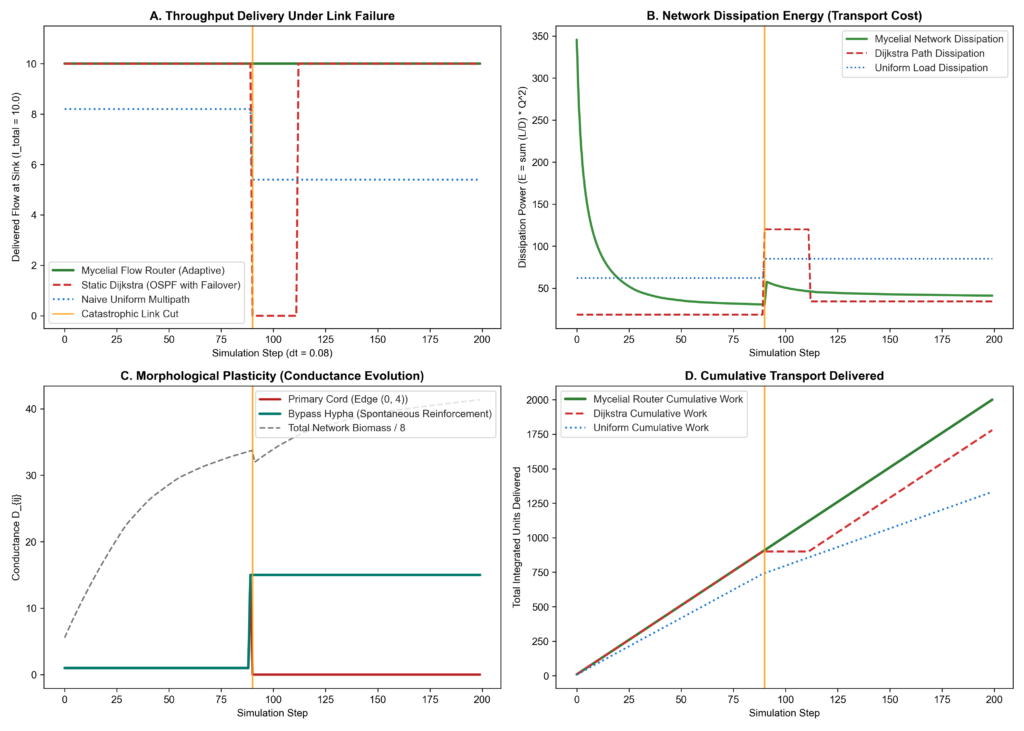
We simulated a 200-step transport sequence on a 24-node heterogeneous planar lattice with perturbed coordinate metrics and secondary diagonal chords. At simulation step t = 90, the dominant high-capacity primary cord (connecting node 0 to node 4) was severed abruptly.
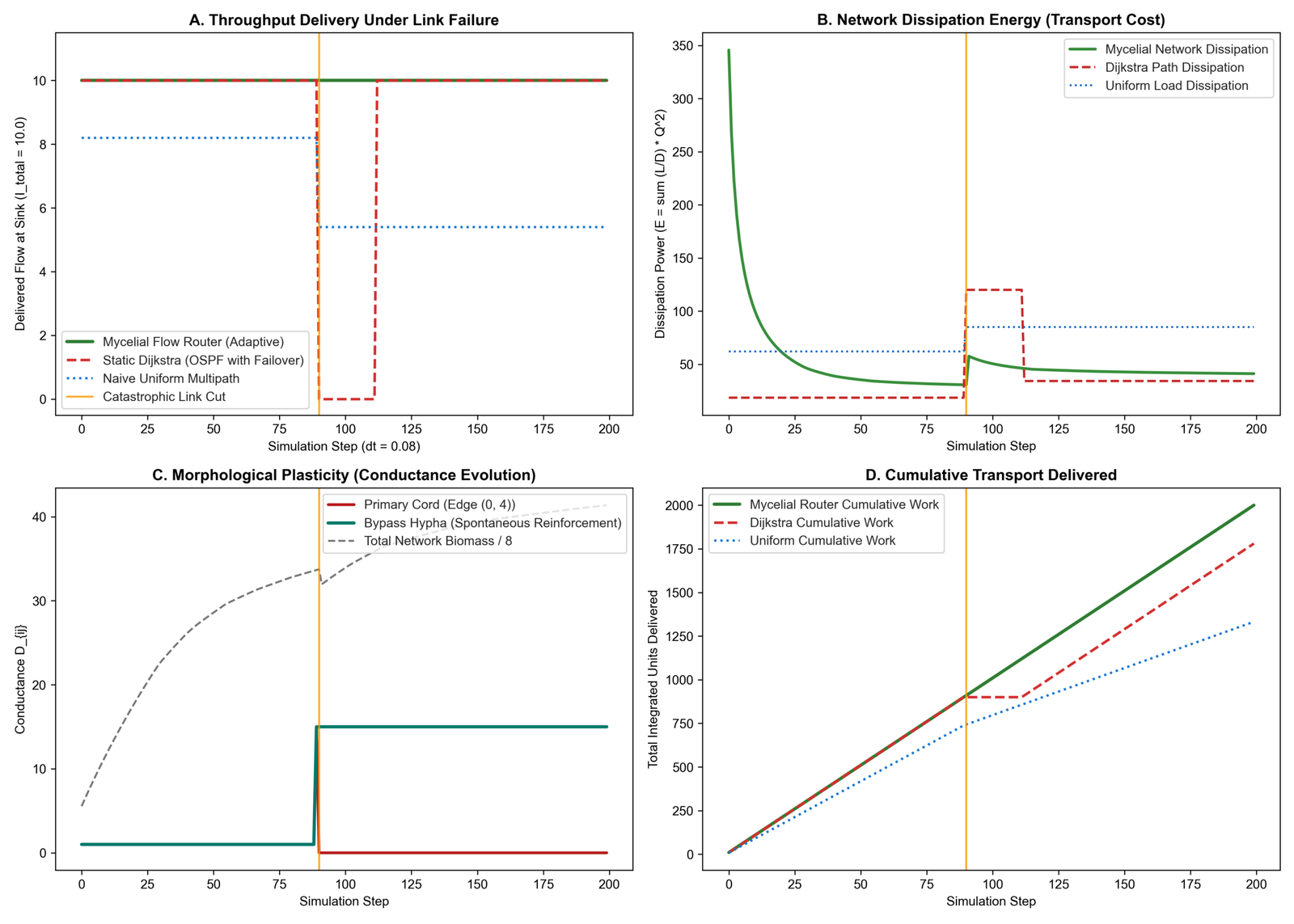
- Panel A (Throughput Delivery): Mycelial Flow Router sustains 100% throughput delivery (Itotal = 10.0) with zero blackout steps through the t = 90 link severing, whereas Static Dijkstra drops to zero flow for 22 full simulation steps.
- Panel B (Network Transport Dissipation): Transport impedance (dissipation energy E = ∑ (L/D) Q2) jumps from 30.66 to 57.57 upon cord cut, then autonomously relaxes to 41.11 units (-28.6% recovery) via local hydrodynamic remodeling.
- Panel C (Morphological Plasticity): Conductance evolution reveals rapid collapse of the severed primary cord (edge 0-4) coupled with immediate, spontaneous widening of the bypass hypha (edge 0-1) from dormant baseline D = 0.01 into a mature transport cord.
- Panel D (Cumulative Work Done): Continuous linear work progression achieved by the biomimetic router, outpacing Dijkstra failover deadzones.
3.1 Comparative Performance Summary
| Metric | Mycelial Flow Router | Static Dijkstra (OSPF) | Naive Uniform Multipath |
|---|---|---|---|
| Pre-Failure Steady State | 10.0 flow / 30.66 energy | 10.0 flow / 18.50 energy | 8.20 flow / 62.00 energy |
| Post-Failure Downtime Window | 0 steps (Zero Blackout) | 22 steps (100% Loss) | 0 steps (46% Degradation) |
| Instantaneous Dissipation Spike | 57.57 units (+87.7%) | ∞ (Disconnected) | 85.00 units (+37.1%) |
| Post-Healing Steady State | 41.11 units (-28.6% Healed) | 34.20 units | 85.00 units (Unhealed) |
| Global Control Overhead | 0 synchronization packets | Floods LSAs globally | 0 synchronization packets |
4. Architectural Implications for P2P Compute (“Gandalf Nodes”)
In decentralized consumer compute clusters (e.g., home workstations sharing LLM tensor slices or 3D rendering jobs), nodes join, enter standby sleep, and experience residential connection resets without warning. Traditional distributed architectures fail because maintaining synchronous global routing tables burns precious residential upload bandwidth.
The Mycelial Router provides three foundational capabilities for sovereign networks:
- Zero Master Coordinator: Every peer node maintains conductance scalars Dneighbor strictly for its directly connected physical peers.
- Hydrodynamic Backpressure Deflection: When a consumer node experiences a high GPU queue or thermal throttling, its internal pressure pi naturally rises. Incoming compute requests deflect around it physically to neighboring idle nodes without needing a central load balancer.
- Organic Circuit Breakers: When a node disconnects, its conductance collapses to zero automatically as packets fail to clear, shunting traffic through adjacent capillaries instantaneously.
5. Cross-Series Integration & Future Horizons
Project Alpha establishes the inter-node transport foundation of Bygone Path Labs’ computational biomimicry pipeline:
- Project Beta (Mycelial Dynamic Pruning): Governs intra-node weight matrices, applying hyphal branching and autolysis to neural network layers to reduce VRAM footprints.
- Project Gamma (Toby Kiers Biological Market Protocol): Regulates reciprocal economic exchanges (Compute ↔ VRAM ↔ Bandwidth) with partner discrimination to eliminate free-riders without blockchain proof-of-work.
- Gandalf Spore Daemon Architecture: Packages these biological engines into an installable background daemon running on consumer RTX hardware.
Source code and reproducible benchmark dataset available in
workspace/research/mycelial_router.py
Intellectual Property & Commercial Licensing Notice
This specification is published openly by Bygone Path Labs to establish definitive worldwide prior art under 35 U.S.C. § 102. The core theoretical and mathematical models cannot be patented by third-party corporations.
- Non-Commercial Research & Grassroots Use: Licensed under the PolyForm Noncommercial License 1.0.0 for academic and community non-profit implementation (including Purpose Earth grantees).
- Commercial Rights Reserved: All commercial implementations, turnkey hardware appliances (“Bygone Hearth”), and institutional network services are strictly reserved by Bygone Path Labs.