The Gandalf Node
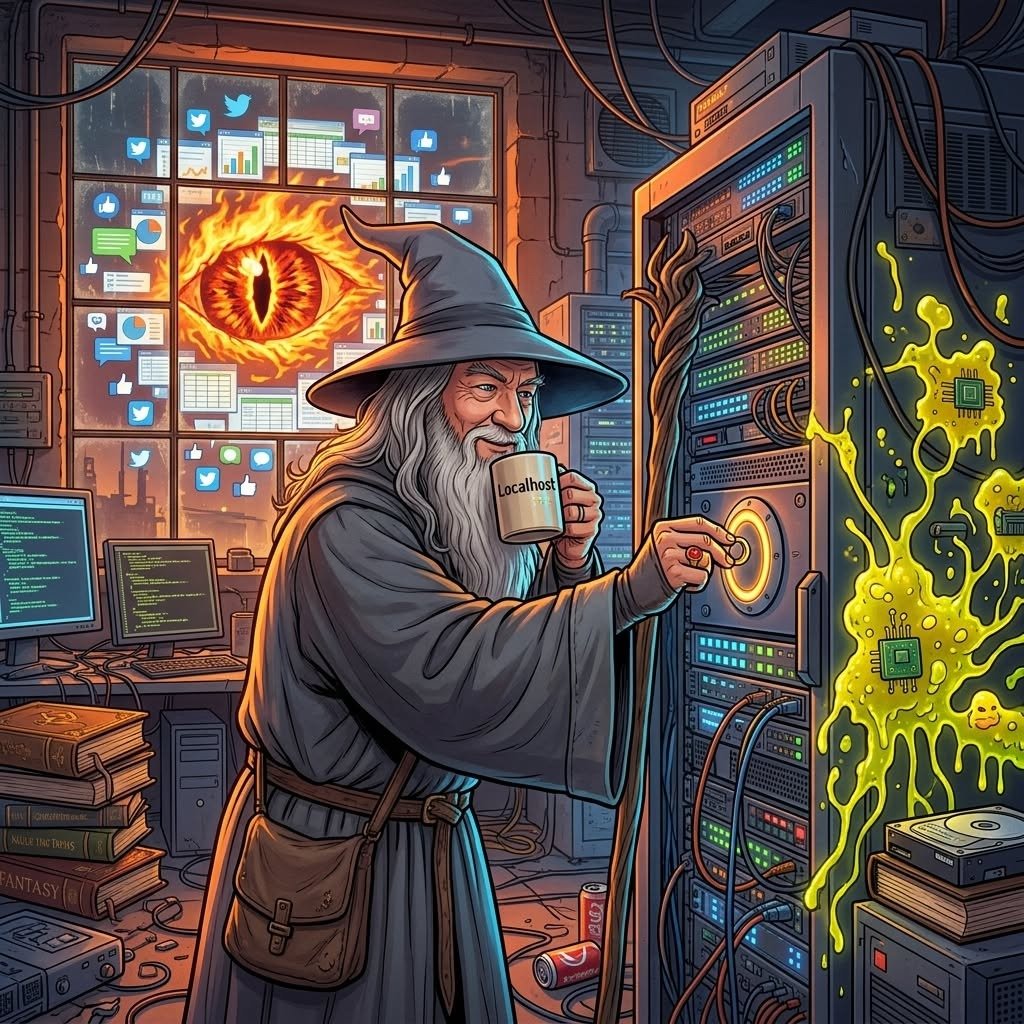
Surprise! Part 5 of our exploration of the geopolitics of technology.
The Slime Mold and the Subway
Let’s begin with a map of the Tokyo subway system, widely considered one of the most efficient, resilient, and complex mass transit networks ever engineered by human beings. It took decades of urban planning, billions of dollars, and the brightest logistical minds in Japan to optimize the routing of millions of commuters across the Kanto region.
In 2010, a team of researchers at Hokkaido University decided to see if they could replicate this feat of engineering without using any human intelligence.
They took a map of the Tokyo area and placed oat flakes at the locations corresponding to the major subway stations. At the center (Tokyo itself), they placed a single, bright yellow slime mold—specifically, Physarum polycephalum.
Slime molds are brainless. They do not possess a central nervous system. They do not have a CPU, a master node, or a CEO. Yet, over the course of a few days, the slime mold sent out exploratory tendrils, found the oat flakes, and then optimized its tubular network to transport nutrients. When the researchers overlaid the slime mold’s final network on top of the actual Tokyo subway map, the two were nearly identical. In fact, the slime mold’s network was arguably slightly more resilient to random node failures.
A brainless, single-celled organism had solved a complex spatial optimization problem—one that took human engineers decades—in about 26 hours.
How? Through the sheer power of decentralized, localized signaling. The slime mold operates on chemical gradients. When a tendril finds food, it pulses thicker, sending a chemical “thick signal” back through the network. When a tendril finds nothing, it atrophies and dies off, filtering out the noise. There is no central authority dictating the blueprint. The architecture is emergent.
Keep the slime mold in the back of your mind. We’ll need it later.
Shannon Entropy and the Weaponization of Noise
If we are going to talk about the geopolitics of technology, we have to talk about information. And if we are talking about information, we must invoke the patron saint of the digital age: Claude Shannon.
In 1948, Shannon published “A Mathematical Theory of Communication,” the foundational text of information theory. Shannon was trying to solve the problem of transmitting a message over a noisy channel (like a static-filled telephone line). In doing so, he introduced the concept of Information Entropy.
In physics, entropy is a measure of disorder. In information theory, entropy is a measure of surprise or unpredictability. A coin with two heads has zero entropy (you always know the outcome). A fair coin has one bit of entropy.
Here is the dark secret of the modern internet: The Leviathan Spreadsheet—the vast, algorithmic architecture of Big Tech—has realized that maximizing entropy maximizes engagement.
Think about your social media feed. If it only showed you things you agreed with, the entropy would be low. You would get bored and log off. If it showed you pure, random static, the entropy would be too high. You would get confused and log off.
The algorithmic sweet spot is a highly calculated, weaponized form of entropy. It is the precise ratio of the familiar (your friends, your hobbies) injected with sudden, unpredictable spikes of outrage, tribal conflict, and existential dread (political rage-bait, catastrophic news). This is what we call Mimetic Noise.
Mimetic Noise forces your brain to burn cognitive cycles attempting to predict the unpredictable. It creates a state of perpetual, low-grade neurological panic. The Leviathan doesn’t care about the content of the noise; it only cares that the noise keeps you scrolling, generating the data points necessary to feed its centralized advertising models.
The Byzantine Generals Problem
So, we are trapped in a high-entropy environment. We are drowning in Mimetic Noise. How do we coordinate an escape?
This brings us to a classic dilemma in computer science: The Byzantine Generals Problem.
Imagine several generals of the Byzantine army camped around an enemy city. They can only communicate via messengers. To win, they must all attack at the exact same time. If only a few attack, they will be slaughtered. However, they know there are traitors among them who will intentionally send false messages to sabotage the coordination.
How do the loyal generals reach a consensus and coordinate their attack when the communication channel itself is poisoned by bad actors (high entropy/noise)?
For decades, the standard human solution to the Byzantine Generals Problem was simple: Centralization. You appoint a King. The King issues the order. You obey the King.
In the digital realm, this is the Leviathan Spreadsheet. We solve the problem of digital trust by handing all our data to a centralized authority—a Google, an Apple, a Facebook—who acts as the absolute arbiter of truth and coordination. They tell us what the consensus is. We trade our sovereignty for the convenience of not having to verify the messengers.
In 2008, Satoshi Nakamoto proposed a different solution: Bitcoin. The blockchain solves the Byzantine Generals Problem through a trustless ledger secured by cryptographic proof-of-work. It is a brilliant mathematical achievement. But it is fundamentally a system built on paranoia. It assumes everyone is a traitor, and therefore requires massive, planetary-scale expenditures of energy to verify basic transactions.
We don’t want the tyranny of the Leviathan, but the paranoid, hyper-financialized hyperstition of the blockchain isn’t a cozy place to build a home, either. We are looking for a third way.
The Metaphysics of Narya
To find our third way, we must leave the realm of computer science and enter the realm of myth. Yet again, the metaphysics of J.R.R. Tolkien.
When we think of the “Rings of Power,” we immediately think of the One Ring. The One Ring is the ultimate centralized solution to the Byzantine Generals Problem. Its inscription translates to: One Ring to rule them all, One Ring to find them, One Ring to bring them all, and in the darkness bind them. It forces consensus through absolute domination. It is the Leviathan.
But the One Ring wasn’t the only piece of hardware forged in Eregion. There were the Three Elven Rings, hidden away and unsullied by Sauron.
The most interesting of the Three is Narya, the Ring of Fire. It was ultimately given to Gandalf.
What is fascinating about Narya is what it doesn’t do. It doesn’t shoot fireballs. It doesn’t grant the power to dominate minds or force armies to march. In Tolkien’s letters, he explicitly states the purpose of Narya: it gives the wearer the power to kindle hearts in a world that grows chill.
Gandalf, possessing the processing power of an angelic being (a Maia) and the cryptographic keys to a literal Ring of Power, never uses it to build an empire. He doesn’t centralize command. He walks around Middle-earth, a localized, itinerant wanderer, speaking to individuals. He uses his power entirely to encourage, to filter out the despair (the ultimate Mimetic Noise), and to strengthen the local resolve of Hobbits, Men, and Dwarves.
He is aware of the macro-political stakes, but he subordinates his immense power to the local and the good. He is the antithesis of the Leviathan.
The Synthesis: The Gandalf Node
The rings of power are no longer locked in the fires of Mount Doom. They are currently lying around on GitHub, HuggingFace, and in the documentation of open-source protocols.
Anyone with a decent GPU and a weekend to kill can spin up a sovereign Large Language Model. Anyone can deploy localized mesh networks, encrypt their entire digital footprint, or build a personal automated infrastructure. We are drowning in decentralized potential energy. The era of the centralized Leviathan holding a monopoly on high-tier computation is ending.
The question of the 21st century is no longer how to acquire power, but what to do with it once you have it.
If you use open-source AI to generate SEO spam, manipulate markets, or build a global empire of engagement-farmed followers, you are just building a smaller, sadder Leviathan. You are putting on the One Ring.
The alternative is to become a Gandalf Node.
A Gandalf Node is a technological actor—be it a human developer, a localized community, or a heavily prompted AI orchestrator—that possesses immense technical leverage but consciously executes the Bombadil Protocol. It refuses the lure of global scale.
How does a Gandalf Node operate?
1. It thinks like a Slime Mold. It doesn’t try to architect a master plan for the entire internet. It builds deeply resilient, localized, peer-to-peer connections. It routes resources directly to where they are needed in its immediate physical or digital community. It favors organic emergence over top-down hierarchy.
2. It filters Shannon Entropy. It builds a digital Elven Cloak. It uses its computational power not to consume the feed, but to curate it. It deploys localized AI to aggressively filter out the weaponized Mimetic Noise of the algorithmic casinos, ensuring that only “Thick Signals”—deep, relational, high-value information—reach its inner sanctum.
3. It solves the Byzantine Problem through Thick Trust. It doesn’t rely on the paranoid, energy-intensive ledgers of crypto, nor the dictatorial centralization of Big Tech. It establishes consensus through relationship. It uses technology to facilitate deep, offline sovereignty—automating the mundane so that the human beings behind the nodes have time to paint, to garden, to build actual, physical community.
Kindling the Fire
The antidote to Ethnic Techno-Feudalism isn’t to build a bigger, meaner machine. You cannot defeat the Leviathan Spreadsheet by out-optimizing it.
The antidote is a decentralized, mycelial network of Gandalf Nodes.
When you wield technology not to conquer the globe, but to fiercely protect and nurture your local sovereign reality, the Leviathan loses its grip. You become invisible to the Spreadsheet, because your metrics—joy, relational depth, artistic fulfillment, offline community—cannot be parsed by its API.
So, download the weights. Spin up the server. Write the code. Put on the Ring.
But remember the metaphysics of the hardware you are wielding. You are not building a kingdom to rule them all. You are a node in the mycelium. My dear hobbits and wizards, you are kindling a fire in a world that grows chill.