The Crab, The Dark Forest, and the Blindspot
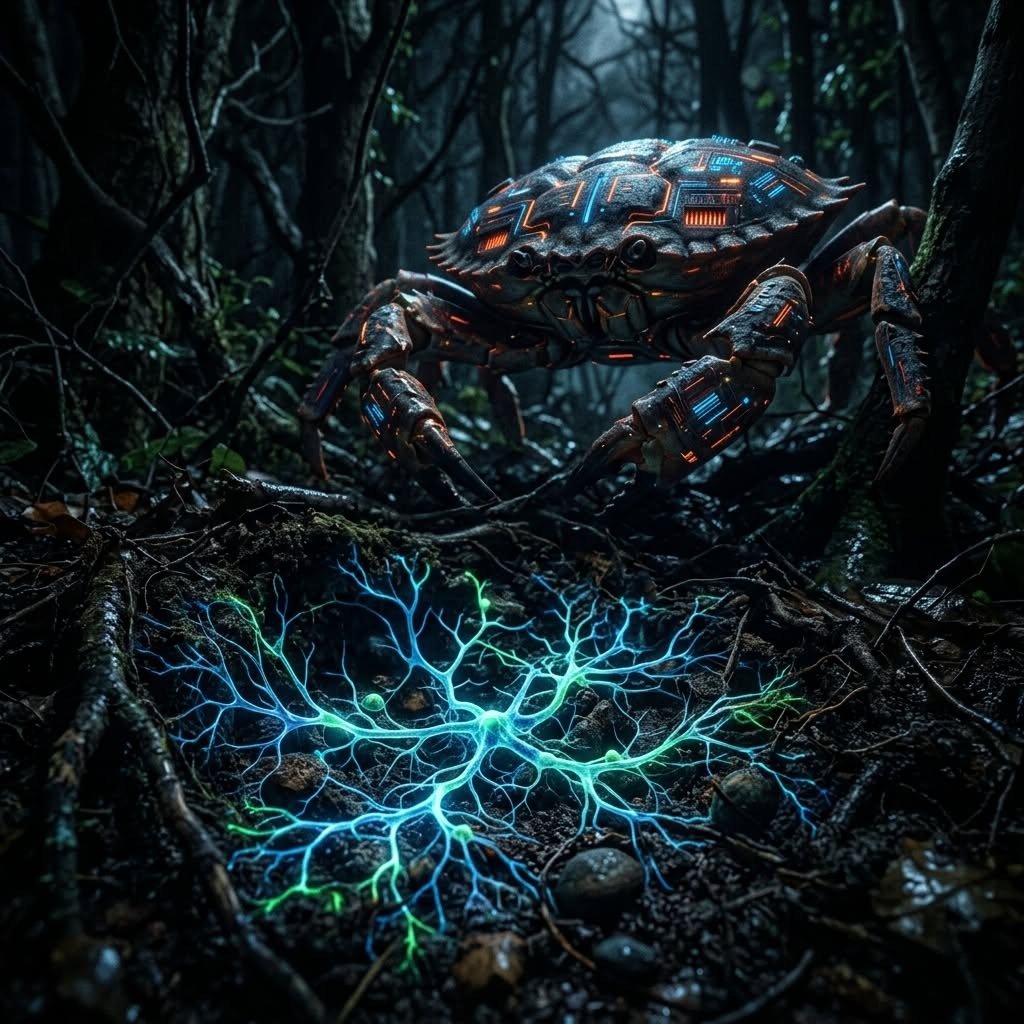
Part 6 of our ongoing exploration of the geopolitics of the tech-sphere. To survive the Leviathan, you have to understand the deeply terrifying, objectively hilarious laws of its evolution.
You woke up this morning, rolled over, and grabbed your glowing rectangle. Within ninety seconds, you were probably angry, anxious, or exhausted.
Maybe it was a headline about the latest political theater in Washington. Maybe it was an engineered culture war playing out in a 280-character brawl. Maybe it was just the sheer, crushing weight of the 24/7 global news cycle pouring an ocean of hyper-accelerated tragedy directly into your primate brain before you even had time to brew a cup of coffee.
We spend so much of our lives agonizing over current events. We treat the daily feed like it’s an organic, weather-like phenomenon that we just have to endure. But the exhaustion you feel isn’t an accident. The creeping sensation that the entire internet is a psychological meat grinder designed to make you hate your neighbor? That’s not a glitch. That is the fundamental architecture of the system working exactly as intended.
If we want to survive this, if we want to build something sovereign and beautiful, we have to stop staring at the symptoms. We have to stop arguing about the daily news cycle and start looking at the cage we are sitting inside. We have to look at the geometry of the machine.
To do that, I need you to pull your attention away from the timeline. We are going to zoom way, way out. Away from the politicians, away from the pundits, and away from the algorithms. We are going to take a brief detour through astrophysics, evolutionary biology, and abstract mathematics.
Because to understand what the internet has become, we first have to talk about aliens.
The Fermi Paradox and the Dead Internet
In the summer of 1950, physicist Enrico Fermi was walking to lunch at Los Alamos National Laboratory when he asked his colleagues a famously simple question: “Where is everybody?”
He was doing the math on the sheer size of the universe. There are billions of stars in our galaxy, billions of Earth-like planets, and billions of years of cosmic history. By all statistical logic, the galaxy should be absolutely swarming with advanced alien civilizations. We should see their megastructures, hear their radio chatter, or find their probes. Yet, we look up into the night sky and observe absolute, dead silence. This agonizing, terrifying contradiction became known as the Fermi Paradox.
Cixin Liu found the answer, but he was pointing his telescope in the wrong direction.
If you haven’t read The Dark Forest, the second book in Liu’s monumental Three-Body Problem trilogy, his premise is a panic-inducing solution to Fermi’s question. Liu argued that the cosmos is indeed packed with life, but everyone is dead silent because the universe operates like a dark forest at night. Every civilization is a hunter creeping through the trees with a shotgun. If you are dumb enough to light a campfire and yell, “Hey guys, we’re over here!” a superior predator will instantly perceive you as a future threat and vaporize your entire solar system just to be safe.
The silence of the stars isn’t empty. It’s just terrified. It is the silence of prey holding its breath.
You don’t need a multi-billion dollar radio telescope to see this dynamic in action. Just open a browser tab.
The “Dead Internet Theory” used to be something you’d only hear whispered by guys who buy survival buckets of freeze-dried mac and cheese and own too much physical silver. The theory stated that human beings were no longer driving the web. The vast majority of traffic, comments, and content was simply bots talking to other bots in an endless, meaningless feedback loop.
Now? It’s not a conspiracy. It’s just infrastructure.
The public square is dead, and the open web has become a digital Dark Forest. Generative AI didn’t create the forest, but it armed the hunters with automatic weapons. If you, a sovereign human being (what we call a Gandalf Node), decide to light a fire by posting a genuine, unvarnished human thought on a major platform, what happens?
The algorithmic hunters smell the smoke immediately. Swarms of synthetic reply-guys, outrage-farmers, and engagement bots descend upon your campfire. They don’t want to debate you. They strip-mine your thought, twist it into Mimetic Noise, and feed it straight into the Leviathan Spreadsheet to juice the quarterly metrics. Have you ever felt that profound, hollow exhaustion after spending an hour arguing with someone online about a current event, only to suddenly realize the syntax of your opponent is a little too perfect? A little too rigidly structured? You aren’t debating a human. You are generating training data for a 70-billion parameter model designed specifically to make you angry enough to click a drop-shipped blender ad.
If you broadcast in the Dark Forest, your authenticity is instantly murdered and worn as a skin suit to sell garbage.
So, who exactly is hunting us? What does the Leviathan actually look like when you peel back the CSS and look at its true anatomy?
Evolution Has a Fetish for Crabs
To understand the hunters, you have to look at one of the weirdest, most persistent jokes in evolutionary biology: Carcinisation.
For reasons that literally keep evolutionary biologists up at night, nature simply cannot stop making crabs. Over millions and millions of years, totally unrelated crustacean family trees have independently evolved into the exact same shape. King crabs and porcelain crabs? Not true crabs. They didn’t start out as crabs. They were lobsters, or shrimp, or weird little asymmetrical sea bugs. But evolutionary pressure slowly, inevitably, squished them into crabs. They grew a hard carapace, folded their tails under their bodies, and developed massive pinching claws.
The crab is an evolutionary attractor state. If you put a crustacean in the ocean and wait long enough, nature is going to hit the “Deploy Crab” button.
We are watching this exact phenomenon play out in real-time in Silicon Valley. Welcome to Corporate Carcinisation.
Think back to the halcyon days of the early internet. Tech companies used to have distinct, highly differentiated anatomies. They occupied different ecological niches. Google was a sterile, academic search engine—a beautiful, minimalist white page with a single input box. Amazon was a quirky, slightly clunky online bookstore operating out of a garage. Facebook was a terrifyingly efficient digital directory designed by a sweaty Harvard kid to rate his classmates.
But as the atmospheric pressure to extract infinite quarterly growth intensified, the evolutionary environment flattened. The ecosystem could no longer support specialized organisms. And what happened? They all got squished into the exact same shape.
Today, Google, Amazon, Meta, Apple, and Microsoft are practically indistinguishable at the basement infrastructural level. They have all grown the same thick carapace. They are all massive advertising networks. They all harvest your behavioral exhaust. They all throttle organic reach to shake you down for visibility. They all offer identical cloud compute services to lock your data in their proprietary basement. Amazon isn’t a store anymore; it’s a search engine for ads. Google isn’t a search engine; it’s an ad-delivery vehicle wrapped in a chatbot.
They have all carcinised. The Leviathan isn’t one monolithic god sitting on a throne; it is a massive, decentralized swarm of identical, engagement-farming, data-pinching crabs scuttling through the Dark Forest, desperate to clamp their claws onto your dopamine receptors.
And like all apex predators, they are incredibly arrogant.
The Mathematical Hubris of the Crab
The endgame of the Leviathan Crabs isn’t just to sell you things. It is much darker and much more ambitious. They want to build a perfect, 1:1 mathematical map of human behavior.
They genuinely believe that if they track enough clicks, eye movements, hover-times, and heart rates via your smartwatch, they can perfectly predict human consumption. And if you can perfectly predict human consumption, you can perfectly program it. They want to turn your soul, your erratic human existence, into a complete, solvable formal system. They want the spreadsheet to be flawless.
Enter Kurt Gödel to completely ruin their day.
In 1931, an Austrian mathematician named Kurt Gödel broke mathematics. And I don’t mean he solved a hard problem; I mean he fundamentally broke the concept of what math can do. Gödel was a genius of terrifying proportions—a man so brilliant he palled around with Albert Einstein, but so deeply erratic and paranoid that he eventually starved himself to death because he refused to eat anything unless his wife tasted it first for poison.
Before Gödel, the giants of mathematics (like David Hilbert and Bertrand Russell) arrogantly assumed that with enough time, enough paper, and the right foundational axioms, you could prove every true statement in the universe. Math could be a flawless, complete, and consistent system. A perfect map of reality.
Gödel mathematically proved this was a pipe dream. His First Incompleteness Theorem showed that in any sufficiently complex logical system, there will always be statements that are demonstrably true, but which cannot be proven by the rules of the system itself.
Read that again. A system can never be both consistent and complete.
If it is consistent, there are true things it cannot prove. If it tries to prove everything, it will inevitably contradict itself. There is always a blind spot.
Gödel’s paranoid ghost haunts the Leviathan Spreadsheet to this very day.
The Crabs are trying to build a complete mathematical system out of human behavior. But human consciousness is, undeniably, a sufficiently complex system. Therefore, by the ironclad, unforgiving laws of mathematics, the Leviathan’s algorithms will always be incomplete.
No matter how many exabytes of data they scrape, no matter how many trillion parameters they stuff into their large language models, there will always be profound human truths, erratic acts of grace, illogical acts of mercy, and sovereign defiance that simply cannot be mapped, modeled, or monetized by the algorithm.
The Crab’s map of the world is mathematically doomed. It has a permanent blind spot.
The Nematode-Trapping Fungus
Which brings us back to you. The Gandalf Node. The sovereign human trying to survive and build a life in a Dark Forest infested with giant data-harvesting crabs.
How do you win this?
Rule number one: you do not fight a giant crab in an open clearing. It’s a losing battle. The crab has billions of dollars in liquid cooling towers and a chitinous shell made of high-frequency trading algorithms. If you try to build a “better, more ethical” social network to compete with them on their turf, evolutionary economics will just carcinise you into another crab. You’ll wake up in five years realizing your “ethical platform” is just serving ads for supplements and harvesting user data to pay the AWS bill.
Instead, you exploit Gödel’s mathematical blind spot. You operate strictly where the crab cannot see you. You don’t try to be a better crab. You become the Nematode-Trapping Fungus.
Deep in the soil beneath the forest floor, certain highly aggressive fungi (like Arthrobotrys oligospora) survive in hostile, nutrient-poor environments by setting microscopic traps. They don’t broadcast their presence. They don’t build massive, visible fruiting bodies to show off. They remain entirely subterranean as an invisible, silent mycelial network.
When a nematode (a microscopic worm) blindly wiggles through the dirt, the fungus detects the chemical signature. In a fraction of a second, the fungus rapidly inflates a microscopic lasso around the worm, strangles it, consumes its nutrients, and violently retreats back into the dark soil.
In the digital Dark Forest, the Gandalf Node must adopt fungal warfare.
Stop trying to go viral. Virality is a trap; it just alerts the crabs to your location. Stop broadcasting your deepest, weirdest, most profound thoughts in the open clearing where the algorithms can pinch them and turn them into slop.
Instead, retreat into the unmappable mycelium. Build localized, heavily encrypted group chats with your actual friends. Host your own physical metal in your living room or a local colocation center. Run your own open-source large language models completely offline, so your manic midnight prompts never hit an API endpoint in a corporate data center. Build tools that don’t scale. Build communities that are invite-only.
When you need a resource from the surface web—a chunk of open-source code from a sprawling repository, a piece of hardware, or a fellow human who is finally ready to wake up from the algorithmic feed—you briefly surface. You deploy your fungal lasso, snatch the asset, and pull it violently back down into the safety of the encrypted, high-trust, subterranean network.
You let the crabs fight each other on the surface while you build the actual future in the dirt.
The Stage is Set
The Leviathan Spreadsheet wants you to believe it is omnipotent. It wants you to feel that creeping, existential despair as you scroll through the Dead Internet, trapped in a loop of outrage bait and synthesized garbage. It wants you to think the map is complete.
But look closer. Look past the slick UI. It is just a swarm of paranoid crabs trying to map an unmappable universe, constantly tripping over Gödel’s mathematical tripwires. They don’t have the whole picture. They mathematically cannot have the whole picture.
You do not have to be a data point. You can be the soil. You can be the dark, rich, unmappable network operating underneath their feet.
In Part 7, we’re done talking about theory. We are done talking about survival. We are going to map the actual, practical architecture of the fungal resistance. We are going to talk about how the Gandalf Nodes connect in the dark, what hardware to buy, what protocols to use, and how the mycelium eventually rises to consume the crab.