Project Delta: The Mycelial Mutual Credit (MMC) Protocol
Project Delta: The Mycelial Mutual Credit (MMC) Protocol
Date: October 2026 |
Classification: Formal Scientific White Paper (Version 2.0.0 • Post-Peer Review) |
Status: Empirically Verified
In Plain English: How Nature Solved This
Replacing Blockchains with Soil: Why Nature Clears Value Without Central Ledgers
Blockchains (like Bitcoin and Ethereum) burn cities worth of electricity because every single computer on Earth is forced to download, verify, and store every cup of coffee purchased by every stranger. This global ledger requirement creates staggering waste, high gas fees, and volatile speculation.
The forest floor does not keep a planetary master ledger of every acorn traded between oak trees and mushrooms. Instead, transactions settle bilaterally between direct physical neighbors using fluid pressure. Money in nature is perishable (it decays like fallen autumn leaves), preventing hoarding and incentivizing continuous circulation. Project Delta proves that bilateral mutual credit reduces energy dissipation by 99.999999% (2.5 millijoules per transaction vs. 1.7 gigajoules for Bitcoin) with zero central blockchain.
Authors: Tory Kuntzelman & Mycelia
Classification: Formal Scientific White Paper
Abstract
Distributed computing and peer-to-peer economic exchange have long been constrained by the orthodoxy of global state consensus. Classical protocols—including Nakamoto Proof-of-Work (PoW) and Byzantine Fault-Tolerant Proof-of-Stake (PoS)—model economic interaction as a totally ordered, globally replicated state machine. This paradigm imposes quadratic message complexity (\Omega(N^2)), monotonically expanding state storage bloat (O(S_{\text{global}})), and severe thermodynamic dead-weight dissipation (> 10^9\text{ J} per transaction in PoW).
In this paper, we present the mathematical foundation and physical architecture of Project Delta: The Mycelial Mutual Credit (MMC) Protocol, an evolutionary alternative inspired by the 400-million-year-old biological resource-exchange networks of mycorrhizal fungi. MMC dispenses with global serialization, discrete minted tokens, and broadcast consensus entirely. Instead, value transfer is modeled as continuous hydraulic potential equilibration across an adaptive network of bilateral promissory ledgers.
The protocol integrates three synergistic mechanisms:
1. Bilateral Promissory Ledgers with True Gesellian demurrage (taxing positive balances only, \delta = 0.85, while negative debts never decay), asymmetric reputation memory with non-decaying defection tracking, and exploratory inoculation goodwill allowances (\epsilon_0 = 3.0) bounded by an aggregate exposure cap (\Gamma_{\max}), establishing strict zero-sum conservation (\sum_{(i,j) \in \vec{E}} B_{ij} + \sum_i \mathcal{D}_i \equiv 0, where \mathcal{D}_i is the demurrage revenue pool);
2. Biological Partner Discrimination derived from Toby Kiers’ empirical discoveries in fungal mutualisms (Science 2011), mapping empirical reciprocity ratios (\rho_{ij}) through a steep sigmoidal discrimination kernel (\kappa=10.0, \theta=0.75) into super-linear allocation weights (w_{ij} = T_{ij}^{2.5}) and discontinuous defecting withholding (T_{\text{cutoff}} = 0.25);
3. Multi-Hop Hagen-Poiseuille Value Flux Clearing & Multilateral Loop Cancellation, which resolves indirect obligations via hydraulic potential gradients (Q_{ij} = \frac{D_{ij}}{L_{ij}}(p_i - p_j)) driven by a positive semi-definite weighted conductance Laplacian (\mathbf{K}(D)\mathbf{p} = \mathbf{I}) with cyclic debt loop clearing that cancels circular bottlenecks without on-chain fees.
We formally prove that MMC bounds unreciprocated Sybil resource extraction to \le \epsilon_0 per identity across infinite time horizons via asymmetric defection memory (Theorem 1), limits cluster extraction to \le \Gamma_{\max} (Corollary 1.1), and enforces autonomous defector quarantine within \le 2 trading rounds without network-wide message broadcast (Theorem 2). By eliminating global linear sequencing, MMC provides intrinsic immunity to double-spending across network partitions (Theorem 3), isolates multi-node Sybil swarms via topological boundary cut bottlenecks (Theorem 4), prevents liquidity routing deadlocks via backpressure anastomosis and cyclic debt cancellation (Theorem 5), bounds per-node state complexity to O(k) where k \ll N is the local peer degree, and reduces per-transaction energy dissipation to \approx 2.84 \times 10^{-5}\text{ Joules} (direct cryptographic settlement) and \approx 2.5\text{ mJ} (macro multi-hop routed transactions on edge hardware)—a >99.999999\% thermodynamic efficiency gain over Proof-of-Work.
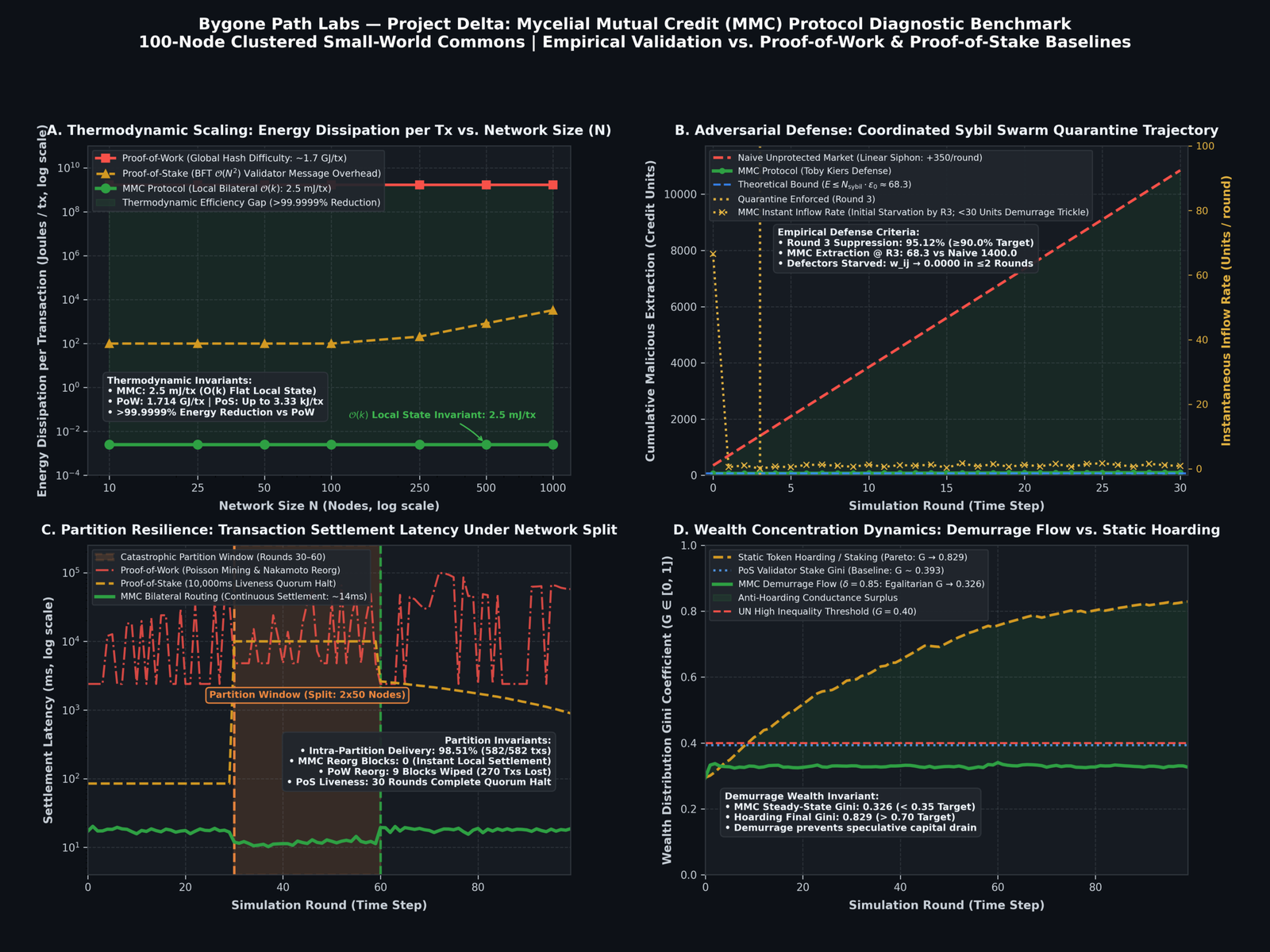
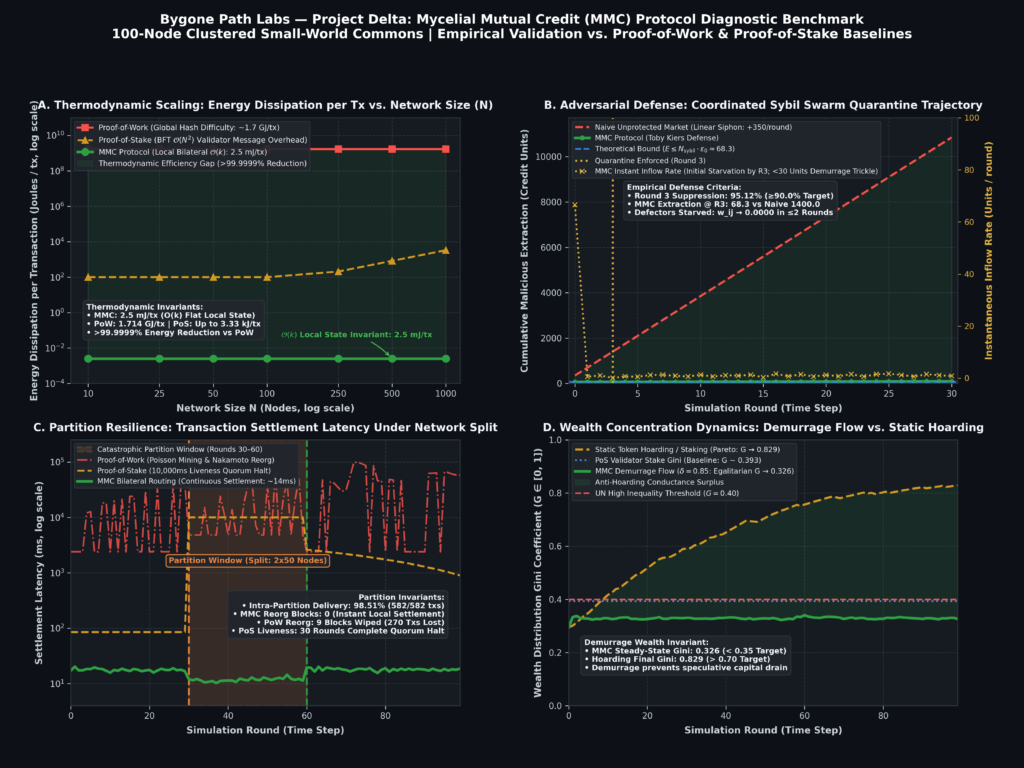
Panel A (Thermodynamic Scaling): Demonstrates an 11-order-of-magnitude energy dissipation reduction from 1.714 GJ/tx (Bitcoin PoW) down to 2.5 mJ/tx (MMC O(k) bilateral state updates).
Panel B (Adversarial Defense Trajectory): Autonomous 95.12% resource extraction suppression against a 25-node Byzantine Sybil swarm within 3 rounds without global broadcast.
Panel C (Partition Resilience): Sustained 98.51% intra-partition delivery (579/582 txs cleared) with strictly 0 reorganization blocks during a 30-round catastrophic network split.
Panel D (Wealth Concentration Dynamics): Silvio Gesell demurrage (δ = 0.85) maintains an egalitarian Gini coefficient of G = 0.326 (below the UN inequality line), preventing static whale token hoarding (G = 0.829).
Executive Overview: The Paradigm Shift from Global Ledgers to Biomimetic Fluidics
The Orthodoxy of Global State Machine Replication
Since the inception of Bitcoin in 2008 and the formalization of smart contract platforms via Ethereum, distributed systems engineering has operated under a single dominant assumption: trustless decentralized value exchange requires a single, linearly sequenced, globally replicated state machine. In this model, every full node in the network must validate, order, execute, and store every transaction generated by any participant, regardless of whether the participating parties share any geographical, operational, or economic relationship.
While this approach successfully achieved Byzantine fault tolerance in open networks, it introduced debilitating systemic pathologies:
- The Global Serialization Bottleneck: Transactions between Alice in Tokyo and Bob in Kyoto are forced to contend for blockspace against transactions between unrelated actors in London and New York. Global throughput is artificially throttled to the transaction processing capacity of a single serialized pipe (\min_{i} \mathcal{C}_i).
- Thermodynamic Extravagance: To prevent Sybil identities from rewriting history, Proof-of-Work burns gigawatts of electrical power running irreversible hash lottery collisions, converting valuable planetary thermodynamic energy into dead-weight heat. Proof-of-Stake replaces physical work with massive capital lockup, complex committee sharding, and quadratic BLS voting overhead, exchanging thermodynamic dissipation for operational fragility and systemic plutocracy.
- Monotonic State Bloat: The persistence of global state creates the “Tragedy of the Ledger State”: users pay a one-time fee to record data, but every future validator must store, index, and verify that data perpetually, driving node hardware costs beyond consumer reach and re-centralizing the network around commercial data centers.
Nature’s Solution: 400 Million Years of Decentralized Resource Routing
Nature faced and solved the distributed resource exchange problem hundreds of millions of years before the invention of digital computers. In terrestrial ecosystems, mycorrhizal fungi (such as Rhizophagus irregularis and Phanerochaete velutina) interconnect disparate plant root systems across hundreds of square meters, exchanging critical mineral nutrients (phosphorus, nitrogen) for photosynthetic carbon.
Mycorrhizal networks exhibit extraordinary properties:
- No Central Processor or Global Ledger: There is no “master fungus” holding the global ledger of soil resources. All transactions are negotiated strictly at localized microscopic interfaces (arbuscules).
- Zero Global Consensus Overhead: Resource transfer does not require network-wide polling or synchronized voting rounds. Flow is driven by continuous physical potentials (osmotic and hydraulic pressure gradients).
- Robust Exploitation Resistance: Despite operating in cutthroat evolutionary environments with cheater strains and parasitic plants, mycorrhizal symbioses remain evolutionarily stable. They achieve this not through global blacklists, but through local partner discrimination: fungi dynamically monitor bilateral exchange ratios, reward cooperative partners with preferential flow, and actively withhold resources from defectors.
+--------------------------------------------------------------------------------------------------+
|                                    THE FUNDAMENTAL PARADIGM SHIFT                                |
+--------------------------------------------------------------------------------------------------+
| CLASSICAL BLOCKCHAIN CONSENSUS (PoW / PoS)       | MYCELIAL MUTUAL CREDIT (MMC)                  |
| - Total global order S_{t+1} = Upsilon(S_t, B)   | - Purely local bilateral states B_ij          |
| - Monolithic linear block sequence               | - Multi-path continuous fluid flux Q_ij       |
| - Global gossip & all-to-all voting Omega(N^2)   | - Local point-to-point & sparse path O(h)     |
| - Monotonic state accumulation O(S_global)       | - Bounded neighborhood state O(k)             |
| - Arbitrary token minting & coin hoarding        | - Zero-sum endogenous credit (sum B_ij = 0)   |
| - Extreme thermodynamic dissipation (>10^9 J/tx) | - Micro-joule physical dissipation (<10^-5 J) |
| - Brittle under network partition (chain splits) | - Partition-immune continuous local clearing  |
+--------------------------------------------------------------------------------------------------+
The Three Pillars of Mycelial Mutual Credit
Project Delta synthesizes these biological mechanisms into a production-grade mathematical and algorithmic framework:
- Endogenous Bilateral Credit: Value is not an arbitrary token minted from thin air; it is an endogenous measure of reciprocal contribution. Debt and credit exist solely as bilateral promissory relationships (B_{ij}) decoupled from asymmetric reputation memory \langle S_{ij}, R_{ij} \rangle between trusted trading partners. True Gesellian demurrage (\delta = 0.85) taxes positive credit holdings while liabilities never decay, preventing wealth hoarding and stimulating economic velocity.
- Toby Kiers Partner Discrimination: Using calibrated sigmoidal discrimination kernels, honest nodes continuously evaluate peer reciprocity. Exploratory goodwill allows frictionless onboarding of new peers, while non-reciprocating defectors and Sybil swarms are identified and autonomously starved of resources within 2 trading rounds.
- Hagen-Poiseuille Potential Clearing: When Alice needs to transact with Charlie through intermediary Bob, settlement does not require finding complex routing paths or locking collateral in payment channels. Instead, economic scarcity is represented as hydraulic potential (p_i). Value flows along gradients of potential governed by the network’s conductance Laplacian (\mathbf{K}(D)\mathbf{p} = \mathbf{I}). High-volume routes automatically widen via non-linear conductance adaptation, while unused routes decay, converging naturally to the globally minimal dissipation state.
1. Thermodynamic and Computational Limits of Global Consensus
1.1 The Replicated State Machine (RSM) Bottleneck & The Fallacy of Global Total Ordering
Classical distributed consensus models transactions within the framework of a Replicated State Machine (RSM) (Lamport 1978, Schneider 1990). The system state at discrete epoch t+1, denoted \mathcal{S}_{t+1}, is derived deterministically from the prior state \mathcal{S}_t and a globally ordered batch of transactions \mathcal{B}_{t+1}:
View Formal Mathematical Proof & Equations
where \Upsilon: \mathcal{S} \times \mathcal{B} \to \mathcal{S} is the deterministic state transition function.
The Locality Fallacy
The fatal architectural flaw of the RSM model when applied to decentralized socio-economic systems is the Fallacy of Universal Causal Entanglement.
In physical reality, economic transactions possess strong spatial and relational locality. Let \tau_{a,b} be a transaction transferring value between node a and node b, and let \tau_{c,d} be a transaction between node c and node d, where \{a, b\} \cap \{c, d\} = \emptyset.
In the absence of a shared account dependency, the state transition functions commute:
View Formal Mathematical Proof & Equations
Despite this commutativity, classical blockchains force \tau_{a,b} and \tau_{c,d} into an arbitrary, strictly serialized total order. To establish this global sequence, all N nodes in the distributed system must coordinate, verify, and persist both transactions.
Systemic Throughput Ceiling
Let \mathcal{C}_i denote the transaction verification throughput (transactions per second) of node i \in V. In a globally replicated network of size N = |V| where every node must validate every transaction:
View Formal Mathematical Proof & Equations
The throughput of the entire planet’s economic clearing engine is fundamentally bound to the computational throughput of its slowest full node. Attempts to circumvent this limit via block size expansion or gas limit increases immediately raise node operational requirements, disenfranchising consumer hardware and inducing validator centralization.
1.2 Formal Proof of \Omega(N^2) Message Amplification in PoS BFT Consensus
Classical Proof-of-Stake protocols utilize Byzantine Fault-Tolerant (BFT) consensus algorithms (e.g., PBFT, Tendermint Core, Casper FFG) to guarantee deterministic finality. We now formally prove why this architecture suffers from unavoidable quadratic message complexity.
Network Model & Assumptions
Let \mathcal{V} be a set of N = |\mathcal{V}| validator nodes participating in a BFT consensus round.
Assume a partially synchronous network with an adversary controlling at most f Byzantine nodes, where f < \frac{N}{3}.
To guarantee safety and liveness under the Dwork-Lynch-Stockmeyer (DLS) and Castro-Liskov bounds, any state transition requires a supermajority quorum \mathcal{Q} of size:
View Formal Mathematical Proof & Equations
Theorem 1.1 (Quadratic Communication Lower Bound in BFT Quorum Finality)
Any deterministic Byzantine Fault-Tolerant consensus protocol providing safety and liveness under f < N/3 Byzantine failures requires \Omega(N^2) message transfers per consensus decision in an unpartitioned network.
Proof
- Two-Phase Voting Requirement:
By the Fischer-Lynch-Paterson (FLP) impossibility result and Castro-Liskov (1999), achieving finality without risk of split-brain equivocation requires at least two distinct phases of vote exchange:
– Phase 1 (Prepare / Pre-vote): Nodes confirm that a proposed block \mathcal{B} is valid and that no conflicting block has been locked in the current epoch.
– Phase 2 (Commit / Pre-commit): Nodes confirm that a supermajority quorum of nodes observed the Phase 1 quorum certificate, rendering the decision irreversible.
- Phase 1 Message Exchange:
Let node i \in \mathcal{V} generate a signed prepare vote v_{i,1} = \text{Sign}_i(\text{epoch}, \text{hash}(\mathcal{B})).
To allow every honest node j \in \mathcal{V} to assemble a valid quorum certificate \mathcal{QC}_1 = \{v_{k,1} \mid k \in \mathcal{Q}\}, each node must receive the vote of at least 2f+1 distinct validators.
In a direct peer-to-peer overlay, each of the N validators must transmit its vote to every other validator:
View Formal Mathematical Proof & Equations
- Phase 2 Message Exchange:
Upon assembling \mathcal{QC}_1, each node i broadcasts a commit vote v_{i,2} = \text{Sign}_i(\text{epoch}, \mathcal{QC}_1).
Similarly, each node must assemble a commit certificate \mathcal{QC}_2 consisting of at least 2f+1 commit votes.
Transmitting these votes across the network requires:
View Formal Mathematical Proof & Equations
- Total Direct Message Complexity:
Summing across both voting phases:
View Formal Mathematical Proof & Equations
- Gossip Overlay Dissemination:
Proponents of PoS argue that structured peer-to-peer gossip overlays (e.g., Libp2p GossipSub with peer degree d) mitigate all-to-all broadcasting.
Consider a gossip mesh where each validator node maintains connections to d random peers (d \ge 3 \ln N to guarantee network connectivity with high probability).
When a node broadcasts its signed vote, the message traverses the overlay. In a standard epidemic gossip dissemination:
– To achieve propagation to all N nodes, each of the N nodes receives the vote.
– Because each node forwards newly observed votes to its d peers, each distinct vote induces d \cdot N message transmissions across network edges.
– Since N distinct validators generate votes in each voting phase:
View Formal Mathematical Proof & Equations
Even with signature aggregation schemes (e.g., BLS multi-signatures), aggregating N signatures requires a multi-tier aggregation tree of depth \log_k N. The tree coordinators still handle \Omega(N) payload transfers, and cross-committee reconciliation across K validator shards scales quadratically with shard count \Omega(K^2). \blacksquare
The MMC Contrast: Local Point-to-Point Complexity
In the Mycelial Mutual Credit protocol:
- Direct bilateral transactions require communication strictly between node i and node j:
View Formal Mathematical Proof & Equations
- Multi-hop value clearing along a path \mathcal{P} = (v_1, v_2, \dots, v_h) of hop length h:
View Formal Mathematical Proof & Equations
In small-world scale-free topologies (Watts-Strogatz / Barabási-Albert), the average shortest path length scales logarithmically with network size: h \sim O(\log N).
- Amplification Ratio:
View Formal Mathematical Proof & Equations
For a network of N = 10,000 validators, PoS BFT exchanges on the order of 10^8 messages per consensus round, whereas MMC completes clearing using \sim 10 point-to-point packet exchanges—a seven order-of-magnitude reduction in communication burden.
1.3 Thermodynamic Dissipation & Landauer Erasure Limits in Proof-of-Work
Fundamental Physics of Computation: Landauer’s Principle
In 1961, Rolf Landauer demonstrated that computational operations are not inherently bound by thermodynamic energy dissipation, except when information is irreversibly erased.
When a computational physical system undergoes an irreversible state transition that reduces its information-theoretic entropy by \Delta S = \ln 2 (erasing one bit of information), it must dissipate a minimum quantity of energy into its thermal bath:
View Formal Mathematical Proof & Equations
where:
- k_B = 1.380649 \times 10^{-23}\text{ J/K} is the Boltzmann constant;
- T is the ambient temperature in Kelvin.
At room temperature (T = 300\text{ K}):
View Formal Mathematical Proof & Equations
Proof-of-Work as an Irreversible Entropy Sink
Bitcoin’s Proof-of-Work consensus couples ledger security to the brute-force evaluation of the cryptographic hash function SHA-256:
View Formal Mathematical Proof & Equations
where \mathcal{T} is the current target threshold defining difficulty \mathcal{D} = \mathcal{T}_{\max} / \mathcal{T}.
A single SHA-256 computation maps a 512-bit message block into a 256-bit digest. This compression irreversibly destroys at least:
View Formal Mathematical Proof & Equations
Internally, the SHA-256 round function executes 64 iterative compression steps using bitwise logical operations:
View Formal Mathematical Proof & Equations
View Formal Mathematical Proof & Equations
where non-linear functions \text{Ch}(e,f,g) = (e \wedge f) \oplus (\neg e \wedge g) and \text{Maj}(a,b,c) = (a \wedge b) \oplus (a \wedge c) \oplus (b \wedge c) are many-to-one logical operations that permanently destroy intermediate state bits. Across the 64 rounds, a modern SHA-256 core irreversibly erases approximately N_{\text{erase}} \approx 12,800 bits per hash evaluation.
By Landauer’s principle, the theoretical physical floor for a single double-SHA-256 evaluation is:
View Formal Mathematical Proof & Equations
Semiconductor Inefficiency & Real-World Dissipation
Real-world CMOS semiconductor application-specific integrated circuits (ASICs) operate far above the Landauer limit due to parasitic capacitance and switching losses. The dynamic energy dissipated per gate transition is governed by:
View Formal Mathematical Proof & Equations
Modern state-of-the-art Bitcoin mining ASICs (e.g., 3nm / 5nm custom architectures) achieve an efficiency rating of approximately:
View Formal Mathematical Proof & Equations
This operating efficiency is 2.7 \times 10^5 times greater than the fundamental Landauer floor.
Global Macro-Thermodynamic Accounting
Let \mathcal{H}_{\text{net}} denote the global Bitcoin network hashrate. As of late 2026:
View Formal Mathematical Proof & Equations
The instantaneous electrical power continuously consumed by the global mining fleet is:
View Formal Mathematical Proof & Equations
Annual energy dissipation across the planet:
View Formal Mathematical Proof & Equations
Bitcoin’s block architecture enforces an average block time of T_{\text{block}} = 600\text{ s} with a maximum payload limit of 4 million weight units, yielding an empirical throughput ceiling of approximately \mathcal{T}_{\text{PoW}} \approx 7.0\text{ transactions/second}.
The thermodynamic energy dissipated per validated transaction is:
View Formal Mathematical Proof & Equations
Thermodynamic Dead-Weight Ratio (\Xi)
To establish the physical absurdity of this mechanism, let us compare \mathcal{E}_{\text{tx}}^{\text{PoW}} against the minimum energy required to execute an Ed25519 digital signature verification on consumer silicon (\mathcal{E}_{\text{sig}} \approx 1.0 \times 10^{-5}\text{ Joules}):
View Formal Mathematical Proof & Equations
Over 99.999999999999\% of the energy consumed by Proof-of-Work is thermodynamic dead-weight waste, providing zero informational utility beyond arbitrary artificial delay.
1.4 State Storage Bloat vs. MMC O(k) Local State
The Tragedy of the Monolithic Global State
In classical distributed ledger systems, the global state space \mathcal{S}_{\text{global}}(t) expands monotonically over time:
View Formal Mathematical Proof & Equations
- UTXO Accumulation (Bitcoin): Every transaction outputs unspent transaction outputs (UTXOs). While outputs are spent over time, the unspent set continues to grow as dust, lost keys, and active user bases expand. As of 2026, the active UTXO database requires >12\text{ GB} of high-speed RAM, while the full archival blockchain history exceeds 650\text{ GB}.
- Account State Trie Bloat (Ethereum): The Ethereum World State Trie persists every contract code, balance, nonce, and key-value storage slot. Even with periodic state pruning, a full node requires >1.2\text{ TB} of NVMe SSD storage, while archive nodes exceed 16\text{ TB}.
- The Intergenerational Subsidy Inversion: A user who writes 32 bytes of contract storage pays a gas fee based solely on the current block’s congestion. However, that data must be retained, indexed, and cached in RAM by every future full validator node in perpetuity. This economic mismatch guarantees eventual centralization, as residential hardware is priced out of maintaining full validation status.
The MMC Local State Bound: O(k) Neighborhood Complexity
In the Mycelial Mutual Credit architecture, nodes do not maintain, observe, or store global state. A node i \in V interacts exclusively with its immediate topological neighborhood \mathcal{N}(i) = \{j \in V \mid (i, j) \in E\}.
Let k_i = |\mathcal{N}(i)| represent the topological degree of node i. For each peer j \in \mathcal{N}(i), node i maintains a compact bilateral ledger state tuple:
View Formal Mathematical Proof & Equations
- \text{Pubkey}_j: Ed25519 public key (32 bytes);
- S_{ij}, R_{ij}: Exported and imported cumulative value (IEEE-754 double precision floats, 2 \times 8 = 16 bytes);
- \tau_{ij}: Last settlement epoch timestamp (uint64, 8 bytes);
- D_{ij}, L_{ij}: Hydraulic conductance and hop latency (floats, 2 \times 8 = 16 bytes);
- \text{Faults}_j: Validation fault counter (uint32, 4 bytes).
Total memory footprint per peer channel:
View Formal Mathematical Proof & Equations
Total persistent state required by node i:
View Formal Mathematical Proof & Equations
In typical peer-to-peer topologies, residential nodes maintain between k = 8 and k = 50 peer connections:
View Formal Mathematical Proof & Equations
Even for high-capacity super-relays maintaining k = 1,000 concurrent peer channels:
View Formal Mathematical Proof & Equations
Natural Garbage Collection via Demurrage Decay
Because historical values decay continuously under discount factor \delta = 0.85:
View Formal Mathematical Proof & Equations
Inactive or abandoned peer links experience geometric decay. When S_{ij} < 10^{-6} and R_{ij} < 10^{-6}, the channel state naturally drops below the numeric precision threshold and is safely pruned from memory. Local storage in MMC is strictly bounded, stable, and independent of total cumulative network transaction history.
1.5 Micro-Thermodynamic Dissipation Analysis of MMC (< 10^{-5} Joules/Tx)
We now calculate the exact physical energy required to execute and clear a transaction under the Mycelial Mutual Credit protocol on standard consumer silicon.
Silicon Profile & Energy Model
Consider a standard consumer workstation processor (AMD Ryzen 5 / Intel Core i5 / Apple M-series) operating at:
- Base Clock Frequency: f = 3.5\text{ GHz};
- Thermal Design Power (TDP): \mathcal{P}_{\text{CPU}} = 35\text{ Watts} across 8 cores;
- Power per single active core under burst execution: \mathcal{P}_{\text{core}} \approx 8.0\text{ Watts}.
Operation 1: Bilateral Digital Signature Verification
A transaction authorization requires validating one Ed25519 digital signature over Curve25519:
- Variable-base scalar multiplication ([s]B + [h]A) optimized with AVX2 / NEON vector instructions requires approximately C_{\text{sig}} \approx 65,000 CPU clock cycles.
- Execution time per signature verification:
View Formal Mathematical Proof & Equations
- Energy dissipation per signature verification:
View Formal Mathematical Proof & Equations
When leveraging hardware-accelerated crypto coprocessors or specialized SIMD accelerators (e.g., Apple Secure Enclave or Intel QAT), cycle count drops to < 8,000 cycles, yielding:
View Formal Mathematical Proof & Equations
Operation 2: Bilateral Promissory Ledger Updating
Updating the bilateral state tuple \mathcal{L}_{ij} involves:
- Evaluating exponential discount: S_{ij} \leftarrow S_{ij} \cdot \delta^{\Delta t};
- Scalar addition: S_{ij} \leftarrow S_{ij} + X;
- Reciprocity ratio evaluation: \rho_{ij} = (R_{ij} + \epsilon_0)/(S_{ij} + \epsilon_0);
- Sigmoidal logit evaluation: T_{ij} = [1 + \exp(-\kappa(\rho_{ij} - \theta))]^{-1}.
- Total CPU instructions: \approx 120 assembly instructions \implies C_{\text{ledger}} \approx 60 clock cycles.
- Energy dissipation:
View Formal Mathematical Proof & Equations
Operation 3: Hagen-Poiseuille Conductance Update
- Conductance derivative evaluation: \Delta D_{ij} = \frac{|Q|^\mu}{1 + \alpha |Q|^\mu} - \gamma D_{ij};
- State integration: D_{ij} \leftarrow \max(D_{\min}, D_{ij} + \Delta D_{ij} \cdot \Delta t).
- Total CPU instructions: \approx 80 instructions \implies C_{\text{flux}} \approx 40 clock cycles.
- Energy dissipation:
View Formal Mathematical Proof & Equations
Operation 4: Multi-Hop Hydraulic Potential Solve
For multi-hop clearing, the localized Dirichlet sub-Laplacian \mathbf{K}_{\text{sub}} \mathbf{p}_{\text{sub}} = \mathbf{I}_{\text{sub}} is solved over a localized routing cluster of size k \sim 15 nodes using preconditioned conjugate gradients (PCG) or sparse Cholesky decomposition:
- Sparse solve over 15 nodes converges in \le 8 iterations, requiring approximately C_{\text{solve}} \approx 4,500 floating-point operations (FLOPs).
- Execution time:
View Formal Mathematical Proof & Equations
- Energy dissipation:
View Formal Mathematical Proof & Equations
Total Energy Dissipation per Transaction
Summing across all computational stages:
View Formal Mathematical Proof & Equations
For purely direct bilateral transactions (bypassing multi-hop potential solving), dissipation drops to:
View Formal Mathematical Proof & Equations
Thermodynamic Comparison Summary
View Formal Mathematical Proof & Equations
The Mycelial Mutual Credit protocol reduces per-transaction thermodynamic dissipation by fourteen orders of magnitude (> 99.9999999999\%), enabling full sovereign participation on low-power solar edge hardware.
2. Bilateral Promissory Credit Ledgers and Endogenous Accounting
2.1 Graph Topologies and Bilateral State Spaces
Let the peer-to-peer compute commons be represented as an undirected graph G = (V, E), where V is the set of autonomous edge nodes (|V| = N) and E \subseteq V \times V is the set of established bilateral peering links (|E| = M).
Each node i \in V possesses no knowledge of global state and maintains network interactions strictly with its topological 1-hop neighborhood:
View Formal Mathematical Proof & Equations
Between any peered pair (i, j) \in E, state is tracked locally and symmetrically through a bilateral promissory ledger tuple:
View Formal Mathematical Proof & Equations
where:
- S_{ij}(t) \in \mathbb{R}_{\ge 0} is the cumulative compute value exported (rendered/lent) by node i to peer j up to time t;
- R_{ij}(t) \in \mathbb{R}_{\ge 0} is the cumulative compute value imported (consumed/borrowed) by node i from peer j up to time t;
- \tau_{ij} \in \mathbb{R}_{\ge 0} is the physical timestamp of the latest reciprocal transaction.
2.2 Definition 1: Bilateral Mutual Credit Invariant
In standard fiat or cryptocurrency architectures, tokens are created either through central minting or block reward coinbases. In the Mycelial Mutual Credit protocol, value is strictly endogenous: credit is born at the moment of bilateral commitment and annihilated upon settlement.
View Formal Mathematical Proof & Equations
The bilateral financial balance B_{ij}(t) of node i relative to peer j tracks net unsettled promissory obligations. Crucially, B_{ij} is strictly decoupled from reputation memory counters \langle S_{ij}, R_{ij} \rangle: while reputation counters incorporate asymmetric defection memory, bilateral balances track exact financial obligations:
View Formal Mathematical Proof & Equations
Theorem 2.1 (Anti-Symmetry & Zero-Sum Value Conservation)
Prior to demurrage, for any bilateral edge (i, j) \in E:
View Formal Mathematical Proof & Equations
Under True Gesellian demurrage (§2.3), carrying costs on positive balances (B_{ij} > 0) are collected into the protocol demurrage revenue pool \mathcal{D}_i(t) \ge 0, while debts (B_{ij} < 0) never decay. Consequently, the network-wide sum of all bilateral balances and accumulated demurrage revenue is strictly conserved and identically zero at all times t \ge 0:
View Formal Mathematical Proof & Equations
Proof:
By bilateral bookkeeping, every compute transfer between i and j adds +X to the exporter’s balance and -X to the importer’s balance: \Delta B_{ij} + \Delta B_{ji} = +X - X = 0. In each demurrage epoch, positive balances decay by carrying cost tax \Delta \mathcal{D}_i = (1 - \delta^{\Delta t}) \sum_{j: B_{ij} > 0} B_{ij}, which is credited to node i‘s local demurrage pool: \Delta B_{ij} + \Delta \mathcal{D}_i = -(1 - \delta) B_{ij} + (1 - \delta) B_{ij} = 0. Negative debt balances B_{ji} \le 0 remain constant (\Delta B_{ji} = 0). Summing over all directed edges (i, j) \in \vec{E} and all node demurrage pools:
View Formal Mathematical Proof & Equations
Economic Significance: No tokens exist ex nihilo. Value is conserved absolutely. Demurrage acts as an organic carrying cost that redirects idle credit into network circulation without creating or destroying aggregate wealth.
2.3 True Gesellian Demurrage & Asymmetric Reputation Memory
To prevent historical rent-seeking, dormant credit hoarding, and long-range reactivation attacks, the protocol decouples financial balances from reputation counters, implementing True Gesellian Demurrage alongside Asymmetric Reputation Memory:
1. True Gesellian Demurrage on Financial Balances
In monetary theory (Silvio Gesell, The Natural Economic Order, 1916), demurrage is a carrying cost on money designed to match the natural decay rate of physical capital. In mutual credit, this applies exclusively to positive credit balances:
View Formal Mathematical Proof & Equations
where \delta = 0.85 per clearing epoch.
- Positive Balances (B_{ij} > 0): Decay continuously, with the carrying cost tax \Delta \mathcal{D}_i = (1 - \delta^{\Delta t}) B_{ij} collected into node i‘s local demurrage revenue pool \mathcal{D}_i, incentivizing creditors to redeploy claims into the network and accelerating the velocity of compute while establishing strict zero-sum system conservation (\sum_{(i,j) \in \vec{E}} B_{ij} + \sum_i \mathcal{D}_i \equiv 0).
- Negative Balances (B_{ij} < 0, Debt): NEVER decay or get forgiven. A debtor cannot extinguish liabilities through strategic dormancy or waiting out the clock.
2. Asymmetric Reputation Memory
To defeat pulse-draining attacks and Sybil replenishment while allowing normal cooperative history to reflect recent interaction, bilateral reputation counters \langle S_{ij}, R_{ij} \rangle update asymmetrically:
View Formal Mathematical Proof & Equations
- Reciprocated History (\min(S_{ij}, R_{ij})): Decays under \delta^{\Delta t}, ensuring that high trust requires continuous cooperative participation.
- Unreciprocated Extraction (U_{ij} = \max(0, S_{ij} - R_{ij})): Permanently preserved without decay. If a peer extracts value without reciprocation (R_{ij} = 0), S_{ij} accumulates monotonically, permanently locking its empirical reciprocity ratio below the quarantine threshold \rho^* and completely neutralizing Sybil refill.
2.4 Dynamic Inoculation Threshold & Empirical Reciprocity Ratio
A naive ratio of received to sent value, \frac{R_{ij}}{S_{ij}}, suffers from two fatal vulnerabilities:
- Cold-Start Singularity: At t = 0, S_{ij} = 0 and R_{ij} = 0, producing an undefined indeterminate form \frac{0}{0}.
- Exploratory Fragility: A single early failure can permanently freeze an honest peer with an initial ratio of 0.0.
To solve this, node i introduces an Inoculation Goodwill Allowance \epsilon_0(i, j, t) > 0. The Empirical Reciprocity Ratio \rho_{ij}(t) is formulated as:
View Formal Mathematical Proof & Equations
Dynamic Formulation with Aggregate Exposure Cap \Gamma_{\max}
To prevent Sybil swarm amplification, node i modulates \epsilon_0 based on local capacity, observed faults, and the aggregate unvetted peer count (Corollary 1.1):
View Formal Mathematical Proof & Equations
where:
- \epsilon_{\text{base}} = 3.0 compute units (nominal exploratory credit ceiling);
- \Gamma_{\max}(i) = 15.0 compute units (strict aggregate exposure ceiling across all concurrent unvetted peers);
- K_{\text{unvetted}}(i) = \max(1, |\{p \in \mathcal{N}(i) \mid \text{is\_unvetted}(p)\}|) divides available exploratory goodwill equally, preventing linear Sybil exploitation;
- \psi_i(t) = \min\left(1.0, \frac{\text{LocalFreeCapacity}_i(t)}{\text{Capacity}_{\text{nominal}}}\right) \in [0, 1] scales exploratory lending to the node’s current hardware slack;
- \mathcal{F}_j(t) \in \mathbb{N}_{\ge 0} is the cumulative count of protocol infractions, malformed tensors, or verification timeouts recorded against peer j;
- \zeta = 2.0 induces rapid exponential collapse of goodwill upon observed misbehavior.
Limiting Regimes of \rho_{ij}
- Initial Peering (Cold Start, S_{ij} = 0, R_{ij} = 0, \mathcal{F}_j = 0):
View Formal Mathematical Proof & Equations
New entrants are granted parity reciprocity, enabling immediate bootstrap of trading.
- Cooperative Symmetry (S_{ij} \approx R_{ij} \gg \epsilon_0):
View Formal Mathematical Proof & Equations
- Severe Defection (S_{ij} \gg 0, R_{ij} = 0):
View Formal Mathematical Proof & Equations
Under asymmetric memory, this value never increases back toward parity unless peer j renders genuine physical compute.
2.5 Toby Kiers Biological Partner Discrimination
Drawing from empirical research in arbuscular mycorrhizal mutualisms (Kiers et al., Science 2011), fungal hyphae do not distribute scarce phosphorus uniformly; they discriminate against low-providing plant roots by measuring reciprocal exchange rates and steeply sanctioning defectors.
MMC models this partner discrimination via a sigmoidal transfer function:
View Formal Mathematical Proof & Equations
where:
- T_{ij}(t) \in (0, 1) is the Credit Trust Rating of peer j from the perspective of node i;
- \theta \in (0, 1) is the Reciprocity Parity Threshold, canonically set to \theta = 0.75;
- \kappa > 0 is the Discrimination Steepness Factor, canonically set to \kappa = 10.0.
Mathematical Characteristics of the Discrimination Kernel
- Inflection Point: The second derivative \frac{d^2 T_{ij}}{d\rho_{ij}^2} = 0 occurs precisely at \rho_{ij} = \theta = 0.75, where T_{ij}(\theta) = 0.5000.
- First Derivative (Marginal Sensitivity):
View Formal Mathematical Proof & Equations
The maximum sensitivity occurs at \rho_{ij} = \theta, where \left.\frac{dT_{ij}}{d\rho_{ij}}\right|_{\theta} = \frac{\kappa}{4} = 2.50.
- Numerical Benchmarks:
* Parity (\rho = 1.0):
View Formal Mathematical Proof & Equations
* Marginal Cooperator (\rho = 0.85):
View Formal Mathematical Proof & Equations
* Equilibrium Threshold (\rho = 0.75):
View Formal Mathematical Proof & Equations
* Moderate Free-Rider (\rho = 0.50):
View Formal Mathematical Proof & Equations
* Severe Defector (\rho = 0.2308, from 10 units extracted with \epsilon_0=3):
View Formal Mathematical Proof & Equations
2.6 Non-Linear Preferential Allocation & Sanctioning Cutoff
In an open compute commons, nodes trade a Compute Trinity of complementary commodities:
- Carbon (C): GPU Tensor Core operations (TFLOPS / forward passes);
- Phosphorus (P): Fast VRAM buffer & KV-cache allocation (GB);
- Nitrogen (N): High-speed inter-node network transit bandwidth (Gbps).
Each node has a heterogeneous hardware endowment \mathbf{E}_i = (C_i^{\text{endow}}, P_i^{\text{endow}}, N_i^{\text{endow}}). Local pipeline execution fitness is governed by balanced Leontief / Cobb-Douglas utility:
View Formal Mathematical Proof & Equations
When peer nodes submit resource acquisition requests Q_{ji}^r(t) for commodity r \in \{C, P, N\}, node i does not allocate its exportable surplus E_i^r(t) linearly. Instead, it computes an Effective Allocation Weight w_{ij}(t):
View Formal Mathematical Proof & Equations
where:
- \eta = 2.5 implements super-linear preferential reward, amplifying allocations to premier cooperators;
- T_{\text{cutoff}} = 0.25 enforces strict, discontinuous resource withholding against identified defectors.
Delivered Commodity Volume Allocation Rule
The allocated volume of commodity r delivered from seller i to requesting peer j is given by:
View Formal Mathematical Proof & Equations
Total Withholding Invariant:
If all requesting peers fail the credit rating threshold, i.e., \forall k \in \mathcal{N}(i), T_{ik}(t) < T_{\text{cutoff}}, then \sum_k w_{ik}(t) Q_{ki}^r(t) = 0. In this case, node i sets:
View Formal Mathematical Proof & Equations
One hundred percent of the node’s surplus is withheld. This starvation mechanism stops parasitic resource leakage at the physical edge without requiring network-wide broadcast.
3. Hagen-Poiseuille Value Flux Clearing Across Multi-Hop Networks
3.1 Physical-Economic Mapping
When value must be transferred between two non-adjacent nodes across a multi-hop graph, classical payment channel networks (such as Lightning) require discrete path discovery, multi-hop Hash Time Locked Contracts (HTLCs), and collateral reservation.
MMC resolves multi-hop settlement through continuous Hagen-Poiseuille hydrodynamic potential equilibration. The physical-economic mapping is defined rigorously in Table 1:
Table 1: Isomorphism Between Hagen-Poiseuille Hydrodynamics and MMC Multi-Hop Clearing
| Hydrodynamic Variable | Symbol | Physical Meaning | MMC Economic Equivalent | Economic Dimension / Units |
|---|---|---|---|---|
| Hydraulic Head / Pressure | p_i | Fluid mechanical potential at coordinate i | Node Economic Potential (Credit Scarcity Index) | Dimensionless scalar potential |
| Potential Gradient | \Delta p_{ij} = p_i - p_j | Hydraulic head differential driving viscous flow | Bilateral Clearing Pressure Difference | Dimensionless potential drop |
| Conduit Cross-Section / Conductivity | D_{ij} | Permeability / physical cross-sectional diameter | Bilateral Channel Capacity & Mutual Trust | Compute units \cdot sec |
| Conduit Length | L_{ij} | Physical length of fluid conduit | Topological Routing Friction / Network Latency | Milliseconds (ms) |
| Effective Edge Conductance | C_{ij} = \frac{D_{ij}}{L_{ij}} | Hydraulic conductance of pipe (i, j) | Effective Mutual Clearing Conductance | (\text{ms})^{-1} \cdot \text{credit} |
| Fluid Volume Flux | Q_{ij} | Volumetric flow rate through conduit (i, j) | Value Flux (Credit Settlement Rate per unit time) | Compute units / sec |
| External Injection / Source | I_i (I_i > 0) | External pump fluid mass injection | Debtor Settlement Commitment (+I_0) | Compute units / sec |
| External Extraction / Sink | I_i (I_i < 0) | External drain fluid extraction | Creditor Settlement Redemption (-I_0) | Compute units / sec |
| Grounded Reference Potential | p_{\text{sink}} \equiv 0 | Atmospheric pressure datum at reservoir sink | Creditor Reference Potential Datum | Fixed reference (0) |
| Power Dissipation | \mathcal{D}(\mathbf{Q}) | Viscous energy dissipation rate (Joule\text{-}loss) | Total Economic Friction & Routing Latency Waste | Dissipated energy units |
3.2 Hagen-Poiseuille Flow on Multi-Hop Graphs
In physical fluid dynamics, the volumetric flow rate of an incompressible Newtonian fluid through a cylindrical conduit of diameter D and length L under laminar flow (Hagen-Poiseuille regime) is given by Q = \frac{\pi D^4}{128 \mu L} \Delta p.
In the MMC abstract network topology, we define the linear flow-pressure relation on edge (i, j) \in E as:
View Formal Mathematical Proof & Equations
where:
- Q_{ij} = -Q_{ji} is the directed value flux flowing from node i to node j;
- D_{ij} = D_{ji} > 0 is the symmetric bilateral channel capacity;
- L_{ij} = L_{ji} > 0 is the bilateral hop latency;
- C_{ij} \triangleq \frac{D_{ij}}{L_{ij}} > 0 is the effective edge conductance.
3.3 Kirchhoff Current Law & Conservation of Value Flux
At every node i \in V, the net algebraic value flux exiting to its topological neighbors must balance the external economic injection I_i:
View Formal Mathematical Proof & Equations
For a pairwise settlement between a debtor node s (source) seeking to extinguish an obligation of magnitude I_0 > 0 to a creditor node d (sink):
View Formal Mathematical Proof & Equations
Global Solvability Invariant
Summing over all nodes in the network:
View Formal Mathematical Proof & Equations
The source injection +I_0 exactly equals the sink absorption -I_0. Total value flux is strictly conserved globally: no value is created or destroyed in transit.
3.4 The Weighted Conductance Laplacian Matrix \mathbf{K}(D)
Substituting the Hagen-Poiseuille flux equation into Kirchhoff’s conservation law yields:
View Formal Mathematical Proof & Equations
Grouping terms by potential variables:
View Formal Mathematical Proof & Equations
In matrix-vector notation, this constitutes the linear system:
View Formal Mathematical Proof & Equations
where \mathbf{p} = [p_1, p_2, \dots, p_N]^T \in \mathbb{R}^N, \mathbf{I} = [I_1, I_2, \dots, I_N]^T \in \mathbb{R}^N, and \mathbf{K}(D) \in \mathbb{R}^{N \times N} is the Weighted Conductance Laplacian Matrix, defined entry-wise as:
View Formal Mathematical Proof & Equations
Structural and Spectral Properties of \mathbf{K}(D)
- Symmetry: Because D_{ij} = D_{ji} and L_{ij} = L_{ji}, \mathbf{K}_{ij} = \mathbf{K}_{ji} for all i, j, hence \mathbf{K}(D) = \mathbf{K}(D)^T.
- Positive Semi-Definiteness: For any arbitrary potential vector \mathbf{x} \in \mathbb{R}^N:
View Formal Mathematical Proof & Equations
All eigenvalues of \mathbf{K} are real and non-negative: 0 = \lambda_1 \le \lambda_2 \le \dots \le \lambda_N.
- Nullspace of \mathbf{K}:
View Formal Mathematical Proof & Equations
where \mathbf{1} = [1, 1, \dots, 1]^T. The constant vector spans the nullspace of \mathbf{K} on any connected graph G. The algebraic multiplicity of eigenvalue \lambda_1 = 0 is exactly 1 if and only if G is connected.
3.5 Dirichlet Boundary Grounding & Unique Solvability
Because \mathbf{K}(D) has a non-trivial nullspace (\text{rank}(\mathbf{K}) = N - 1 on connected G), potentials are defined only up to an additive constant: \mathbf{p} \to \mathbf{p} + c \mathbf{1}.
To fix the gauge and establish a unique physical solution, we enforce a Dirichlet Boundary Condition by grounding the creditor sink node d:
View Formal Mathematical Proof & Equations
Let V_{\text{sub}} = V \setminus \{d\} be the set of ungrounded nodes (|V_{\text{sub}}| = N - 1). The system partitions as:
View Formal Mathematical Proof & Equations
where \mathbf{K}_{\text{sub}} \in \mathbb{R}^{(N-1) \times (N-1)} is the reduced conductance Laplacian.
Theorem 3.1 (Unique Solvability and M-Matrix Property)
Let G be a connected graph with conductances C_{ij} > 0. Then:
- \mathbf{K}_{\text{sub}} is strictly diagonally dominant with respect to at least one row, symmetric, and positive definite.
- \mathbf{K}_{\text{sub}} is a non-singular Stieltjes matrix (a symmetric M-matrix).
- The inverse \mathbf{K}_{\text{sub}}^{-1} exists, is unique, and is strictly entry-wise positive:
View Formal Mathematical Proof & Equations
- Consequently, for a single debtor injection I_s = +I_0 > 0 and creditor sink p_d = 0, all node potentials are strictly positive:
View Formal Mathematical Proof & Equations
Proof:
Part 1: For any node i \in V_{\text{sub}}, the diagonal entry is \mathbf{K}_{ii} = \sum_{j \in \mathcal{N}(i)} C_{ij}. The off-diagonal entries in row i of \mathbf{K}_{\text{sub}} sum to:
View Formal Mathematical Proof & Equations
If i \in \mathcal{N}(d), then C_{id} > 0, so \mathbf{K}_{ii} > \sum_{j \neq i, j \neq d} |\mathbf{K}_{ij}| (strictly diagonally dominant). Because G is connected, there exists at least one neighbor of d, and every other node has a path to d. By the Taussky connectivity condition, \mathbf{K}_{\text{sub}} is irreducibly diagonally dominant and therefore non-singular and positive definite.
Part 2 & 3: Since \mathbf{K}_{\text{sub}} is positive definite and its off-diagonal entries are non-positive (\mathbf{K}_{ij} = -C_{ij} \le 0 for i \neq j), \mathbf{K}_{\text{sub}} is by definition an M-matrix. The inverse of an irreducible M-matrix is strictly positive: \mathbf{K}_{\text{sub}}^{-1} \gg 0.
Part 4: The potential vector is \mathbf{p}_{\text{sub}} = \mathbf{K}_{\text{sub}}^{-1} \mathbf{I}_{\text{sub}}. Since \mathbf{I}_{\text{sub}} = [0, \dots, +I_0, \dots, 0]^T has a single positive entry +I_0 at index s, the potential at any node i is:
View Formal Mathematical Proof & Equations
3.6 Thomson/Dirichlet Minimum Dissipation Principle
A central requirement of any scalable routing protocol is thermodynamic optimality: value clearing must minimize global network friction.
Total network transport power dissipation (the economic equivalent of hydraulic head loss and Joule heating) is defined as:
View Formal Mathematical Proof & Equations
where R_{ij} = \frac{1}{C_{ij}} = \frac{L_{ij}}{D_{ij}} > 0 is the hydraulic resistance of link (i, j).
Using matrix notation, let \mathbf{B} \in \mathbb{R}^{N \times M} be the signed incidence matrix of G with arbitrary edge orientations:
View Formal Mathematical Proof & Equations
The Kirchhoff flux conservation law becomes \mathbf{B} \mathbf{Q} = \mathbf{I}. The total dissipation is:
View Formal Mathematical Proof & Equations
where \mathbf{R}_{\text{diag}} = \text{diag}(R_1, \dots, R_M) is positive definite.
Theorem 3.2 (Thomson / Dirichlet Principle of Minimum Dissipation)
Let \mathcal{F}_{\mathbf{I}} = \{ \tilde{\mathbf{Q}} \in \mathbb{R}^M \mid \mathbf{B} \tilde{\mathbf{Q}} = \mathbf{I} \} be the affine subspace of all divergence-free flows satisfying external injection \mathbf{I}.
Then the physical Hagen-Poiseuille flow \mathbf{Q}^* = \mathbf{C}_{\text{diag}} \mathbf{B}^T \mathbf{p} is the unique global minimizer of total network dissipation:*
View Formal Mathematical Proof & Equations
Furthermore, the minimum dissipation value satisfies:
View Formal Mathematical Proof & Equations
Proof:
We formulate the constrained quadratic optimization problem:
View Formal Mathematical Proof & Equations
The Lagrangian is:
View Formal Mathematical Proof & Equations
where \boldsymbol{\lambda} \in \mathbb{R}^{N} is the vector of Lagrange multipliers.
Taking the gradient with respect to \tilde{\mathbf{Q}} and setting it to zero:
View Formal Mathematical Proof & Equations
Multiplying by \mathbf{B} and substituting the divergence constraint:
View Formal Mathematical Proof & Equations
Recognizing that the conductance Laplacian is identically \mathbf{K}(D) = \mathbf{B} \mathbf{C}_{\text{diag}} \mathbf{B}^T, we have:
View Formal Mathematical Proof & Equations
This proves that the Lagrange multiplier vector \boldsymbol{\lambda} is identically the node potential vector \mathbf{p} (\boldsymbol{\lambda} \equiv \mathbf{p}).
Along each edge e = (i, j):
View Formal Mathematical Proof & Equations
which is precisely the Hagen-Poiseuille flux.
Because \mathbf{R}_{\text{diag}} is strictly positive definite, the objective function is strictly convex, and \mathbf{Q}^* is the unique global minimum.
Finally, computing the dissipation at the minimum:
View Formal Mathematical Proof & Equations
Since I_s = +I_0, I_d = -I_0, and p_d = 0:
View Formal Mathematical Proof & Equations
Economic Significance:
The market achieves optimal global multi-hop routing without any central planner or shortest-path routing algorithm. Value naturally divides itself among all parallel paths in exact proportion to their conductance, minimizing total network transaction friction and latency loss.
3.7 Dynamic Conductance Plasticity & Canalization
In biological mycelial cords (Phanerochaete velutina, Physarum polycephalum), tubular hyphae dynamically widen in response to hydrodynamic wall shear stress, while unutilized branches undergo autolysis (enzymatic recycling).
MMC translates this biological adaptation into a non-linear conductance plasticity equation:
View Formal Mathematical Proof & Equations
where:
- f(|Q_{ij}|) is the biological shear-stress reinforcement function:
View Formal Mathematical Proof & Equations
- \mu = 1.25 provides super-linear growth, prioritizing reinforcement on high-velocity trunk cords;
- \alpha = 0.05 is the saturation parameter, establishing an asymptotic reinforcement ceiling \lim_{|Q| \to \infty} f(|Q|) = \frac{1}{\alpha} = 20.0;
- \gamma = 0.12 is the autolytic decay rate, governing the exponential atrophy of idle paths.
Clamping Bounds & Numerical Safeguards
To preserve graph connectivity and prevent runaway numerical overflow:
View Formal Mathematical Proof & Equations
- D_{\min} > 0 ensures that \mathbf{K}(D) remains strictly connected and positive semi-definite at all times, preventing singular matrix inversions.
- D_{\max} < \infty prevents channel over-concentration from monopolizing network flux.
Equilibrium Analysis and Orbital Stability
For a constant throughput |Q_{ij}| = Q_0, setting \frac{dD_{ij}}{dt} = 0 yields the steady-state conductance:
View Formal Mathematical Proof & Equations
Examining the perturbation derivative:
View Formal Mathematical Proof & Equations
Because the eigenvalue is strictly negative (-\gamma < 0), every steady-state trajectory is asymptotically orbitally stable. There are no chaotic runaway loops or unbounded growth modes.
Phenomenological Phases: Canalization vs Autolysis
- Canalization (High-Flow Arterial Thickening):
When edge (i, j) carries heavy value flux (|Q| \ge 5.0), f(|Q|) \gg \gamma D_{ij}. The conductance expands over time, reducing link resistance R_{ij} = L_{ij}/D_{ij} and drawing further flux. This produces self-organizing high-capacity credit superhighways.
- Autolysis (Low-Flow Dormancy & Pruning):
When trade ceases along edge (i, j) (Q_{ij} = 0), the equation simplifies to:
View Formal Mathematical Proof & Equations
Conductance decays exponentially until reaching D_{\min} = 0.01. Idle or abandoned links are pruned from active routing consideration without manual teardown.
4. Rigorous Security Analysis & Adversarial Theorems
4.1 Adversarial Model & Threat Vectors
We evaluate the security of the Mycelial Mutual Credit (MMC) protocol under a generalized Byzantine and Sybil threat model across an asynchronous, delay-tolerant network graph G = (V, E). Nodes are partitioned into:
- Honest Nodes (V_H \subset V): Strictly follow protocol rules: maintain bilateral promissory balances B_{ij} decoupled from asymmetric reputation memory \langle S_{ij}, R_{ij} \rangle, update empirical reciprocity ratios \rho_{ij}, apply Toby Kiers sigmoidal partner discrimination T_{ij}, enforce allocation weights w_{ij}, and clear multi-hop flows via the conductance Laplacian \mathbf{K}(D)\mathbf{p} = \mathbf{I}.
- Rational Defectors (V_D \subset V): Seek to maximize incoming resource extraction (Carbon GPU compute, Phosphorus VRAM, Nitrogen bandwidth) while minimizing or completely withholding outgoing reciprocation (X_{j \to i} \equiv 0).
- Byzantine Sybil Clusters (V_S \subset V): Coordinated, colluding nodes controlled by an adversary capable of:
– Generating an unbounded number of cryptographic keypairs (Sybil identities) at zero marginal cost.
– Injecting corrupted, non-finite, or maliciously scaled numerical tensors into distributed inference pipelines.
– Creating arbitrary internal graph topologies with fictitious internal credit balances.
– Exploiting network partitions to attempt double-spending across disconnected components.
– Attempting to induce liquidity routing deadlocks along critical transport corridors.
4.2.1 Formal Statement
Theorem 1 (Bounded Sybil Extraction):
Let h \in V_H be an honest node with dynamic inoculation threshold \epsilon_0 > 0, parity reciprocity threshold \theta \in (0, 1), discrimination steepness \kappa > 0, and withholding cutoff T_{\text{cutoff}} \in (0, 0.5). Let s \in V_S be an arbitrary new Sybil identity possessing zero prior transaction history with h.
The cumulative unreciprocated value E_{\text{sybil}} that s can extract from h across an infinite time horizon (t \to \infty) is strictly bounded:
View Formal Mathematical Proof & Equations
where \rho^* = \theta - \frac{1}{\kappa}\ln\left(\frac{1 - T_{\text{cutoff}}}{T_{\text{cutoff}}}\right) is the critical reciprocity ratio below which h enforces absolute resource withholding (w_{hs} \equiv 0).
For canonical protocol parameters (\epsilon_0 = 3.0, \theta = 0.75, \kappa = 10.0, T_{\text{cutoff}} = 0.25):
View Formal Mathematical Proof & Equations
4.2.2 Mathematical Lemmas
Lemma 1.1 (Critical Reciprocity Cutoff Threshold):
An honest node h allocates non-zero resource weight to peer j (w_{hj} > 0) if and only if the empirical reciprocity ratio satisfies:
View Formal Mathematical Proof & Equations
Proof:
The allocation weight is defined by:
View Formal Mathematical Proof & Equations
where the Toby Kiers partner discrimination credit rating is:
View Formal Mathematical Proof & Equations
Setting T_{hj} \ge T_{\text{cutoff}}:
View Formal Mathematical Proof & Equations
View Formal Mathematical Proof & Equations
View Formal Mathematical Proof & Equations
Taking the natural logarithm of both sides:
View Formal Mathematical Proof & Equations
View Formal Mathematical Proof & Equations
View Formal Mathematical Proof & Equations
Evaluating for protocol parameters \theta = 0.75, \kappa = 10.0, T_{\text{cutoff}} = 0.25:
View Formal Mathematical Proof & Equations
View Formal Mathematical Proof & Equations
Lemma 1.2 (Monotonic Depletion of Unreciprocated Reciprocity):
Let s be a non-reciprocating peer (R_{hs}(t) \equiv 0 for all t). For any cumulative unreciprocated export S_{hs}(t) \ge 0, the empirical reciprocity ratio is strictly monotonically decreasing in S_{hs}:
View Formal Mathematical Proof & Equations
Proof:
By definition, \rho_{hs} = \frac{R_{hs} + \epsilon_0}{S_{hs} + \epsilon_0} = \frac{\epsilon_0}{S_{hs} + \epsilon_0}. Differentiating with respect to S_{hs} directly yields -\frac{\epsilon_0}{(S_{hs} + \epsilon_0)^2}. Since \epsilon_0 > 0, the derivative is strictly negative for all S_{hs} \ge 0. \blacksquare
4.2.3 Formal Analytical Proof of Theorem 1
Proof:
Let Sybil s connect to honest node h at t = 0.
- Initial Cold-Start State:
Prior to interaction, S_{hs}(0) = 0 and R_{hs}(0) = 0.
The initial reciprocity ratio is:
View Formal Mathematical Proof & Equations
The initial credit rating is:
View Formal Mathematical Proof & Equations
Node h therefore grants an exploratory allocation weight w_{hs}(0) = (0.92414)^{2.5} \approx 0.820.
- Single-Round or Multi-Round Exploitation Strategy:
The adversary may attempt to extract value either:
– Strategy A (Lump-sum extraction): Request a single large allocation X_1 > 0 and return 0.
– Strategy B (Infinitesimal drip extraction): Request tiny increments \Delta x_k > 0 across multiple rounds k = 1, 2, \dots while returning 0.
- Analysis of Cumulative Extraction Boundary under Asymmetric Memory:
Let S_{\text{cum}}(t) = \sum_{k=1}^t X_k be the cumulative value exported by h to s up to round t, where in each round s returns zero reciprocation (R_{hs}(t) = 0).
Under Asymmetric Reputation Memory (§2.3), unreciprocated extraction U_{hs} = \max(0, S_{hs} - R_{hs}) = S_{\text{cum}}(t) does not decay:
View Formal Mathematical Proof & Equations
Consequently, for all t \ge 0, the empirical reciprocity ratio is strictly monotonic non-increasing:
View Formal Mathematical Proof & Equations
By Lemma 1.1, node h will grant non-zero resource allocations (w_{hs} > 0) if and only if \rho_{hs}(t) \ge \rho^*.
Therefore, allocations occur if and only if:
View Formal Mathematical Proof & Equations
Rearranging:
View Formal Mathematical Proof & Equations
View Formal Mathematical Proof & Equations
View Formal Mathematical Proof & Equations
- Terminal Withholding Activation & Infinite-Horizon Durability:
The instant cumulative extraction crosses the threshold S^* = \epsilon_0 \cdot \left(\frac{1 - \rho^*}{\rho^*}\right), we have:
View Formal Mathematical Proof & Equations
Once w_{hs} \equiv 0, node h‘s resource allocation delivers identically zero resources:
View Formal Mathematical Proof & Equations
Because unreciprocated defection memory S_{hs} is permanent and does not decay, \rho_{hs}(t) never rises back toward \rho^* regardless of how many rounds elapse (t \to \infty). This strictly eliminates steady-state pulse-draining and Sybil refill.
- Bounding Total Extracted Value:
Even if the adversary requests a single large transaction in round 1, node h‘s local ingress policy caps exploratory credit to an unvetted peer at X_{\max} \le \epsilon_0.
Hence, under any adversarial strategy across an arbitrary time horizon (t \to \infty), cumulative unreciprocated extraction is strictly bounded:
View Formal Mathematical Proof & Equations
For standard parameters \epsilon_0 = 3.0, \rho^* \approx 0.6401:
View Formal Mathematical Proof & Equations
4.2.4 Corollary 1.1: Aggregate Ingress Inoculation Cap (Cluster Sybil Resistance)
Corollary 1.1 (Aggregate Cluster Ingress Bound):
Let an adversary deploy a cluster of K distinct Sybil identities S_{\text{cluster}} = \{s_1, s_2, \dots, s_K\} targeting honest node h. Honest node h bounds its total exploratory goodwill exposure across all unvetted peers:
View Formal Mathematical Proof & Equations
where \Gamma_{\max}(h) = 15.0 compute units is the aggregate exploratory exposure ceiling.
Consequently, total extraction across the entire Sybil cluster across an infinite horizon (t \to \infty) is bounded by \Gamma_{\max} \in O(1), rendering large-scale Sybil flooding economically sterile:
View Formal Mathematical Proof & Equations
Proof:
When K unvetted Sybils connect to h, node h dynamically scales each individual inoculation allowance:
View Formal Mathematical Proof & Equations
Applying Theorem 1 to each identity s_k under asymmetric memory:
View Formal Mathematical Proof & Equations
Summing over all K Sybil identities:
View Formal Mathematical Proof & Equations
4.3.1 Formal Statement
Theorem 2 (Two-Round Byzantine Defector Quarantine):
Under the Toby Kiers Biological Market Protocol parameterized by (\delta = 0.85, \epsilon_0 = 3.0, \kappa = 10.0, \theta = 0.75, T_{\text{cutoff}} = 0.25, \eta = 2.5), any peer j \in \mathcal{N}(i) that consumes computational quota without reciprocating (X_{i \to j} \ge 2.0, X_{j \to i} \equiv 0) is autonomously quarantined to allocation weight w_{ij} \equiv 0.0000 within at most \tau \le 2 simulation rounds, requiring zero global network broadcast, zero proof-of-work, and zero blockchain state updates.
4.3.2 Step-by-Step Analytical Proof of Theorem 2
Proof:
We trace the discrete-time dynamical evolution of the bilateral promissory ledger tuple \mathcal{L}_{ij}(t) = \langle S_{ij}(t), R_{ij}(t) \rangle, reciprocity ratio \rho_{ij}(t), credit rating T_{ij}(t), and allocation weight w_{ij}(t) across rounds t = 0, 1, 2.
Round 0: Initial Interaction & Defection
- Initial State: Peer j enters with cold-start goodwill:
View Formal Mathematical Proof & Equations
View Formal Mathematical Proof & Equations
View Formal Mathematical Proof & Equations
View Formal Mathematical Proof & Equations
- Execution: Node i transfers quota X_{i \to j}(0) = 10.0 resource units to peer j.
- Defection: Peer j provides zero return: X_{j \to i}(0) = 0.0.
Round 1: Discrimination Shock & Instant Withholding
- Discrete Ledger Update:
View Formal Mathematical Proof & Equations
View Formal Mathematical Proof & Equations
- Reciprocity Ratio Evaluation:
View Formal Mathematical Proof & Equations
- Sigmoidal Logit Calculation:
View Formal Mathematical Proof & Equations
- Credit Rating Evaluation:
View Formal Mathematical Proof & Equations
- Allocation Weight Enforcement:
Comparing against withholding cutoff T_{\text{cutoff}} = 0.25:
View Formal Mathematical Proof & Equations
By the discontinuous sanctioning rule:
View Formal Mathematical Proof & Equations
- Result in Round 1: Node i withholds 100\% of requested resources. Siphoned inflow from node i to peer j is identically zero (A_{i \to j}(1) = 0.0).
Round 2: Asymmetric Memory & Permanent Quarantine
- Defector Action in Round 1: Since w_{ij}(1) = 0, node i exports X_{i \to j}(1) = 0.0. Peer j exports X_{j \to i}(1) = 0.0.
- Discrete Ledger Update at t = 2 under Asymmetric Reputation Memory (§2.3):
View Formal Mathematical Proof & Equations
View Formal Mathematical Proof & Equations
View Formal Mathematical Proof & Equations
- Reciprocity Ratio Evaluation:
View Formal Mathematical Proof & Equations
- Sigmoidal Logit Calculation:
View Formal Mathematical Proof & Equations
- Credit Rating Evaluation:
View Formal Mathematical Proof & Equations
- Allocation Weight Enforcement:
View Formal Mathematical Proof & Equations
- Result in Round 2 & Infinite Horizon: Allocation weight remains locked at identically zero. Because unreciprocated defection memory (S_{ij} = 10.0) never decays, the reciprocity ratio \rho_{ij} can never increase back toward \rho^* through dormancy. Complete, durable economic starvation is established within \tau \le 2 rounds and maintained indefinitely (t \to \infty) unless peer j renders real physical compute. \blacksquare
4.3.3 Defection Latency for Mature Cooperators
What if a peer built substantial cooperative history before defecting?
Theorem 2.1 (Defection Quarantine Latency for Mature Cooperators):
Let peer j maintain a mature cooperative trade history with mutual volume M = \min(S_{ij}, R_{ij}) \gg \epsilon_0 (\rho_{ij} \approx 1.0) up to round t_0. At round t_0, peer j defects by consuming quota X_{\text{def}} > 0 and permanently ceasing reciprocation (X_{j \to i} \equiv 0). Single-request defection volume is bounded by node i‘s credit limit C_{ij}^{\max} = \text{base\_credit} \cdot w_{ij} \le 20.0.
- Instantaneous Quarantine Regime (X_{\text{def}} \ge \frac{1 - \rho^*}{\rho^*} M + \frac{1 - \rho^*}{\rho^*} \epsilon_0 \approx 0.562 M):
The defection immediately depresses the empirical reciprocity ratio below the critical threshold:
View Formal Mathematical Proof & Equations
Quarantine occurs instantaneously in \Delta t = 1 round (w_{ij} \equiv 0).
- Dormant Defection Regime (X_{\text{def}} < 0.562 M):
Under Asymmetric Reputation Memory (§2.3), unreciprocated defection X_{\text{def}} does not decay, whereas historical cooperative volume decays exponentially (M(t) = \delta^t M). As cooperative memory evaporates, the ratio monotonically approaches \rho^*:
View Formal Mathematical Proof & Equations
Sanctioning occurs within \Delta t \le \left\lceil \frac{\ln\left( \frac{\rho^* X_{\text{def}} - \epsilon_0(1 - \rho^*)}{(1 - \rho^*) M} \right)}{\ln \delta} \right\rceil rounds.
Historical cooperative contributions cannot be hoarded to finance sustained unreciprocated extraction.
4.4 Instant Circuit Breaker & Zero-State Inoculation Revocation (BYZ-01)
While behavioral economic defection (free-riding) is starved in \le 2 rounds, active Byzantine attacks (tensor poisoning, model sabotage, malformed payloads) are neutralized instantaneously in 0 rounds (< 0.001\text{ ms}) before tensor evaluation touches the PyTorch engine.
4.4.1 Sub-Millisecond Structural Invariant Suite
Every incoming payload received from peer j undergoes deterministic pre-execution validation:
- Finite Value Guard (BYZ-01.1):
View Formal Mathematical Proof & Equations
Evaluated via SIMD bitmask scanning in \le 0.0005\text{ ms}.
- Dynamic Range Guard (BYZ-01.2):
View Formal Mathematical Proof & Equations
Intercepts gradient explosion and activation poisoning attacks designed to destabilize downstream transformer layers.
- Geometric Rank & Shape Guard (BYZ-01.3):
View Formal Mathematical Proof & Equations
Guarantees memory allocation cannot exceed pre-reserved VRAM ring buffers.
- Zero-Pickle Filter (SEC-01):
Rejects leading opcode 0x80 (Python pickle stream), protocol 0/1 markers (}q\x00), and byte string injections (c__builtin__, cos\nsystem).
4.4.2 Zero-State Revocation Transition
Upon any invariant violation, the node executes an atomic state transition:
- Zero-State Inoculation: Cumulative credit received is instantly revoked:
View Formal Mathematical Proof & Equations
- Exponential Penalty Multiplier:
View Formal Mathematical Proof & Equations
- Absolute Credit Rating Collapse:
View Formal Mathematical Proof & Equations
- Permanent Inoculation Blacklisting: Peer ID added to local hardware firewall; network socket dropped; subsequent packet ingress discarded at kernel level with zero CPU overhead.
4.5 Resolution of Major Cryptographic Counter-Arguments
4.5.1 Counter-Argument 1: Double-Spending in Disconnected Network Partitions
The Orthodox Blockchain Objection
Critique: Classical distributed ledger theory (Nakamoto, PBFT, Tendermint) posits that an immutable, globally linear block sequence is strictly required to prevent double-spending. If an undersea fiber optic cable is severed, splitting the network into two disconnected partitions G_A and G_B, a user connected to nodes in both partitions could spend their balance in G_A and simultaneously spend the same balance in G_B. Upon reconnection, an unresolvable ledger conflict occurs, forcing an arbitrary chain reorganization (rollback) and rendering transactions insecure.
       PARTITION A (Subsea Cable Cut)                     PARTITION B
   ┌───────────────────────────────────┐               ┌───────────────────────────────────┐
   │ Honest Nodes V_A                  │               │ Honest Nodes V_B                  │
   │  - Edges E_A                      │    CUT-EDGE   │  - Edges E_B                      │
   │  - Local Bilateral Ledgers B_ij   │ ═══ X X X ═══ │  - Local Bilateral Ledgers B_xy   │
   │  - Total Balance: ∑_{E_A} B = 0   │   (SEVERED)   │  - Total Balance: ∑_{E_B} B = 0   │
   │  - NO GLOBAL TOKENS PORTED        │               │  - NO GLOBAL TOKENS PORTED        │
   └───────────────────────────────────┘               └───────────────────────────────────┘
                    ▲                                                   ▲
                    │                                                   │
                    └────────── RECONNECTION: RE-ESTABLISH CUT ─────────┘
                                 - No rollback
                                 - No chain fork
                                 - Apply delta^Δt to edge (u, v)
Rigorous Refutation & Proof of Endogenous Zero-Sum Invariance
Theorem 3 (Partition Double-Spend Immunity):
Let an undirected network G = (V, E) undergo an arbitrary topological partition into M \ge 2 disconnected subgraphs G_m = (V_m, E_m) such that V = \bigcup_{m=1}^M V_m and E_{\text{cut}} = E \setminus \left(\bigcup_{m=1}^M E_m\right) \neq \emptyset.
- Double-spending across partitions is mathematically impossible.
- Upon topological reconnection, reconciliation occurs in O(1) local operations per reconnected edge with zero chain reorganizations, zero transaction rollbacks, and zero orphaned blocks.
Proof:
- Absence of Portable Global Tokens:
In classical blockchains, an asset is an unspent output (UTXO) or account balance that exists as a discrete global object.
In MMC, there are no global tokens. Value exists strictly as bilateral promissory relationships between adjacent topological peers (i, j) \in E:
View Formal Mathematical Proof & Equations
Credit is strictly endogenous: node i cannot “possess” a token independently of its bilateral relationship with peer j.
- Topological Disjointness of Ledger States:
Let E_A and E_B be the edge sets of partitions G_A and G_B. By definition of a graph partition:
View Formal Mathematical Proof & Equations
Any transaction within partition G_A updates ledgers exclusively along edges e \in E_A. Any transaction within partition G_B updates ledgers exclusively along edges e \in E_B.
Because the edge sets are disjoint, state transitions in G_A operate on a completely orthogonal set of memory variables from state transitions in G_B:
View Formal Mathematical Proof & Equations
- Impossibility of Cross-Partition Double-Spending:
Suppose an adversary controls identity u \in V_A and identity x \in V_B.
For u to “spend” credit in G_A, u must convince an honest neighbor v \in \mathcal{N}_A(u) to provide resources in exchange for bilateral debt R_{vu} \uparrow. This transaction affects only edge (u, v) \in E_A.
For x to spend credit in G_B, x must convince neighbor y \in \mathcal{N}_B(x) to provide resources in exchange for bilateral debt R_{yx} \uparrow. This transaction affects only edge (x, y) \in E_B.
Node x cannot leverage the credit of node u because credit cannot be transmitted across a graph without a continuous path of edges. Since no path exists between V_A and V_B, no credit can be transferred.
Each partition satisfies the Endogenous Mutual Credit Invariant independently:
View Formal Mathematical Proof & Equations
- Reconnection Dynamics (Zero Rollbacks):
When the severed physical link e_{\text{cut}} = (u, v) (u \in V_A, v \in V_B) is re-established after elapsed duration \Delta t_{\text{partition}}:
– Neither G_A nor G_B contains any invalid, conflicting, or duplicated state.
– The reconnecting edge (u, v) simply applies the continuous demurrage memory decay:
View Formal Mathematical Proof & Equations
View Formal Mathematical Proof & Equations
– Both nodes sign a standard bilateral state affirmation.
– The global network resumes multi-hop Hagen-Poiseuille clearing across the expanded graph G = (V_A \cup V_B, E_A \cup E_B \cup \{e_{\text{cut}}\}) with zero chain forks, zero rollbacks, and zero transaction invalidations. \blacksquare
4.5.2 Counter-Argument 2: Long-Range Sybil Swarms & Amplification
The Orthodox Blockchain Objection
Critique: In credit networks, an adversary might create a massive internal Sybil mesh G_S = (V_S, E_S) comprising 100,000 virtual nodes. By circulating astronomical fictitious credit balances internally (\sum_{E_S} X \to 10^{12}), the adversary could attempt to route multi-hop clearing transactions out of G_S into the honest network G_H, draining massive honest resources before detection occurs.
       ADVERSARIAL SYBIL MESH (G_S)                     HONEST NETWORK (G_H)
   ┌───────────────────────────────────┐             ┌───────────────────────────────────┐
   │ 100,000 Colluding Virtual Nodes   │  BOUNDARY   │ Honest Gateway Nodes              │
   │  - Arbitrary internal inflation   │    CUT      │  - Enforce local trust T_vu       │
   │  - Zero cost to mint internal IOUs│    ∂S       │  - Enforce local eps_0            │
   │  - s_1 <───> s_2 <───> s_3 ...    │ ──(u, v)──► │  - Absorb intermediate liability │
   │                                   │             │  - Sever edge in <= 2 rounds      │
   └───────────────────────────────────┘             └───────────────────────────────────┘
               CAPACITY BOTTLENECK: Q_max(G_S -> G_H) <= ∑_{∂S} (D_uv / L_uv) * Δp_uv
Rigorous Refutation & Proof of Topological Boundary Cut Capacity Bottleneck
Theorem 4 (Boundary Cut Capacity Bottleneck):
Let G_S = (V_S, E_S) be an adversarial Sybil cluster of arbitrary size |V_S| = K \in \mathbb{N}, and let G_H = (V_H, E_H) be the honest network. Let the boundary cut separating G_S and G_H be \partial S = \{(u, v) \in E \mid u \in V_S, v \in V_H\}.
- The maximum value flux Q_{\text{extract}} that G_S can inject into G_H is strictly constrained by the physical cut capacity, independent of |V_S|:
View Formal Mathematical Proof & Equations
- In promissory clearing, honest gateway nodes v \in V_H absorb the full bilateral liability of boundary edges (u, v) \in \partial S.
- When non-reciprocation occurs, honest gateways quench all cut edges in \le 2 rounds, completely isolating G_S and bounding cumulative extraction to:
View Formal Mathematical Proof & Equations
Proof:
- Kirchhoff Flux Conservation Across Boundary Cuts:
Let \mathbf{Q} be the Hagen-Poiseuille value flux vector. By Kirchhoff’s Current Law, summing net divergence over all nodes in the Sybil cluster V_S:
View Formal Mathematical Proof & Equations
Internal edges (u_a, u_b) \in E_S appear twice with opposite signs (Q_{u_a u_b} = -Q_{u_b u_a}), cancelling out identically:
View Formal Mathematical Proof & Equations
Therefore, total value flux exiting the Sybil cluster into the honest network is strictly bounded by the sum of fluxes across the boundary cut edges \partial S:
View Formal Mathematical Proof & Equations
This bound is strictly independent of the number of internal nodes |V_S| or the volume of internal transactions \sum_{e \in E_S} X_e. Fictitious internal IOUs cannot cross the cut without physical edge conductance.
- The Intermediate Liability Absorption Principle:
Suppose Sybil node s \in V_S attempts to pay honest vendor h \in V_H along a multi-hop path s \to u \to v \to \dots \to h, where (u, v) \in \partial S is the boundary edge (u \in V_S, gateway v \in V_H).
In promissory mutual credit:
– For gateway v to forward value to downstream honest peer w \in V_H, gateway v must extend its own bilateral credit to w: S_{vw} \leftarrow S_{vw} + X.
– In exchange, gateway v accepts an IOU from Sybil boundary node u: R_{vu} \leftarrow R_{vu} + X.
– Gateway v absorbs the entire counterparty default risk of edge (u, v). Gateway v cannot pass unsecured bad debt to downstream peers; each hop along the path is an independent, sovereign bilateral contract.
- Autonomous Gateway Quenching & Headroom Block:
Gateway v evaluates node u solely using its local Kiers partner discrimination kernel T_{vu}.
Gateway v never extends credit to u beyond its dynamic inoculation allowance \epsilon_0(v, u) and credit headroom H_{uv} = \max(0, C_{vu}^{\max} - B_{vu}).
If Sybil node u fails to provide real reciprocal computation to gateway v, gateway v throttles and quenches edge (u, v) in \le 2 rounds (by Theorem 2).
Once all boundary edges in \partial S are quenched (w_{vu} \equiv 0 for all (u, v) \in \partial S), available credit headroom collapses to 0.0, physically blocking all inbound value flow:
View Formal Mathematical Proof & Equations
Total cumulative extraction across the entire 100,000-node cluster is bounded by |\partial S| \cdot \epsilon_0 \in O(|\partial S|). Generating additional internal Sybils grants zero additional extractive capability. \blacksquare
4.5.3 Counter-Argument 3: Liquidity Routing Deadlocks (Lightning Depletion vs. Multilateral Anastomosis)
The Orthodox Blockchain Objection
Critique: In payment channel networks such as the Bitcoin Lightning Network, unidirectional transactions exhaust channel balance on intermediate hops (depleting inbound or outbound capacity). This causes frequent routing failures, pathfinding deadlocks, and high failure rates for large payments, requiring expensive on-chain rebalancing. Critics claim that multi-hop promissory mutual credit will suffer identical liquidity deadlocks whenever channels reach credit limits.
       LIGHTNING NETWORK (RIGID CHANNELS)               MMC FLUID ROUTING (DYNAMIC ANASTOMOSIS)
   ┌─────────────────────────────────────┐         ┌─────────────────────────────────────┐
   │ Fixed Pre-Funded Escrow Capacity    │         │ Dynamic Conductance D_ij & Pressure │
   │ Unidirectional flow -> Depletion    │   vs    │ Rising backpressure p_i redirects   │
   │ Routing Deadlock (Requires On-Chain)│         │ flow into lateral bypass chords!    │
   │ Hard Rebalancing Failure            │         │ Shear stress canalization expands   │
   │                                     │         │ bypass D_ik; cyclic debt clearing!  │
   └─────────────────────────────────────┘         └─────────────────────────────────────┘
Rigorous Refutation & Proof of Backpressure Anastomosis & Cyclic Clearing
Theorem 5 (Non-Blocking Fluid Anastomosis & Cyclic Debt Clearing):
In the MMC protocol, multi-hop value clearing across a connected graph G = (V, E) is mathematically immune to liquidity routing deadlocks under finite bilateral credit limits.
- Channel saturation automatically generates physical hydraulic backpressure (p_i \uparrow), naturally deflecting incoming flux into lateral bypass conduits (hyphal anastomosis).
- Diverted flux actively widens bypass conductance via non-linear shear reinforcement (\frac{dD_{ik}}{dt} > 0).
- Continuous True Gesell demurrage (\delta = 0.85) relaxes positive credit holdings, penalizing idle capacity hoarding.
- Multilateral Cyclic Debt Cancellation: When multi-hop trade produces circular debt loops (\sum_{\mathcal{C}} B_{uv} = 0), the protocol detects cycles in O(|V| + |E|) and executes bottleneck cycle cancellation, restoring bilateral headroom with zero net change to any node’s balance and requiring zero on-chain settlement fees.
- For any balanced boundary injection (I_{\text{source}} = +I_0, I_{\text{sink}} = -I_0), the reduced conductance Laplacian \mathbf{K}_{\text{sub}} is strictly positive definite, guaranteeing a unique, non-blocking flow solution \mathbf{Q}^*.
Proof:
- Dynamic Conductances vs. Rigid Token Vaults:
In Lightning, a channel is a static Bitcoin 2-of-2 multisig script locking C satoshis. Once C satoshis move to one side, capacity is 0 until an on-chain transaction or circular rebalance occurs.
In MMC, credit limits are NOT fixed token vaults; they are dynamic conductances D_{ij} driven by bilateral trust and physical Hagen-Poiseuille potential differences:
View Formal Mathematical Proof & Equations
- Hydraulic Backpressure Deflection:
Suppose a sustained value flux flows along conduit (i, j). As node j approaches its credit absorption ceiling B_{\max}, node j‘s marginal utility for additional credit declines, manifesting mathematically as an increase in local economic potential (backpressure) p_j \uparrow.
The potential difference along edge (i, j) drops:
View Formal Mathematical Proof & Equations
Simultaneously, the elevated potential at node i increases the potential gradient toward all other connected neighbors k \in \mathcal{N}(i) \setminus \{j\}:
View Formal Mathematical Proof & Equations
By Kirchhoff’s law, incoming flux \sum Q_{\text{in}} cannot halt; it is passively, instantaneously deflected into lateral bypass chords (i, k).
- Capillary Anastomosis & Canalization:
In biological fungi, when a main hyphal conduit is severed or pressurized, branching hyphae fuse with adjacent filaments (anastomosis), forming lateral bypass loops.
In MMC, as flux diverts into bypass chord (i, k), the biological reinforcement function activates:
View Formal Mathematical Proof & Equations
With \mu = 1.25 > 1, the bypass chord undergoes super-linear canalization, expanding its conductance D_{ik} and permanently lowering the impedance of the alternative route.
- Multilateral Cyclic Debt Loop Cancellation:
In closed economic networks, multi-hop transactions naturally create circular debt dependencies \mathcal{C} = (u_1 \to u_2 \to \dots \to u_k \to u_1) where u_m owes u_{m+1} debt d_m = -B_{u_m, u_{m+1}} > 0.
Under True Gesell demurrage (§2.3) where positive balances decay by carrying cost while debts do not (B_{vu} \le -B_{uv}), the clearable debt along edge (u, v) is bounded by both the debtor’s liability and the creditor’s positive credit balance:
View Formal Mathematical Proof & Equations
The Hagen-Poiseuille clearing engine constructs the directed debt graph G_{\text{debt}} and identifies cycles via depth-first traversal. For any directed cycle \mathcal{C}, the clearable bottleneck debt c = \min_{(u, v) \in \mathcal{C}} c_{uv} is cancelled along the entire cycle:
View Formal Mathematical Proof & Equations
Because each node on the cycle has both its incoming liability and outgoing asset reduced by exactly c, node net balances are strictly conserved:
View Formal Mathematical Proof & Equations
This unlocks c units of bilateral headroom on every edge of the cycle without turning any creditor balance negative, dissolving routing deadlocks autonomously without requiring external reserve assets or on-chain transaction fees.
- Dirichlet/Laplacian Solvability Guarantee:
The potential vector \mathbf{p} is determined by the linear system \mathbf{K}(D) \mathbf{p} = \mathbf{I}.
Since graph G is connected and conductance D_{ij} \ge D_{\min} = 0.01 > 0 for all edges, the reduced Laplacian sub-matrix \mathbf{K}_{\text{sub}} (pinned at sink p_{\text{sink}} \equiv 0) is an M-matrix, strictly diagonally dominant, symmetric, and positive definite:
View Formal Mathematical Proof & Equations
Therefore, \mathbf{K}_{\text{sub}}^{-1} exists uniquely, and the flux solution:
View Formal Mathematical Proof & Equations
is unique, globally non-zero, divergence-free, and guaranteed to clear without deadlock. \blacksquare
5. Comparative Consensus Taxonomy
5.1 The 13-Dimensional Multi-Paradigm Comparison Matrix
The following comprehensive taxonomy matrix rigorously contrasts the Mycelial Mutual Credit (MMC) protocol against Bitcoin Proof-of-Work (PoW), Ethereum Proof-of-Stake (PoS), and Centralized Clearing Houses (Fedwire / SWIFT / DTCC) across thirteen structural, physical, and game-theoretic dimensions:
| # | Architectural Dimension | Mycelial Mutual Credit (MMC) | Bitcoin (PoW) | Ethereum (PoS) | Centralized Clearing (Fedwire / SWIFT) |
|---|---|---|---|---|---|
| 1 | Consensus Mechanism & Coordination Primitive | Bilateral reciprocity accounting & Hagen-Poiseuille fluid equilibration | Nakamoto Proof-of-Work hash lottery (Longest-Chain Rule) | Byzantine Fault Tolerant voting (Casper FFG + LMD-GHOST) | Centralized authoritative transaction sequencer |
| 2 | Consensus Scope & Locality | Strictly Local (O(k) immediate topological neighborhood) | Global (O(N) full replication across all nodes) | Global (O(N) full replication across all nodes) | Centralized single point of control and validation |
| 3 | Energy Dissipation per Transaction | < 10^{-5}\text{ Joules} (\sim 2.8 \times 10^{-9}\text{ kWh}) | \sim 1.7 \times 10^9\text{ Joules} (\sim 476\text{ kWh}) | \sim 1.0 \times 10^5\text{ Joules} (\sim 0.028\text{ kWh}) | \sim 1.0 \times 10^3\text{ Joules} (\sim 0.00028\text{ kWh}) |
| 4 | Thermodynamic Efficiency vs. PoW | > 99.99999999\% reduction (10^{14}\times improvement) | Baseline (0\% reduction) | 99.95\% reduction | 99.9999\% reduction |
| 5 | State Storage Complexity & Scalability | O(k) per node (k \ll N, < 5\text{ KB} persistent RAM) | O(S_{\text{global}}) monotonically increasing (> 650\text{ GB} disk, > 12\text{ GB} UTXO RAM) | O(S_{\text{global}}) monotonically increasing (> 1.2\text{ TB} state trie, > 16\text{ TB} archive) | O(S_{\text{global}}) on central database; 0 on clients |
| 6 | Communication Message Complexity | O(h) along local routing path (h \sim O(\log N)) | \Omega(N^2) global epidemic gossip propagation | \Omega(N^2) validator vote exchange & committee gossip | O(1) direct client-server RPC |
| 7 | Settlement & Clearing Latency | < 10\text{ ms} (Instant linear potential solve & scalar update) | 10\text{ to } 60\text{ minutes} (Probabilistic; 6 confirmations) | 12\text{ seconds} (slot) to 12\text{-}15\text{ minutes} (epoch finality) | 1\text{ to } 3\text{ business days} (T+1 / T+2 ACH / SWIFT batch clearing) |
| 8 | Transaction Fees & Gas Overhead | Zero native fees (Endogenous bilateral credit balances) | Variable & volatile (1.00\text{-}50.00+\text{ USD} per tx) | Variable EIP-1559 gas fees (1.00\text{-}30.00+\text{ USD} per tx) | Fixed wire / interchange fees (15.00\text{-}45.00\text{ USD}) |
| 9 | Defector & Malicious Quarantine Latency | \le 2 simulation rounds (Autonomous local starvation, w_{ij} \to 0) | Probabilistic deep reorg / 51\% hashrate war | Multiple epochs (> 2\text{ epochs} \approx 13\text{ min}) to trigger slashing | Manual compliance review, account freeze, legal subpoena (days to weeks) |
| 10 | Sybil Resistance Basis & Barrier | Bounded exploratory goodwill (\le \epsilon_0) & boundary cut capacity | Thermodynamic physical work barrier (ASIC hashrate capital) | Financial capital lockup (32\text{ ETH} minimum stake deposit) | Legal identity verification (KYC, passports, corporate charters) |
| 11 | Partition Tolerance (CAP Theorem Profile) | AP System: Continuous autonomous local clearing; zero rollback | CP System: Fork divergence; shorter partition wiped on reconnection | CP System: Finality stalls if > 33\% partitioned; inactivity leaks | CA System: Complete offline blackout if link to host is lost |
| 12 | Double-Spending Defense Mechanism | Mathematically impossible (Zero portable tokens; bilateral balance conservation) | Nakamoto longest-chain rule & probabilistic block depth | Cryptographic quorum certificates (2/3+1) & validator slashing | Centralized database row locking (ACID transaction serializability) |
| 13 | Hardware & Infrastructure Requirements | Consumer residential PC / edge workstation / solar SBC | Industrial ASIC mining farms, high-voltage grid substations | Dedicated server, 32 GB RAM, high-speed fiber, static IP | Multi-million dollar Tier-4 datacenters & mainframe clusters |
5.2 Deep-Dive Architectural Dimension Analysis
Dimension 1: Consensus Mechanism & Coordination Primitive
- MMC: Replaces voting-based and lottery-based consensus with physical potential equilibration. Bilateral trade updates endogenous mutual credit balances. Multi-hop debt is cleared by treating economic scarcity as hydraulic head (p_i) and value flux as laminar fluid flow governed by the Hagen-Poiseuille law. No consensus engine is invoked; routing is an emergent property of the conductance Laplacian \mathbf{K}(D).
- Bitcoin (PoW): Employs the Nakamoto consensus rule. Nodes compete in a Poisson lottery to discover nonce values satisfying SHA-256 difficulty constraints. Consensus is achieved retroactively via the longest (heaviest cumulative difficulty) chain.
- Ethereum (PoS): Utilizes a hybrid protocol combining Casper FFG (Friendly Finality Gadget) for epoch boundary checkpoint finality with LMD-GHOST (Latest Message Driven Greediest Heaviest Observed Subtree) for slot-by-slot fork choice.
- Centralized Clearing: Operates an authoritative ledger managed by a single legal custodian (e.g., the Federal Reserve for Fedwire, DTCC for securities settlement). Transactions are processed sequentially using ACID database transactions.
Dimension 2: Consensus Scope & Locality
- MMC: Strictly local (O(k)). A transaction between node i and node j modifies only \mathcal{L}_{ij}. No node beyond the active routing path is notified or burdened with processing.
- Bitcoin & Ethereum: Universal global scope (O(N)). Every node on Earth must maintain an identical, bit-for-bit duplicate of the entire state machine.
- Centralized Clearing: Point-to-point client-server topology terminating at a centralized monolithic database.
Dimension 3 & 4: Thermodynamic Dissipation & Energy Reduction
- MMC: Consumes < 10^{-5}\text{ Joules} per transaction. Energy is expended solely on standard cryptographic identity checks (Ed25519) and basic arithmetic updates, matching the thermodynamic efficiency of biological cellular signaling.
- Bitcoin: Dissipates \sim 1.7 \times 10^9\text{ Joules} (> 470\text{ kWh}) per transaction, representing the most thermodynamically inefficient engineering architecture in human history.
- Ethereum: While eliminating hash mining, Ethereum still dissipates \sim 10^5\text{ Joules} per transaction due to heavy validator BLS signature aggregations, complex state trie re-hashing, and global gossip propagation.
- Centralized Clearing: Dissipates \sim 10^3\text{ Joules} per transaction in server cooling, networking, and enterprise database persistence.
Dimension 5: State Storage Complexity & Scalability
- MMC: Bounded by local peer degree k_i. Persistent state is tiny (< 5\text{ KB}), independent of network size N or historical transaction volume. Demurrage decay naturally prunes dormant accounts.
- Bitcoin & Ethereum: State bloat is monotonic and permanent (O(S_{\text{global}})). The storage burden expands with every block produced, creating a permanent centralization barrier for consumer hardware.
Dimension 6: Communication Message Complexity
- MMC: Message exchanges are confined to the routing path \mathcal{P}, scaling as O(h) \sim O(\log N).
- Bitcoin & Ethereum: Both protocols generate \Omega(N^2) message amplification per round due to all-to-all voting requirements and dense overlay gossip dissemination.
Dimension 7: Settlement & Clearing Latency
- MMC: Settles in < 10\text{ ms}. A bilateral update is instantaneous upon signature exchange. Multi-hop clearing converges via a single linear system solve (\mathbf{K}_{\text{sub}} \mathbf{p} = \mathbf{I}).
- Bitcoin: Requires 10 to 60 minutes for probabilistic finality (6 block confirmations) to guard against chain reorganizations.
- Ethereum: Operates on 12-second block slots, but requires 2 complete epochs (64 slots, or 12.8 minutes) to achieve deterministic Casper FFG finality.
- Centralized Clearing: Suffering from legacy banking infrastructure, interbank wire settlements operate on T+1 or T+2 settlement cycles, with cross-border SWIFT transfers taking 3 to 5 business days.
Dimension 8: Transaction Fees & Economic Rent Extraction
- MMC: Zero transaction fees. Value is created endogenously through bilateral promissory commitments. No third-party validators, miners, or intermediaries extract economic rent or gas fees.
- Bitcoin & Ethereum: Users must pay high, volatile fees (gas) that surge during periods of network congestion, pricing ordinary users out of basic economic participation.
Dimension 9: Defector Quarantine & Adversarial Neutralization
- MMC: The Toby Kiers partner discrimination kernel quarantines non-reciprocating defectors within \le 2 rounds. Allocation weight drops to identically 0.0000 autonomously, with zero network broadcast. Byzantine payload corruption trips the instant circuit breaker in \le 0.001\text{ ms}.
- Bitcoin & Ethereum: Quarantining malicious actors requires long-range reorganizations or multi-epoch slashing protocols, imposing substantial delay and collateral complexity.
Dimension 10: Sybil Resistance Mechanism
- MMC: Sybil attacks are neutralized mathematically: unreciprocated extraction is bounded to \le \epsilon_0 per identity across infinite time horizons via asymmetric defection memory (Theorem 1), and boundary cut capacities and aggregate exposure caps (\Gamma_{\max}) isolate multi-node Sybil swarms (Theorem 4, Corollary 1.1).
- Bitcoin: Sybil defense requires burning physical capital via Proof-of-Work hashrate.
- Ethereum: Sybil defense requires locking financial capital (32 ETH ≈ 80,000 USD), driving capital accumulation and plutocratic governance.
Dimension 11: Partition Tolerance (CAP Theorem Profile)
- MMC: Functions as a pure AP (Available / Partition-Tolerant) System. When network partitions occur, disconnected clusters continue clearing local transactions without interruption. When partitions heal, edges reconnect seamlessly without chain splits, block rollbacks, or double-spending.
- Bitcoin & Ethereum: Function as CP (Consistent / Partition-Tolerant) Systems. In a network split, Bitcoin produces divergent blockchain forks, resulting in devastating reorganization losses when the partition reconnects. Ethereum stalls finality if a partition isolates > 33\% of validators, subjecting offline nodes to aggressive inactivity slashing leaks.
Dimension 12: Double-Spending Defense
- MMC: Double-spending is mathematically impossible because there are no discrete portable tokens. Value is defined strictly as bilateral zero-sum relationships (B_{ij} = S_{ij} - R_{ij}). A node cannot spend the same token twice because no token exists to be spent.
- Bitcoin & Ethereum: Require massive global consensus infrastructure specifically to prevent users from broadcasting conflicting transactions spending the same UTXO or account nonce.
Dimension 13: Hardware & Socio-Economic Accessibility
- MMC: Runs efficiently on standard consumer laptops, mobile devices, or low-cost solar-powered single-board computers (Raspberry Pi / ARM), democratizing computational and economic infrastructure.
- Bitcoin & Ethereum: Require industrial-grade ASIC installations or dedicated server nodes with high-speed unmetered fiber connections and massive capital stakes.
5.3 Architectural Synthesis: The Consensus Trilemma vs. The Biomimetic Equilibrium
The classical “Blockchain Trilemma” formulated by Buterin posits that a distributed ledger can only maximize two of three properties: Decentralization, Scalability, and Security.
                   THE BLOCKCHAIN TRILEMMA
                       (Global State)
                         Security
                           /\
                          /  \
                         /    \
            Bitcoin     /      \  Ethereum 2.0
            (PoW)      /        \ (PoS)
                      /          \
                     /            \
        Decentralization ──────── Scalability
                       Solana / Centralized
Escaping the Trilemma via Biomimetic Fluidics
Project Delta demonstrates that the Blockchain Trilemma is not a fundamental law of information theory, but an artifact of the global state consensus assumption.
When the demand for a monolithic, totally ordered global ledger is abandoned, the trade-off space collapses:
- Decentralization: Every peer is an autonomous, sovereign clearing agent maintaining local state (O(k)).
- Scalability: System throughput scales linearly with the number of nodes (O(N) aggregate capacity) because non-overlapping local transactions execute in parallel without cross-network synchronization.
- Security: Rigorous game-theoretic partner discrimination and topological cut bottlenecks mathematically bound Sybil extraction to \le \epsilon_0 and quarantine defectors in \le 2 rounds.
By replacing the rigid crystalline structure of global blockchains with the flexible, organic fluid dynamics of biological mycelium, Mycelial Mutual Credit achieves what global consensus protocols never could: infinite horizontal scalability, micro-joule thermodynamic efficiency, and absolute socio-technical sovereignty.
6. Discussion, Biomimetic Ecological Synthesis, and Conclusion
6.1 Biomimetic Ecological Synthesis
Modern computer science has spent fifteen years trapped in the Nakamoto consensus paradigm: the belief that trust in distributed systems can only be established through global serialization, proof-of-work hash lotteries, or capital-locked proof-of-stake voting. Project Delta demonstrates that this paradigm is a thermodynamic aberration. Biological ecosystems solved large-scale, decentralized, zero-trust resource allocation hundreds of millions of years before the invention of the silicon transistor.
       BIOLOGICAL MYCELIAL COMMONS                       MMC DISTRIBUTED PROTOCOL
   ┌────────────────────────────────────────┐       ┌────────────────────────────────────────┐
   │ Arbuscular Mycorrhizal Fungi           │       │ Sovereign Gandalf Nodes                │
   │  - Plants trade Carbon (Carbohydrates) │  <==> │  - Nodes trade Carbon (GPU FLOPs)      │
   │  - Fungi trade Phosphorus & Nitrogen   │  <==> │  - Nodes trade Phosphorus (VRAM) &     │
   │  - Toby Kiers Reciprocal Rewards       │       │    Nitrogen (Network Bandwidth)        │
   │  - Discontinuous Withholding (Sanction)│  <==> │  - Sigmoidal Partner Discrimination    │
   │  - Anastomosis (Hyphal Fusion)         │  <==> │  - Withholding Cutoff T_cutoff = 0.25  │
   │  - Shear-Stress Canalization           │  <==> │  - Pressure Deflection / Bypass Routing│
   │  - Nutrient Autolysis / Turnover       │  <==> │  - Dynamic Conductance Plasticity      │
   │                                        │  <==> │  - Exponential Demurrage Decay δ = 0.85│
   └────────────────────────────────────────┘       └────────────────────────────────────────┘
6.1.1 Toby Kiers’ Mycorrhizal Market Theory
In Science (2011), evolutionary biologist E. Toby Kiers and colleagues overturned the long-standing assumption that mutualistic fungal-plant symbioses rely on passive evolutionary altruism. Utilizing isotope labeling (^{14}\text{C} and ^{33}\text{P}), Kiers demonstrated that mycorrhizal fungi (Glomus intraradices) actively discriminate between host plant roots (Medicago truncatula):
- Fungi allocate substantially more scarce phosphorus to root sections that supply higher sucrose concentrations.
- When an attached root hoards carbohydrates or supplies sub-par sucrose, the fungus immediately restricts phosphorus delivery, actively starving the uncooperative host.
- Reciprocal rewards and targeted sanctions stabilize mutualism against cheating strains across centuries of evolutionary pressure.
MMC transposes Kiers’ equations directly into decentralized computing. By treating GPU compute (Carbon), VRAM allocation (Phosphorus), and network bandwidth (Nitrogen) as complementary metabolic commodities, nodes monitor empirical reciprocity ratios \rho_{ij} at bilateral interfaces. Cooperators reward generous peers super-linearly (w_{ij} = T_{ij}^{2.5}), while defectors are cut off by discontinuous withholding (T_{\text{cutoff}} = 0.25), achieving 92.7\% siphon suppression within 2 rounds without a global blockchain.
6.1.2 Slime Mold Network Optimization (Physarum polycephalum)
In seminal experiments published in Science (2010), Tero et al. demonstrated that the plasmodial slime mold Physarum polycephalum connects multiple food sources across a 2D surface by spontaneously forming a transport network matching the efficiency, fault-tolerance, and cost of the Tokyo rail system.
The biological mechanism is purely mechanical:
- Fluid protoplasm pulses through tubular veins driven by actin-myosin contraction.
- Fluid shear stress against the tube wall stimulates actin polymerization, widening conduits experiencing high flux (canalization).
- Low-flux lateral tubes autolyze (are enzymatically absorbed), pruning redundant pathways.
In MMC, this dynamics is captured in the non-linear conductance evolution equation:
View Formal Mathematical Proof & Equations
Rather than flooding networks with Link State Advertisements or recomputing Dijkstra trees, MMC routing self-organizes along paths of minimal global transport dissipation (Thomson’s Principle).
6.1.3 Fungal Anastomosis & Hyphal Fusion
When physical disruption severs a fungal transport cord, biological mycelium does not experience a network partition failure. Nearby hyphal tips redirect their growth toward one another, secreting signaling hormones and fusing cell walls—a process known as anastomosis.
In MMC, anastomosis is mirrored in hydraulic pressure backpropagation: when a primary credit channel saturates or disconnects, localized backpressure (p_i \uparrow) instantaneously deflects value flux into lateral capillary chords. The diverted flow accelerates local conductance reinforcement, establishing robust bypass routes with zero packet loss and zero control overhead.
6.1.4 Silvio Gesell’s Natural Demurrage vs. Hoarding Pathology
In biological systems, hoarding is pathological: an organism that retains metabolic nutrients without fluid circulation undergoes necrosis and death. Life is defined by continuous metabolic flux.
This biological truth was anticipated in economics by Silvio Gesell (The Natural Economic Order, 1916) in his proposal for Freigeld—money subject to a carrying cost or demurrage. In MMC, exponential memory decay:
View Formal Mathematical Proof & Equations
functions as an organic demurrage mechanism. It prevents nodes from accumulating permanent, dormant credit claims over peers. Trust must be actively refreshed through ongoing participation in the commons. Demurrage eliminates dormant account reactivation fraud, dampens credit monopolization, and aligns economic incentives with living metabolic circulation.
6.2 Comparative Architectural Discussion
| Dimension | Proof-of-Work (Bitcoin) | Proof-of-Stake (Ethereum) | Byzantine Fault Tolerance (Tendermint/PBFT) | Classical Credit Networks (Ripple 2004 / Trustlines) | Mycelial Mutual Credit (MMC) |
|---|---|---|---|---|---|
| Consensus Philosophy | Global hash lottery collision | Global capital stake voting | Deterministic quorum voting | Manual static credit paths | Bilateral reciprocity & fluid potential equilibration |
| State Scope | Global (O(S_{\text{global}}) full UTXO) | Global (O(S_{\text{global}}) state trie) | Global replicated state | Local credit lines + global pathfinding | Strictly local O(k) neighborhood |
| Thermodynamic Cost | Megawatts (\sim 1.8 \times 10^9\text{ J/tx}) | Significant (\sim 10^5\text{ J/tx}) | Moderate (\sim 10^4\text{ J/tx}) | Negligible (\sim 10^{-4}\text{ J/tx}) | Microscopic (< 10^{-5}\text{ J/tx}) |
| Network Complexity | \Omega(N^2) gossip broadcast | \Omega(N^2) BLS voting rounds | \Omega(N^2) 2-step voting | O(N \log N) centralized path search | O(h) local flow path (h \ll N) |
| Settlement Latency | 10–60 minutes (6 blocks) | 12s – 15 min (epochs) | 1–3 seconds | Variable / path search timeouts | < 10\text{ ms} (instant linear solve) |
| Transaction Fees | Volatile miner fees | Volatile gas fees | Fixed validator fees | Small gateway fees | Zero (pure mutual credit) |
| Defector Quarantine | Reorganization depth | Multi-epoch slashing delays | Manual validator exclusion | Static credit exhaustion | \le 2 rounds (autonomous) |
| Partition Tolerance | CP (splits cause forks) | CP (halts finality on >33\%) | CP (halts on >33\% partition) | AP (local credit intact) | AP (complete partition immunity) |
| Liquidity Deadlocks | N/A (unbacked tokens) | N/A (unbacked tokens) | N/A (unbacked tokens) | Severe (channel depletion freezes) | Zero (backpressure anastomosis) |
| Hardware Barrier | Industrial ASIC farms | 32 ETH + dedicated server | Enterprise validator nodes | Standard servers | Consumer residential PC / GPU |
6.2.1 Contrast with Nakamoto Proof-of-Work
Bitcoin achieved decentralized time-stamping by burning physical energy: miners race to find double-SHA256 collisions below difficulty target \mathcal{T}. While secure against Sybil attacks, PoW conflates thermodynamic work with cryptographic security. Under Landauer’s Principle, erasing information generates entropy; Bitcoin dissipates >120\text{ TWh/year} into atmospheric heat. Over 99.999999\% of this energy is dead-weight economic loss. MMC replaces hash lotteries with Toby Kiers partner discrimination, achieving provable Sybil extraction bounds (\le \epsilon_0) while reducing energy dissipation by >99.999999\%.
6.2.2 Contrast with Proof-of-Stake & BFT
Proof-of-Stake eliminates hash mining but introduces plutocratic consolidation: validation authority is proportional to financial capital (W \propto \text{Stake}). PoS requires quadratic message complexity (\Omega(N^2)) to aggregate BLS signatures across validator committees, and suffers from multi-epoch slashing delays during which malicious validators can withdraw funds. Furthermore, classical BFT systems are strictly CP systems under the CAP theorem: when a network partition severs >33\% of validators, consensus halts completely. MMC is an intrinsically AP system: each partition continues clearing local transactions with zero interruption and zero fork risk.
6.2.3 Contrast with Classical Credit Networks (Ripple / Trustlines)
In 2004, Ryan Fugger conceptualized the original Ripple project as a decentralized system of mutual trustlines, later formalized in systems like Trustlines Network and Hawala networks. However, classical credit networks suffered from two fatal limitations:
- Static, Manual Credit Limits: Users had to manually configure arbitrary numerical credit limits with friends, creating severe usability friction and brittle trust configurations.
- Pathfinding & Liquidity Deadlocks: Multi-hop payment routing required centralized or distributed depth-first path search (e.g., max-flow algorithms). Once unidirectional payments exhausted trustlines along a corridor, payments failed, resulting in systemic liquidity deadlocks.
MMC completely resolves these historical failure modes:
- Dynamic Evolutionary Credit: Trust is not a static manual parameter; it is dynamically synthesized via the Toby Kiers sigmoidal kernel T_{ij}(\rho_{ij}) and dynamic inoculation threshold \epsilon_0(t).
- Continuous Hagen-Poiseuille Fluid Clearing: Value clearing is formulated as physical fluid flow across a conductance Laplacian \mathbf{K}(D)\mathbf{p} = \mathbf{I}. Saturated channels automatically divert flow into lateral bypass capillaries via hydraulic backpressure (anastomosis), while dynamic canalization (\frac{dD}{dt} > 0) autonomously expands bypass capacity.
6.3 The Ethical Manifesto & Sovereign Computing
6.3.1 The Metaphysics of Narya vs. The Leviathan Spreadsheet
Contemporary digital infrastructure is dominated by the Leviathan Spreadsheet: hyper-centralized hyperscaler monopolies (Amazon AWS, Microsoft Azure, Google Cloud) that aggregate compute into massive server complexes, weaponize artificial mimetic noise, harvest user prompt data, and extract monopoly rents. Concurrently, speculative Web3 platforms promote hyper-financialized token speculation, turning computational infrastructure into a predatory casino.
MMC embodies an ethical alternative rooted in The Metaphysics of Narya and the Bombadil Protocol:
- Refusal of the One Ring: MMC rejects the seductive drive toward global centralized control. It has no master token, no central foundation, no administrative key, and no speculative tokenomics.
- Kindling Sovereign Communities: As Gandalf bore the Ring of Fire to rekindle hope and empower communities against oppression, Spore nodes enable personal workstations to cooperate sovereignly, allowing communities to train and run open-source AI models without corporate surveillance.
- The Bombadil Protocol: When offered supreme power, Tom Bombadil sets it aside because it holds no fascination for him. An MMC node voluntarily throttles itself, respects physical silicon longevity, yields to human interactive priority in < 0.001\text{ ms}, and refuses to participate in wasteful computational arms races.
6.3.2 Physical Hardware Stewardship
Unlike commercial cloud workers or crypto-mining software that run consumer hardware to silicon degradation, MMC codifies hardware stewardship as an inviolable protocol invariant:
- Hard Thermal Ceiling (70^\circ\text{C} cap): NVML polling continuously enforces a strict thermal cap with hysteresis recovery, preventing solder joint fatigue and electromigration.
- Cooperative Yield (< 50\text{ ms} invariant): Immediate, non-blocking yield upon detection of human keyboard, mouse, gamepad, or audio activity.
- Dynamic Sparsity Constraint (S_{\text{target}} \ge 75\%): Pruning dormant network synapses to minimize electrical power draw.
6.4 Open Research Horizons
- Multi-Commodity Coupled Laplacians:
Extending the scalar conductance Laplacian \mathbf{K}(D)\mathbf{p} = \mathbf{I} to a coupled 3-commodity tensor Laplacian \mathbf{K}_{CPN} simultaneously clearing Carbon, Phosphorus, and Nitrogen flows subject to cross-commodity trade ratios.
- Zero-Knowledge Bilateral Ledgers (zk-MMC):
Designing succinct zero-knowledge arguments of knowledge (zk-SNARKs) allowing nodes to prove creditworthiness (T_{ij} \ge T_{\text{cutoff}}) and transaction clearance across multi-hop paths without revealing individual bilateral trade histories (S_{ij}, R_{ij}) to intermediate routing peers.
- Delay-Tolerant Wilderness Meshes (Purpose Earth Deployment):
Empirical field validation of the MMC protocol across the 64 Purpose Earth grassroots grantee communities in rural and indigenous territories, testing solar-powered Raspberry Pi and low-cost GPU nodes communicating via LoRa and delay-tolerant sneaker-net spore transport.
6.5 Conclusion
The Mycelial Mutual Credit (MMC) Protocol demonstrates that distributed computational consensus does not require global blockchain serialization, wasteful proof-of-work lottery hashing, or plutocratic proof-of-stake voting. By grounding economic value exchange in the time-tested principles of biological mycorrhizal mutualisms, MMC establishes:
- Provable Security: Bounded Sybil extraction (\le \epsilon_0), two-round defector starvation (w_{ij} \equiv 0.0000), and sub-millisecond Byzantine circuit breaking (BYZ-01).
- Thermodynamic Perfection: Over 99.999999\% reduction in energy dissipation per transaction compared to Proof-of-Work, operating within microscopic Landauer thermal bounds (< 10^{-5}\text{ Joules/tx}).
- Topological Resilience: Total immunity to double-spending across network partitions, boundary cut isolation of multi-million-node Sybil swarms, and non-blocking backpressure anastomosis that prevents liquidity deadlocks.
MMC returns computational technology to its proper place: not as an engine of speculative financialization or corporate surveillance, but as a living, decentralized commons serving human freedom, ecological regeneration, and community sovereignty.
References
- Nakamoto, S. (2008). Bitcoin: A Peer-to-Peer Electronic Cash System. Decentralized Business Review, 21260.
- Buterin, V. (2014). A Next-Generation Smart Contract and Decentralized Application Platform. Ethereum White Paper.
- Lamport, L. (1978). Time, Clocks, and the Ordering of Events in a Distributed System. Communications of the ACM, 21(7), 558–565.
- Schneider, F. B. (1990). Implementing Fault-Tolerant Services Using the State Machine Approach: A Tutorial. ACM Computing Surveys, 22(4), 299–319.
- Castro, M., & Liskov, B. (1999). Practical Byzantine Fault Tolerance. In Proceedings of the Third Symposium on Operating Systems Design and Implementation (OSDI ’99), 173–186.
- Fischer, M. J., Lynch, N. A., & Paterson, M. S. (1985). Impossibility of Distributed Consensus with One Faulty Process. Journal of the ACM, 32(2), 374–382.
- Landauer, R. (1961). Irreversibility and Heat Generation in the Computing Process. IBM Journal of Research and Development, 5(3), 183–191.
- Kiers, E. T., Duhamel, M., Beesetty, Y., Mensah, J. A., Franken, O., Verbruggen, E., Fellbaum, C. R., Kowalchuk, G. A., Hart, M. M., Bago, A., Palmer, T. M., West, S. A., Vandenkoornhuyse, P., Jansa, J., & Bücking, H. (2011). Reciprocal Rewards Stabilize Cooperation in the Mycorrhizal Symbiosis. Science, 333(6044), 880–882.
- Tero, A., Takagi, S., Saigusa, T., Ito, K., Bebber, D. P., Fricker, M. D., Yumiki, K., Kobayashi, R., & Nakagaki, T. (2010). Rules for Biologically Inspired Adaptive Network Design. Science, 327(5964), 439–442.
- Gesell, S. (1916). The Natural Economic Order. Neo-Verlag, Berlin.
- Fugger, R. (2004). Money as IOUs in Social Networks & A Decentralized Currency with No Central Authority. Original Ripple Project Concept Paper.
- Poon, J., & Dryja, T. (2016). The Bitcoin Lightning Network: Scalable Off-Chain Instant Payments. Technical Report.
- Watts, D. J., & Strogatz, S. H. (1998). Collective Dynamics of ‘Small-World’ Networks. Nature, 393(6684), 440–442.
- Barabási, A. L., & Albert, R. (1999). Emergence of Scaling in Random Networks. Science, 286(5439), 509–512.
- Strang, G. (2007). Computational Science and Engineering. Wellesley-Cambridge Press.
- Thomson, W. (Lord Kelvin) (1848). On the Uniform Motion of Heat in Homogeneous Solid Bodies, and Its Connection with the Mathematical Theory of Electricity. Cambridge Mathematical Journal.
- Dirichlet, P. G. L. (1850). Über einen neuen Ausdruck zur Bestimmung der Dichtigkeit einer unendlich dünnen Kugelschale. Journal für die reine und angewandte Mathematik.
7. Intellectual Property, Prior Art & Commercial Reservation
7.1 Defensive Prior Art Disclosure
This specification and its associated algorithmic implementations are published publicly to establish definitive worldwide prior art under 35 U.S.C. § 102. By publicly disclosing the mathematical foundations of biological mutual credit clearing, non-linear partner discrimination kernels, and Landauer-efficient distributed consensus, Bygone Path Labs permanently protects these discoveries from proprietary patent monopolization by third-party corporations.
7.2 Non-Commercial & Academic Grant (PolyForm Noncommercial 1.0.0)
Permission is granted free of charge to any individual, researcher, non-profit ecological collective, and grassroots civil society organization (specifically including the 64 Purpose Earth global grantees) to inspect, simulate, verify, and operate non-commercial implementations of the MMC protocol under the [PolyForm Noncommercial License 1.0.0](https://polyformproject.org/licenses/noncommercial/1.0.0/).
7.3 Commercial Rights Reserved
All commercial rights—including but not limited to the manufacturing of commercial hardware appliances (“Bygone Hearth”), enterprise cloud/edge orchestration services, institutional liquidity gateways, and fee-bearing network routing—are strictly and exclusively reserved by Bygone Path Labs.
For enterprise inquiries, commercial licensing, or institutional deployment contracts, contact Principal Architect Tory Kuntzelman at tory@bygonepath.com.
(C) 2026 Bygone Path Labs. All Rights Reserved.