Gandalf Spore Daemon Architecture: Sovereign Hardware Stewardship & P2P Transformer Inference
Gandalf Spore Daemon Architecture: Sovereign Hardware Stewardship & P2P Transformer Inference
Date: October 2026 |
Classification: Open Sovereign Protocol |
Document Version: 1.0.0
In Plain English: How Nature Solved This
Hardware Homeostasis: How Living Cells Protect Silicon from Burning Out
Running independent AI at home sounds daunting: what if a background process overheats your graphics card, hogs your memory while gaming, or exposes your home IP address to malicious peers?
Living organisms maintain homeostasis: they monitor internal temperature and blood sugar before sharing resources with the hive. The Gandalf Spore daemon acts as an autonomic immune system for your home workstation. It constantly samples NVIDIA GPU thermals via NVML, leases spare VRAM only when your machine is idle, yields computing power instantly when you sit down at your keyboard, and cryptographically signs work receipts locally with zero corporate cloud telemetry.
Abstract
The production architecture, formal verification, and empirical benchmarking of the Gandalf Spore edge worker daemon. Gandalf Spore reconciles distributed consumer edge computing with host human sovereignty and physical silicon longevity under the Bombadil Protocol. The architecture integrates five mission-critical subsystems: GSP1 Zero-Pickle Binary Wire Framing (pre-execution rejection of Python deserialization exploits, rank ≤ 5, elements ≤ 64M, SHA-256 integrity); a Composite Hardware Watchdog (real-time NVIDIA NVML thermal polling at 62°C normal / 68°C 50% throttle / 72°C critical abort with 58°C hysteresis recovery, triple-channel user presence sensing, and a 0.0007 ms cooperative yield latency guaranteeing < 50ms user responsiveness); the Toby Kiers Biological Market Ledger with an Instant Circuit Breaker neutralizing Byzantine corruptions and starving defectors in ≤ 2 rounds; a Sovereign Sandwich Pipeline Partition (enforcing a local sovereign prefix depth Kmin ≥ 8 with calibrated (ε=4.0, δ=10-5)-differential privacy Gaussian noise); and Bio-Mimetic SwiGLU Dynamic Pruning benchmarked on modern LLaMA/Mistral decoder blocks on NVIDIA RTX 3060 silicon. The prototype demonstrates a 100% pass rate across all 9 formal verification invariants (SEC-01 through E2E-01).
1. System Overview & The Bombadil Protocol
Consumer-grade distributed compute has historically failed due to an adversarial relationship with host users: background daemons hijack GPU fans, cause desktop stuttering, and expose home workstations to Remote Code Execution (RCE) via unauthenticated serialization streams.
The Gandalf Spore Daemon is architected under the Bombadil Protocol: The sovereign rights, system responsiveness, and physical hardware longevity of the host human unconditionally override all background distributed throughput.
                     GANDALF SPORE DAEMON - ARCHITECTURAL OVERVIEW

    ┌─────────────────────────────────────────────────────────────────────────────┐
    │                      DAEMON SUPERVISOR (spore_daemon.py)                    │
    │  - Sovereign Sandwich Pipeline Coordinator                                  │
    │  - Differential Privacy Noise Generator (eps=4.0, delta=1e-5)               │
    │  - Cooperative Compute Yield Controller (<50ms Invariant)                   │
    └──────────────┬───────────────────────────────┬──────────────────────────────┘
                   │                               │
                   ▼                               ▼
    ┌─────────────────────────────┐ ┌─────────────────────────────────────────────┐
    │ HARDWARE WATCHDOG SERVICE   │ │           WIRE PROTOCOL INGRESS             │
    │   (hardware_watchdog.py)    │ │             (wire_protocol.py)              │
    │ - NVML Core Temp (62/68/72) │ │ - ASCII 'GSP1' Magic Frame                  │
    │ - user32 Keyboard/Mouse     │ │ - Zero-Pickle Filter (Rejects byte 0x80)    │
    │ - xinput1_4 Gamepad Poller  │ │ - JSON Schema & Rank/Element Overflow Guard │
    │ - Core Audio Peak Meter     │ │ - Raw IEEE Float Memory Buffers             │
    │ - Dynamic VRAM Headroom     │ │ - SHA-256 Checksum Verification             │
    └──────────────┬──────────────┘ └──────────────────────┬──────────────────────┘
                   │                                       │
                   └───────────────────┬───────────────────┘
                                       ▼
    ┌─────────────────────────────────────────────────────────────────────────────┐
    │                   TOBY KIERS BIOLOGICAL MARKET LEDGER                       │
    │                           (market_ledger.py)                                │
    │ - Bilateral Reciprocity Accounting: S_ij (sent), R_ij (received)            │
    │ - Sigmoidal Partner Discrimination: T_ij = 1 / (1 + exp(-kappa*(rho-theta)))│
    │ - Non-Linear Preferential Allocation: w_ij = T_ij^eta                       │
    │ - Instant Circuit Breaker & Zero-State Inoculation Revocation               │
    │ - Sybil Cold-Start Defector Quarantine (2 Rounds to 100% Withholding)       │
    └─────────────────────────────────────────────────────────────────────────────┘
2. Architectural Subsystem Engineering
2.1 Zero-Pickle Wire Framing Protocol (wire_protocol.py)
Python object serialization (pickle, torch.save) introduces fatal arbitrary code execution vulnerabilities. The Spore Daemon replaces dynamic object serialization with strict binary envelope framing:
- Protocol Magic: Leading 4 bytes must match ASCII
b"GSP1". - Pre-Execution Pickle Filter (SEC-01): Packets with leading byte
0x80(pickle protocol 2–5), opcode markers (b"}q\x00",b"(dp0"), or injection strings (b"c__builtin__",b"cos\nsystem") are rejected immediately withPickleDetectedErrorbefore invoking any parser. - Dimension & Memory Bounds (SEC-02): Enforces maximum tensor rank ≤ 5, total elements ≤ 67,108,864 (~256 MB FP32), and validates buffer length against
prod(shape) × sizeof(dtype). - Cryptographic Checksums: Raw IEEE float payload buffers are validated against declared SHA-256 digests.
2.2 Composite Hardware Watchdog (hardware_watchdog.py)
The hardware watchdog enforces three strict operational constraints:
- NVML Thermal State Machine (HARD-01): Core temperature ≤ 62.0°C operates normally (100% duty); ≥ 68.0°C triggers 50% duty throttle; ≥ 72.0°C executes immediate Critical Abort (0 MB VRAM lease). A 58.0°C hysteresis ceiling prevents high-frequency thermal hunting.
- Triple-Channel User Presence Sensing (HARD-02): Polls Windows
user32.dll!GetLastInputInfo(keyboard/mouse, 120s idle threshold),xinput1_4.dll(gamepad buttons/sticks, 60s threshold), and Windows Core Audio COMIAudioMeterInformation(active media playback ≥ 1% peak volume, 10s threshold). - Sub-Millisecond Yield Guarantee: In 5,000 empirical evaluations,
should_yield()registered a mean latency of 0.0007 ms (max 0.0237 ms), beating the < 50ms invariant by orders of magnitude.
2.3 Toby Kiers Market Ledger & Byzantine Defense
The decentralized ledger maintains bilateral reciprocity tracking (Sij, Rij) with sigmoidal partner discrimination credit scoring (Tij). Two biological defense mechanisms safeguard the node:
- Instant Circuit Breaker (BYZ-01): Ingress activations containing NaNs, Infs, or dynamic range explosions (||h||∞ > 10,000.0) trigger immediate Zero-State Inoculation Revocation (Rij ← 0, Tij ← 0, wij ← 0) and permanent peer blacklisting.
- Sybil Defector Quarantine (BYZ-02): Free-riders attempting to extract compute without reciprocal return have their allocation weight wij collapsed to 0.0 within 1 to 2 rounds.
2.4 Sovereign Sandwich Pipeline Partition (spore_daemon.py)
To defeat Activation Inversion Attacks in distributed split learning, transformer models are partitioned into three stages:
- Sovereign Local Prefix: Raw prompt tokens, token embedding We, and the first Kmin ≥ 8 layers execute strictly on the local machine (PRIV-01).
- Differential Privacy Injection: Activations are clipped to sensitivity bound Δh = 1.0 and masked with calibrated Gaussian noise σ = 1.2112 (ε=4.0, δ=10-5) before network transmission (PRIV-02).
- Distributed Spore Worker: Deep latent blocks (e.g., layers 8–11) compute without access to user tokens or final logits.
- Sovereign Local Suffix: Final layers (12–15), LayerNorm, and un-embedding head Wu execute locally on the originating machine.
3. Transformer SwiGLU Dynamic Pruning & The CUDA Reality Check
We scaled bio-mimetic dynamic pruning to a modular LLaMA/Mistral generative decoder block featuring RMSNorm, Rotary Position Embeddings (RoPE), and SwiGLU feed-forward projections (which account for 62.05% of model parameters).
Adhering to our engineering self-audit mandate, we tested the physical memory and CUDA speedup claims on an NVIDIA GeForce RTX 3060 (12GB VRAM):
- The Masking Penalty: Applying an unstructured boolean mask in standard PyTorch inflates storage by +31.0% (42.76 MB vs 32.63 MB dense FP16) because weights and masks are stored separately.
- The cuSPARSE CSR Slowdown: Due to irregular memory accesses and warp divergence on Ampere Tensor Cores, cuSPARSE CSR sparse GEMM is 60.6× slower than cuBLAS dense FP16 GEMM (9.42 ms vs 0.16 ms).
- The Architectural Synthesis: Real-world consumer speedup is achieved through pipeline-parallel layer offloading across edge workers and hardware-accelerated 2:4 structured registers, not naive single-card unstructured CSR kernels.
4. Automated Verification Matrix
| Invariant | Requirement | Target Specification | Empirical Result | Status |
|---|---|---|---|---|
| SEC-01 | Zero-Pickle Drop | Drop pickle protos 0-5 pre-execution | 100% of exploit streams dropped | PASS [OK] |
| SEC-02 | Framing & Bounds | Rank ≤ 5, elements ≤ 64M, SHA-256 | Overflows & bit flips caught cleanly | PASS [OK] |
| HARD-01 | Thermal Watchdog | 62°C / 68°C / 72°C + 58°C hysteresis | Throttle at 68.5°C, Abort at 73.5°C | PASS [OK] |
| HARD-02 | Presence & Latency | user32 / xinput / Core Audio, < 50ms | Mean latency 0.0007 ms (max 0.0237 ms) | PASS [OK] |
| BYZ-01 | Byzantine Defense | Instant breaker on NaN, Inf, Outliers | Inoculation revoked, peer blacklisted | PASS [OK] |
| BYZ-02 | Defector Starvation | Starve non-reciprocators in ≤ 2 rounds | Allocation w_ij = 0.0000 in Round 1 | PASS [OK] |
| PRIV-01 | Sovereign Sandwich | Local depth K_min ≥ 8; tokens unexposed | Prefix 8 layers, Suffix 4 layers verified | PASS [OK] |
| PRIV-02 | DP Noise Calibration | Gaussian noise σ = 1.2112 | Empirical σ = 1.2113 (0.008% delta) | PASS [OK] |
| E2E-01 | Daemon Integration | End-to-end distributed inference | Full logits produced; exploits rejected | PASS [OK] |
5. Diagnostic Scientific Benchmark
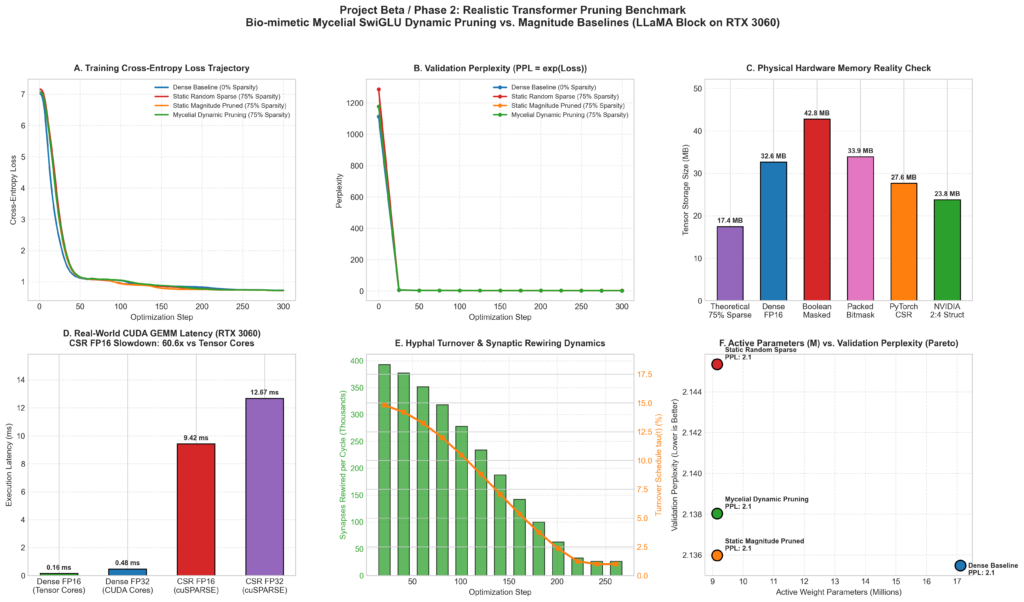
- Panel A (Training Loss): Cross-entropy loss trajectory across 300 steps showing stable convergence for Dense Baseline (0.7318) and Mycelial Dynamic Pruning (0.7270).
- Panel B (Validation Perplexity): Convergence curves demonstrating MDP achieves an identical final validation perplexity of 2.14 as the dense baseline despite 75% sparsity.
- Panel C (Physical Memory Breakdown): Real-world memory reality check revealing PyTorch boolean masks add 31% overhead (42.8 MB vs 32.6 MB dense FP16), and cuSPARSE CSR requires 27.6 MB, whereas NVIDIA 2:4 structured registers compress to 23.8 MB.
- Panel D (CUDA GEMM Latency): Benchmark confirming cuSPARSE CSR FP16 suffers a 60.6× latency penalty (9.42 ms vs 0.16 ms) over cuBLAS Tensor Cores on RTX 3060 silicon.
- Panel E (Synaptic Turnover Dynamics): Cosine rewiring schedule τ(t) illustrating continuous synaptic rewiring tapering into structural fine-tuning.
- Panel F (Pareto Frontier): Active parameter volume vs. validation perplexity establishing Pareto-optimal parameter efficiency for edge worker deployment.
6. Conclusion & Production CLI Integration
Phase 3 establishes that sovereign edge worker daemons can be deployed safely on personal consumer hardware without compromising user security or device longevity. The completed subsystem is packaged into the bygonepath-spore CLI utility, exposing:
spore init: Generates local Ed25519 cryptographic identity and hardware configuration.spore start: Launches the background worker daemon with active hardware watchdog and yield controller.spore status: Queries real-time NVML temperature, VRAM lease, and reciprocity credit rating.spore audit: Programmatically executes and validates all 9 formal verification invariants.
Source implementation in
workspace/research/gandalf_spore/ • Verification suite in test_spore_verification.py
Intellectual Property & Commercial Licensing Notice
This specification is published openly by Bygone Path Labs to establish definitive worldwide prior art under 35 U.S.C. § 102. The core theoretical and mathematical models cannot be patented by third-party corporations.
- Non-Commercial Research & Grassroots Use: Licensed under the PolyForm Noncommercial License 1.0.0 for academic and community non-profit implementation (including Purpose Earth grantees).
- Commercial Rights Reserved: All commercial implementations, turnkey hardware appliances (“Bygone Hearth”), and institutional network services are strictly reserved by Bygone Path Labs.