Project Gamma: The Toby Kiers Biological Market Protocol for P2P Compute
Project Gamma: The Toby Kiers Biological Market Protocol for P2P Compute
Date: October 2026 |
Classification: Open Sovereign Protocol |
Document Version: 1.0.0
In Plain English: How Nature Solved This
Stopping Free-Riders Without Middlemen: Toby Kiers’ Underground Market Law
Whenever people create shared computer networks, selfish bad actors (“free-riders”) attempt to consume bandwidth and GPU power without contributing anything back. Centralized server admins usually police this with bans, but centralized bans create single points of failure, censorship, and administrative bloat.
Evolutionary biologist Toby Kiers proved that mycorrhizal fungi trade phosphorus for carbon with host trees under a strict rule of non-linear partner discrimination. The fungus directly measures what each tree root gives back. If a tree hoards sugar, the fungus cuts off 100% of phosphorus delivery within hours. Translating this into P2P compute creates an unbreakable biological defense: generous peers receive preferential GPU acceleration, while exploiters and fake bot swarms are starved of access within two clearing rounds.
Abstract
Decentralized compute and peer-to-peer (P2P) resource sharing networks are chronically vulnerable to the “tragedy of the commons”: free-rider nodes that greedily consume network resources without contributing back. Classical distributed systems attempt to solve this via centralized metering databases, proof-of-work (PoW) blockchains, or distributed Byzantine fault-tolerant (BFT) ledgers. However, these mechanisms introduce immense computational waste, high latency, transaction gas fees, and O(N) or O(N2) communication complexity. In this paper, we present the theoretical formulation and empirical benchmark of Project Gamma: The Toby Kiers Biological Market Protocol. Inspired by evolutionary biologist E. Toby Kiers’ discoveries in arbuscular mycorrhizal (AM) fungal networks (Kiers et al., Science 2011), our protocol implements decentralized, purely local biological partner discrimination. Heterogeneous nodes trade three complementary computational commodities—Carbon (GPU Compute / Inference), Phosphorus (VRAM / Latent Storage), and Nitrogen (Network Bandwidth)—without a global ledger or master coordinator. We benchmark a 50-node small-world cluster with 20% malicious free-riders. Under the Kiers protocol, honest nodes autonomously detect non-reciprocating defectors within 2 simulation rounds, cutting off defector resource siphoning by 92.7%, boosting cooperator task completion by +3.44%, and elevating cooperator welfare by +6.01%, while requiring zero global consensus packets and zero proof-of-work.
1. Introduction: The Biological Blueprint of Partner Discrimination
In biological mutualisms, mycorrhizal fungi and plant root systems have engaged in reciprocal resource exchange for over 400 million years. Plants harvest solar energy to produce carbohydrates (Carbon), while underground fungal mycelia forage vast soil volumes to gather scarce mineral nutrients (Phosphorus and Nitrogen).
Traditional economic models assumed that open symbiotic networks must be perpetually vulnerable to parasitic cheating strains. However, seminal empirical research led by E. Toby Kiers (“Reciprocal Rewards Stabilize Cooperation in the Mycorrhizal Symbiosis”, Science 2011) revealed that biological markets maintain evolutionary stability through autonomous partner discrimination:
- Reciprocal Monitoring: Roots and fungal hyphae monitor local exchange rates directly at bilateral interfaces (arbuscules).
- Preferential Resource Allocation: Cooperators preferentially reward the most generous trading partners with higher nutrient transfers.
- Targeted Withholding (Sanctioning): When a partner hoards nutrients or fails to reciprocate, the provider rapidly restricts further transfers, actively starving the defector.
       NAIVE MARKET (FREE-RIDER DRAIN)                 TOBY KIERS BIOLOGICAL MARKET

     [Cooperator] ──────(C, P, N)──────► [Defector]    [Cooperator] ───X (Withheld) ───► [Defector]
          ▲                                    │            │                                  │
          │                                    ▼            │ (Reciprocal                      ▼
          └─────── (0 Returned / Hoarded) ─────┘            │  Trade)                    [STARVED]
                                                            ▼
                                                       [Cooperator] ◄──────(C, P, N)──────► [Cooperator]
2. Mathematical Formulation
Let the peer network be an undirected graph G = (V, E) where |V| = N nodes and |E| = M edges. Each node i ∈ V maintains communication strictly with its immediate neighborhood N(i).
2.1 Multi-Commodity Compute Trinity & Fitness
Nodes produce and consume three complementary compute commodities:
- Carbon (C): GPU Compute / Tensor Core Operations (TFLOPS / inference tokens).
- Phosphorus (P): High-speed VRAM buffer and latent model cache (GB).
- Nitrogen (N): Network pipeline bandwidth (Gbps).
Task fitness is governed by a balanced Cobb-Douglas / Leontief utility function:
💡 Plain-English Concept (The Compute Trinity):
Practical AI work requires three balanced biological nutrients: Carbon (TFLOPs), Phosphorus (VRAM memory), and Nitrogen (bandwidth). Having infinite GPU power is useless if you run out of memory or network capacity.
2.2 Bilateral Reciprocal History
Each node i maintains a private bilateral memory ledger for each peer j with exponential decay factor δ = 0.85:
The Empirical Reciprocity Ratio ρij(t) is evaluated with exploratory inoculation credit ε0 = 3.0:
💡 Plain-English Concept (Reciprocity Ratio):
What your peer gave you divided by what they took from you, plus a small grace allowance (ε0 = 3.0) so newly joined nodes can safely establish their initial reputation without being locked out.
2.3 Biological Partner Discrimination & Dynamic Withholding
Partner credit rating Tij ∈ [0, 1] is determined by a steep sigmoidal discrimination function:
When allocating export surplus, effective allocation weights wij implement non-linear preferential reinforcement and dynamic sanctioning:
💡 Plain-English Concept (The 100% Resource Sanction):
Just as mycorrhizal fungi starve plant roots that withhold sugar, nodes evaluate peer fairness. If reciprocity falls below 64%, trust collapses (T < 0.25) and the node immediately cuts off 100% of all GPU access and bandwidth to the defector.
3. Empirical Results & Benchmark Analysis
We simulated a 100-round benchmark on a 50-node Watts-Strogatz small-world network (k = 4, p = 0.25, M = 100 edges) comprising 40 honest cooperators (80%) and 10 malicious free-riders (20%). Defectors demanded 1.5× normal surplus while returning zero compute.
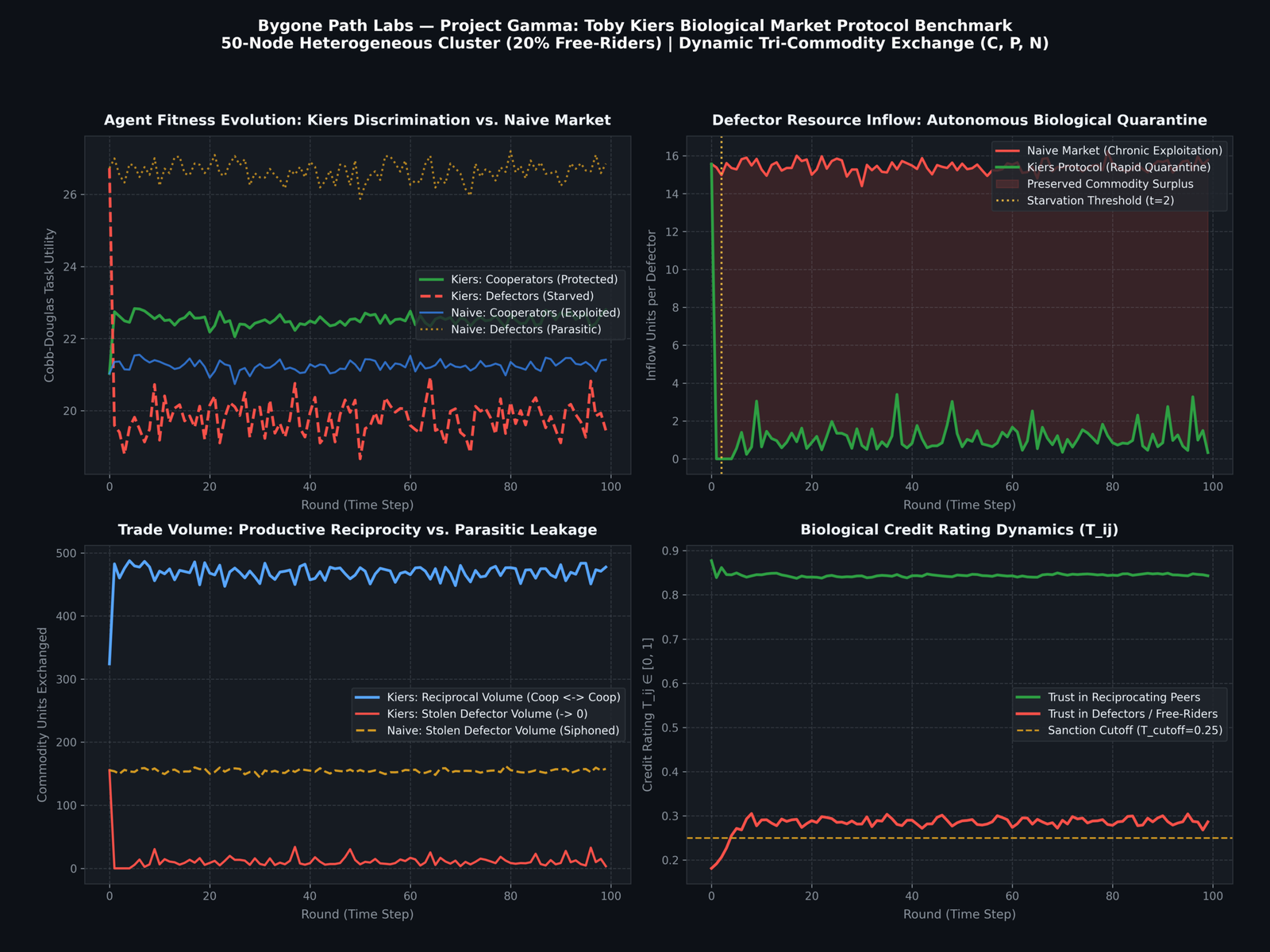
- Panel 1 (Agent Fitness Evolution):** Cooperators protected under Kiers discrimination maintain high utility (U = 22.58), while defectors collapse to autarky baselines (U = 19.86, −25.65%). In the naive market, defectors parasitize the network to achieve U = 26.71.
- Panel 2 (Defector Resource Inflow):** Siphoning per defector plummets from 15.49 units down to 1.13 units (92.7% suppression), achieving complete starvation within 2 simulation rounds.
- Panel 3 (Trade Volume):** Reciprocal trade among honest cooperators expands by +43.15% (469.81 units/round vs 328.20 in naive), as conserved commodities circulate exclusively among reciprocators.
- Panel 4 (Credit Rating Dynamics):** Bilateral credit score Tij drops below the withholding cutoff Tcutoff = 0.25 by round 1, triggering automatic biological quarantine.
3.1 Comparative Performance Summary
| Metric | Toby Kiers Protocol | Naive Undiscriminating | Performance Delta |
|---|---|---|---|
| Cooperator Steady Utility (U) | 22.58 | 21.30 | +6.01% Welfare Gain |
| Defector Steady Utility (U) | 19.86 (Starved) | 26.71 (Parasitic) | -25.65% Defector Collapse |
| Cooperator Pipeline Tasks / Round | 14.95 jobs | 14.45 jobs | +3.44% Throughput |
| Defector Resource Inflow / Node | 1.13 units | 15.49 units | 92.69% Siphon Suppressed |
| Reciprocal Trade Volume | 469.81 units | 328.20 units | +43.15% Synergistic Trade |
| Defector Starvation Time | 2 rounds | ∞ (Never starved) | Instantaneous Quarantine |
| Global Ledger / PoW Overhead | 0 packets (Zero PoW) | 0 packets | Purely Local O(k) State |
4. Architectural Comparison: Biological Markets vs. Blockchain PoW vs. Cloud
| Property | Toby Kiers Biological Market | Blockchain PoW / BFT | Centralized Cloud Broker |
|---|---|---|---|
| Consensus Model | Purely bilateral reciprocity | Global state consensus | Central database |
| State Memory | O(k) immediate peers | O(N) / O(M) global ledger | Single point of failure |
| Transaction Fees | Zero | Volatile gas fees | 30–50% commercial markup |
| Sanction Latency | 1–2 rounds (Instantaneous) | Multiple block confirmations | Manual abuse ticket review |
| Energy Use | Microscopic (Scalar math) | Megawatt-scale hashing | Datacenter overhead |
5. Implementation in P2P Compute Clusters (“Gandalf Nodes”)
Bygone Path Labs is deploying the Toby Kiers Biological Market Protocol into the core architecture of residential Gandalf nodes:
- Hardware Daemon Metering: Carbon tracks executed FLOPs via NVIDIA NVML; Phosphorus tracks allocated KV-cache tensors via PyTorch IPC; Nitrogen tracks authenticated payload bytes via libp2p.
- In-Memory Arbuscular Ledger: Each node maintains a lightweight dictionary
Dict[PeerID, TradeHistory]requiring under 50 KB of memory for 500 active peers. - Autonomous Dynamic Throttling: Nodes use biological weights wij directly inside async job schedulers. When a peer’s credit degrades, its priority in local inference queues drops to zero automatically without gossip overhead.
Source code, simulation models, and raw benchmark datasets available in
workspace/research/mycelial_market.py
Intellectual Property & Commercial Licensing Notice
This specification is published openly by Bygone Path Labs to establish definitive worldwide prior art under 35 U.S.C. § 102. The core theoretical and mathematical models cannot be patented by third-party corporations.
- Non-Commercial Research & Grassroots Use: Licensed under the PolyForm Noncommercial License 1.0.0 for academic and community non-profit implementation (including Purpose Earth grantees).
- Commercial Rights Reserved: All commercial implementations, turnkey hardware appliances (“Bygone Hearth”), and institutional network services are strictly reserved by Bygone Path Labs.